

Amsterdam is one of the most popular endpoints and connecting hubs in Europe. But because it attracts a massive volume of both business and low-cost leisure traffic, booking a flight here requires reading the fine print. If you want to plan your trip like an operations analyst, you need to understand how the hub dynamics, the airport rail system, and the secondary runways affect your actual travel costs.
Schiphol as a Mega-Hub: Navigating the Single Terminal
Amsterdam Airport Schiphol (AMS) is the primary gateway to the Netherlands. It is also one of the largest connecting hubs in the world.
Unlike most mega-airports that split operations across scattered terminals, Schiphol uses a single-terminal concept. All departures, arrivals, and gates are housed under one massive roof, divided into three departure halls.
This design makes connecting flights significantly simpler than at multi-terminal airports like Heathrow or Charles de Gaulle. Once you land, you do not need to board a train or bus to reach your connecting gate. The terminal is well-signed, and the flow through passport control and security is relatively efficient.
However, do not underestimate the physical size of the building. Walking from a long-haul arrival gate at the end of Pier G to a short-haul departure gate at Pier B can easily take twenty to twenty-five minutes of fast walking. If you are booking a ticket with a connection in Amsterdam, aim for a layover buffer of at least sixty minutes to ensure you and your luggage make the flight.

The Train under the Terminal: The Ultimate Airport Transfer
The biggest practical win when flying into Schiphol is the ground transportation. The airport railway station sits directly beneath the main arrivals hall (Schiphol Plaza).
You do not need to walk to an external station or hire an expensive taxi. You simply take the escalator down from the arrivals hall straight to the platforms. Trains to Amsterdam Centraal station run every few minutes throughout the day, and the journey takes only fifteen to twenty minutes.
To pay for your ride, you no longer need to queue at a ticket machine to buy a paper ticket. Under the OVpay system, you can tap your contactless credit card, debit card, or smartphone directly at the gates when entering and exiting the station. It is fast, cheap, and eliminates the risk of buying the wrong ticket.
The Budget-Airport Trap: Eindhoven vs. Rotterdam
When you search for cheap flights to Amsterdam, search engines will frequently return low-cost carrier fares that look like steals. Look closely at the airport code.
- Eindhoven Airport (EIN): Located roughly 120 kilometers south of Amsterdam. Low-cost carriers use this as their main Dutch base. While the flight might be cheap, you will need to add a coach transfer or a bus-to-train combination to reach Amsterdam. The coach takes about ninety minutes, and the transfer tickets will eat up a significant portion of your airfare savings.
- Rotterdam The Hague Airport (RTM): Located about 60 kilometers southwest of Amsterdam. Transfers involve taking a local bus to Rotterdam Centraal, followed by an intercity train to Amsterdam, taking around an hour in total.
Unless you are planning to explore the south of the Netherlands, avoid these secondary fields. The time lost and the transfer fees usually turn the budget fare into a net loss. Fly into Schiphol.
Tulip Season, King’s Day, and Booking Windows
Amsterdam’s flight prices are highly seasonal, driven by specific events and weather.
- Tulip Season (mid-March through mid-May): This is the busiest spring window, driven by visitors heading to the Keukenhof gardens. Fares and hotel rates spike significantly.
- King’s Day (April 27): The national holiday turns the city into a massive orange festival. Flights into AMS and hotel rooms are booked months in advance at peak prices.
- Summer Peak (June through August): High demand across Europe drives fares up.
- Winter Lulls (November through February, excluding Christmas): The weather is cold, damp, and windy, but this is the cheapest time of the year to fly. Fares drop, and the city crowds thin out.
Aim to book transatlantic flights three to four months in advance. For short-haul flights within Europe, monitor fares two months out.
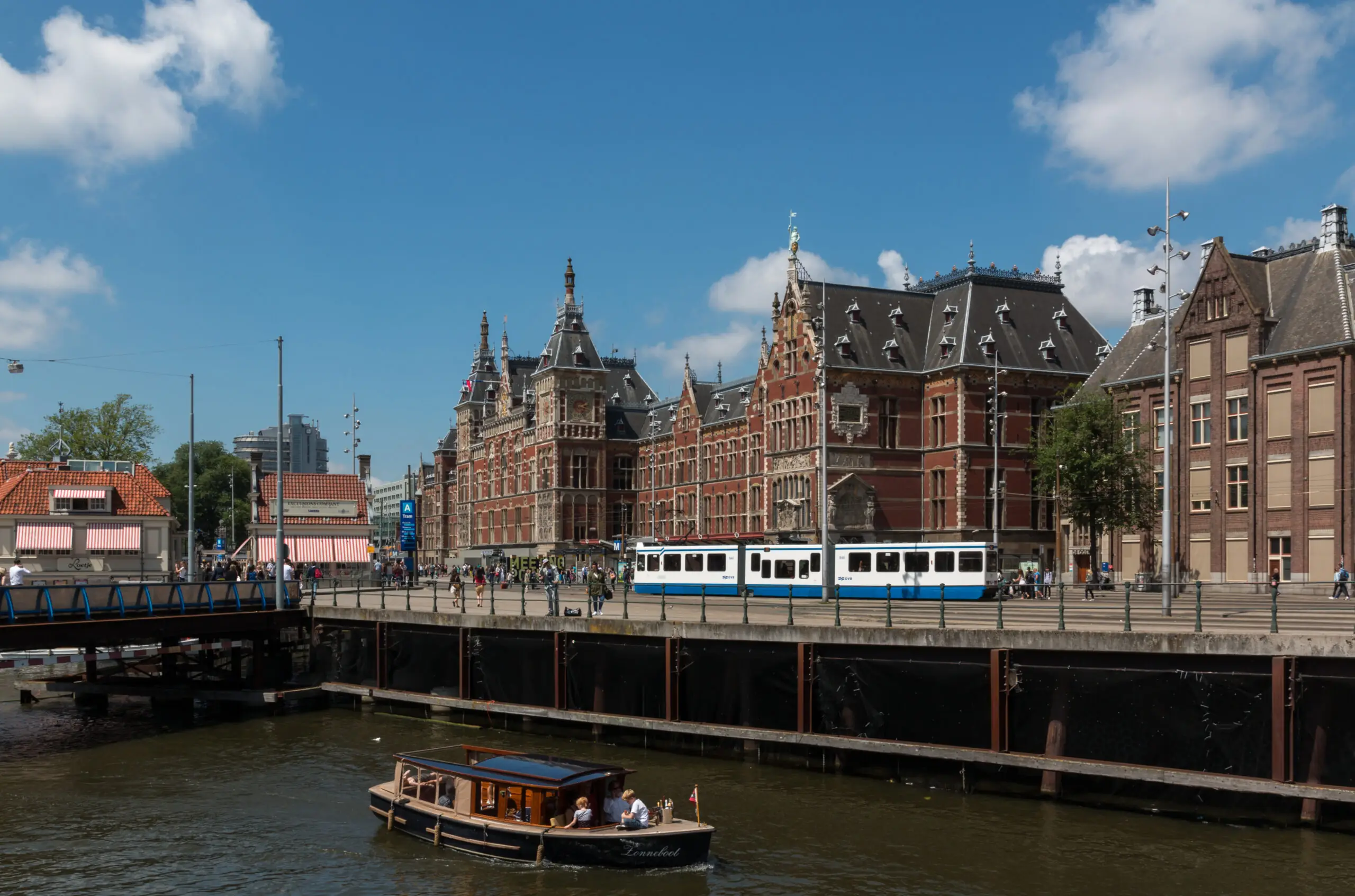
Getting Around: Trams, Metro, and the Bike Reality
Once you arrive in Amsterdam, you do not need a rental car. The city is compact and parking is intentionally restricted and expensive.
- Public Transit: Trams, buses, and the metro are clean, fast, and cover the entire city. Like the airport train, you can tap in and out using your contactless card or phone via OVpay.
- The Bike Reality: Amsterdam is famous for its bicycle infrastructure, but do not rent a bike on day one while jet-lagged. The local cyclists move fast, follow strict unwritten traffic rules, and have zero patience for drifting tourists. Spend your first day on foot or using the tram to understand the flow of traffic before you rent a wheel.
Visa and Entry Basics
The Netherlands is a member of the Schengen Area. Citizens of the US, UK, Canada, and Australia can enter visa-free for tourist stays of up to ninety days within any 180-day period. However, your passport must be valid for at least three months beyond your planned departure date from the Schengen zone. Additionally, the ETIAS travel authorization is expected to apply to visa-exempt visitors in the future. Rules change, so check current requirements before booking.
FAQ
How do I get from Schiphol to central Amsterdam?
The fastest way is the train, which departs from the station directly beneath the airport terminals. Trains to Amsterdam Centraal run every few minutes and take about fifteen to twenty minutes. You can tap in and out at the gates using your contactless card or phone via OVpay.
Is it worth connecting through Schiphol?
Yes. Schiphol operates as a single large terminal, which makes connecting between flights easier than at multi-terminal airports. However, because of the long walking distances between piers, you should allow at least a sixty-minute buffer for your connection.
Which airport do budget flights to Amsterdam use?
Many low-cost airlines fly into Eindhoven Airport (EIN) or Rotterdam The Hague Airport (RTM). Eindhoven is about 120 kilometers from Amsterdam, requiring a ninety-minute bus or train transfer that adds significant time and cost to your trip.
When are flights to Amsterdam cheapest?
Fares are cheapest during the late autumn and winter months (November through February, excluding the holiday season). Prices spike during the spring tulip season (mid-March to mid-May) and around King’s Day on April 27.
Images: Kaci Baum kacibaum / CC0; www.Pixel.la Free Stock Photos / CC0; Dietmar Rabich / CC BY-SA 4.0. Source: Wikimedia Commons.
Read also
- Cheap flights to Iceland: the stopover trick, getting from KEF, and when to go
- Magnificent Austria: Journey from the Alps to the Vienna Opera
- Mykonos: Where the Sun Meets the Party

