

Flying to Australia is the ultimate long-haul challenge. It is not just the sheer distance that makes it complicated; it is the timezone shift, the international date line, and a set of local airport rules that catch most travelers off guard. If you want to book a flight to Sydney without getting stranded or overpaying, you need to understand the mechanics of the route.
The Long Haul: Nonstops vs. The Kangaroo Route
Getting to Sydney (SYD) from the West depends heavily on where your trip begins.
- From the US West Coast: You have the benefit of nonstop flights. Carriers run direct routes from Los Angeles (LAX) and San Francisco (SFO) straight into Sydney. The flight time is roughly fifteen hours.
- From Europe and the UK: There are currently no scheduled nonstop commercial passenger flights. Instead, you will fly the historic “Kangaroo Route,” which requires a stopover. The most common connections are through major hubs in the Middle East (Dubai, Doha, Abu Dhabi) or East Asia (Singapore, Hong Kong, Bangkok).
- Future Nonstops: Qantas has announced plans for ultra-long-haul nonstop flights from London and New York to Sydney, known as Project Sunrise. However, these flights are still upcoming and have not launched regular passenger service, so do not count on booking them for a current trip.
When routing through a connecting hub, do the math on the total travel time. A cheap ticket with a ten-hour layover in a middle hub can turn a twenty-four-hour journey into a multi-day test of endurance. Aim for a layover buffer of three to four hours.
The Stopover Strategy and the Lost Day
Crossing the Pacific Ocean or routing through Asia means you will cross the International Date Line.
When you fly from the US to Australia, you will lose a day. If you depart on a Tuesday evening, you will land on Thursday morning, completely skipping Wednesday. Keep this in mind when booking your hotel nights and arranging airport pickups. On the return flight, you get the day back—you will often land in the US at an earlier local time than when you departed Sydney.
Because of the extreme distance and jet lag, building a stopover into your ticket is a smart move. Pausing for a night in Singapore or Dubai allows your body to adjust to the timezone changes, and most airlines will let you add the stop to your ticket for little to no extra airfare.
The Airport Curfew: Why Timing Matters
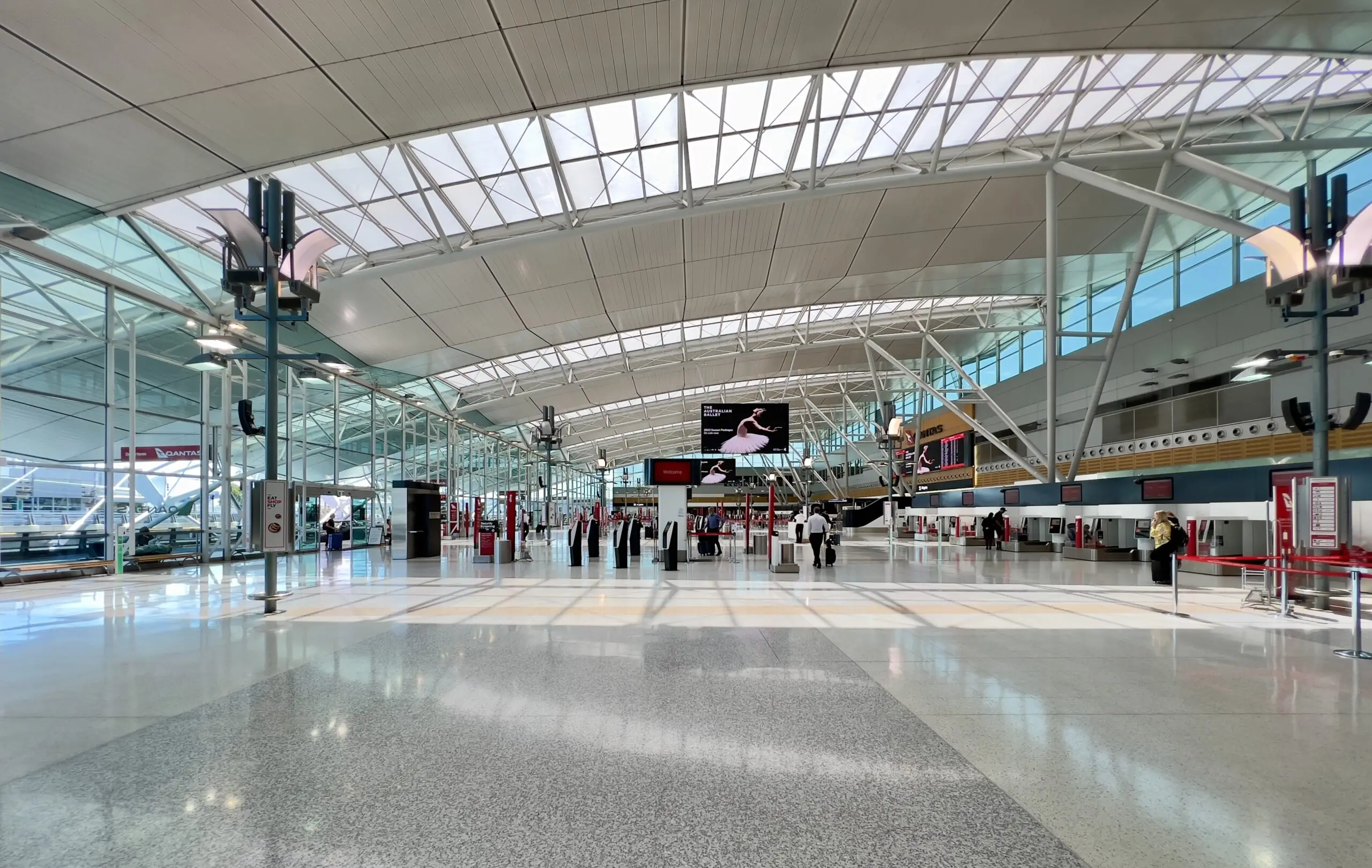
Sydney Kingsford Smith Airport (SYD) has a legally enforced night curfew. From 11 p.m. to 6 a.m., almost all jet operations are banned.
This curfew has a massive impact on flight schedules. Long-haul arrivals from North America and Asia are bunched into a tight window starting at 6 a.m. If a flight lands early, the plane must wait on the tarmac or circle until the curfew lifts. Departures are similarly bunched into the late evening.
This curfew is why you will not find late-night arrivals in Sydney. When comparing flight schedules, plan for an early morning arrival, and keep in mind that your hotel room will likely not be ready for check-in until the afternoon.
Reversed Seasons and Holiday Spikes
Because Australia is in the Southern Hemisphere, the seasons are reversed.
- Summer Peak (December through February): This is the busiest and most expensive time to fly. Tourism peaks around Christmas, and the famous New Year’s Eve fireworks over Sydney Harbour drive airfares and hotel rates to their highest levels of the year.
- Winter (June through August): The weather is cooler and wetter. This is the cheapest season to fly, making it a great time to find budget tickets if you do not mind cool city days.
- The Shoulder Sweet Spot (September to November and March to May): You get warm weather and moderate fares.
Lock in your flights four to six months in advance. Fares to Australia rarely drop at the last minute.
Getting from SYD to the City
Sydney Airport is located unusually close to the city center—only about five miles south of the central business district (CBD).
- The Airport Link Train (T8): The train station is located directly beneath the terminals. It is clean, runs every few minutes, and reaches Central Station in under fifteen minutes. However, the ticket carries a premium “station access fee” that is added to the standard fare, making it a pricy option if you are traveling with a group. You can tap your contactless credit card directly at the gates.
- Taxis and Ride-Shares: Because the distance is short, taking a taxi or rideshare can be more cost-effective than the train if you have two or more travelers in your group. The designated rideshare pickup zones are clearly marked outside the terminals.
Visa and Entry Basics
Australia does not offer tourist visas on arrival. Almost all international visitors, including citizens of the US, UK, Canada, and EU countries, must apply online for an Electronic Travel Authority (ETA) or eVisitor authorization before boarding their flight. The application is processed via a mobile app and is linked electronically to your passport. Rules change, so always verify current requirements before booking.
FAQ
How long is the flight to Sydney?
From the US West Coast, a nonstop flight takes about fifteen hours. From Europe or the UK, the journey requires a connection and takes at least twenty-two to twenty-four hours of total travel time.
Do I need a visa for Australia?
Yes. There are no visas on arrival for tourists. You must apply online for an approved Electronic Travel Authority (ETA) or eVisitor authorization before you depart. Always check current requirements before you book.
When are flights to Sydney cheapest?
The lowest fares are available during the Australian winter (June to August) when temperatures are cooler. Fares peak during their summer (December to February), especially around Christmas and New Year’s Eve.
How do I get from Sydney Airport to the city?
The Airport Link train (T8) is the fastest option, reaching the CBD in under fifteen minutes. If you are traveling with a group of two or more, taking a taxi or rideshare is often cheaper than paying multiple train fares because you avoid the station access fees.
Images: Christian Mehlführer, User:Chmehl / CC BY 2.5; Chris Olszewski / CC BY-SA 4.0; Believetheswype / CC BY-SA 4.0. Source: Wikimedia Commons.
Read also
- Holidays in Australia – reality
- Sydney Opera House: An Architectural Marvel and a Cultural Icon of Australia


