
The Geography of the Bay
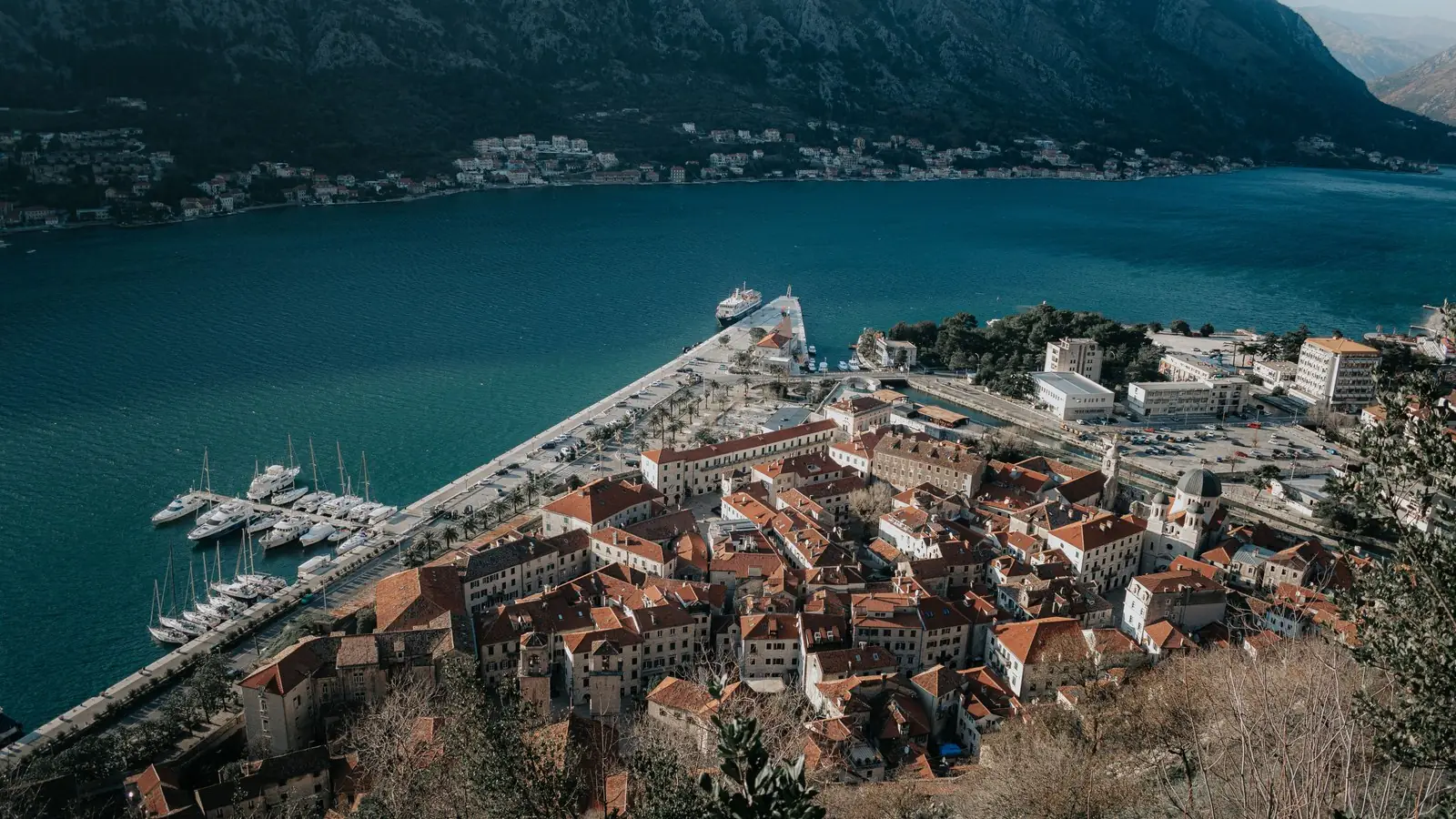
The drama of the setting requires no false geology, though it is constantly marketed with one. The Bay of Kotor (Boka Kotorska) is endlessly sold as “Europe’s southernmost fjord.” It is not a fjord at all. It is actually a ria—a submerged river canyon or drowned river valley—carved by water rather than glacial ice. The sheer limestone mountains plunging straight into the dark, calm water are spectacular on their own terms.
The Venetian and Maritime Layers
While the settlement has deep Illyrian, Roman, and Byzantine roots, the architecture you see today is overwhelmingly Venetian. Kotor spent roughly four centuries under the Republic of Venice (1420–1797) as a heavily fortified frontier port. You can read this history directly on the walls: the winged Lion of St Mark guards the main gates, while the elegant, narrow palazzos and campaniles mirror the architecture of the Italian Adriatic.
The city’s famous walls do not just ring the town; they climb the sheer cliff directly behind it, zig-zagging up to the fortress of St John (San Giovanni or Sveti Ivan). The punishing climb is roughly 1,300 steps, but the payoff is a staggering, commanding view over the entire bay.
That bay supported a formidable maritime tradition. The Boka navy (Bokeljska mornarica) is a living, centuries-old seafaring confraternity that still exists today, a reminder that Kotor’s wealth was built on hard, working seafaring, not tourism.
Earthquakes and Restoration
The town’s history is written in seismic fractures as much as in stone. The Romanesque anchor of the city, St Tryphon Cathedral, was consecrated in the twelfth century (1166). Over the centuries, it was rebuilt repeatedly after successive earthquakes; its twin towers, damaged in the seventeenth century, were never quite finished symmetrically, leaving a permanent record of the destruction.

That cycle continued into the modern era. In April 1979, a massive earthquake heavily damaged Kotor and the Montenegrin coast. That same year, the old town was simultaneously placed on the UNESCO World Heritage list and its list of endangered sites. The “perfectly preserved” historical centre you walk through today is, in fact, the result of decades of painstaking, highly skilled post-quake restoration.
The Cruise Question
Today, Kotor is one of the busiest cruise ports in the Adriatic. On multi-ship days, the narrow lanes of the old town jam solid, and locals simply time their daily lives around the ship schedule. There is no need for contempt here—many readers will arrive on those very ships—but there is a need for practical honesty.
To experience the actual town, check the port calendar online. Climb the walls at opening time before the heat and the crowds hit, and try to stay overnight. When the crowds overwhelm the centre, take a boat out to Perast, a quieter, deeply historic town further around the bay. Just offshore sits Our Lady of the Rocks (Gospa od Škrpjela), a remarkable, man-made islet built up over centuries by local sailors dropping rocks into the water—a tradition known as the fašinada that continues every July.

Many nationalities, including US, UK, and EU passport holders, can enter Montenegro visa-free for short tourist stays. Entry rules change frequently, however, so always check current requirements before you book.
When the evening finally clears the streets, sit near the Sea Gate and watch the cats of Kotor. They are the semi-official mascots of the town, boasting their own museum and carrying the tough, wiry ancestry of centuries of working ship cats—the perfect, unbothered survivors in a port that has outlived every empire that tried to claim it.

FAQ
How do I get to Kotor?
The closest airport is Tivat (TIV), located just over the ridge, roughly eight kilometres away. Alternatively, many visitors fly into the Montenegrin capital, Podgorica (TGD), or across the border into Dubrovnik, Croatia (DBV), and take a bus or taxi around the bay.
Is the Bay of Kotor a fjord?
No. Despite the popular marketing claim that it is Europe’s southernmost fjord, the bay is actually a ria—a submerged river canyon created by rising sea levels rather than glacial erosion.
How do I avoid the cruise crowds?
Check the local port authority’s cruise schedule online. Plan your visit for single-ship or no-ship days if possible. If you must be there on a busy day, climb the walls at opening time, take a day-trip to Perast, and stay overnight so you can enjoy the old town in the quiet early mornings and late evenings.
When is the best time to visit?
Late spring (May to June) and early autumn (September to October) offer warm weather and manageable crowds. July and August are blisteringly hot, incredibly crowded, and dominated by multi-ship days. Winter is very quiet but can be heavily rainy.
