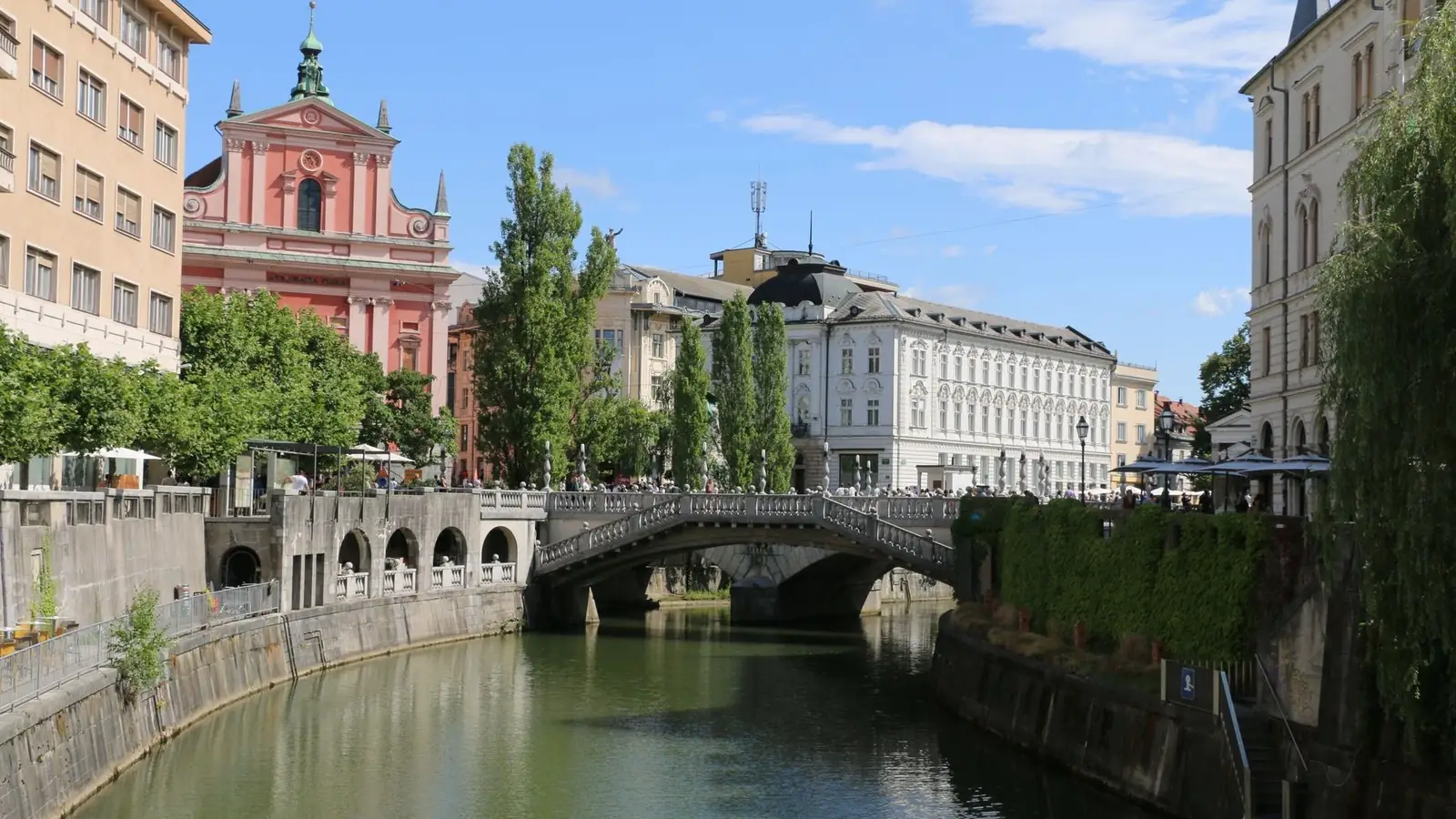

The Plečnik Vision
Between the two world wars, the Slovene architect Jože Plečnik — who had already shaped Prague Castle and worked extensively in Vienna — came home and set about remaking his native city. He treated the whole capital as one unified civic project.
The most iconic structures in the centre are his: the Triple Bridge, the monumental National and University Library (NUK), the riverside market colonnades, the sluice gate, the landscaped embankments, and the sprawling cemetery at Žale. His work is a highly specific, idiosyncratic blend of classical forms and local materials — a singular, staggering vision, finally recognised in 2021 when UNESCO inscribed “The works of Jože Plečnik in Ljubljana” on its World Heritage list.

The Honest Layers
To read the city properly, though, two honest caveats are needed. First, Plečnik did not build everything. For centuries this was the provincial Habsburg town of Laibach (Austrian until 1918), and that older Baroque fabric — visible in the cathedral and the Robba Fountain — still anchors the centre. Crucially, a devastating earthquake in 1895 forced a huge wave of rebuilding, which brought a distinct influx of Vienna Secession and Art Nouveau architecture: the vividly colourful facades around Prešeren Square, and the famous Dragon Bridge, which carries the city’s dragon emblem (a symbol tied to the myth of Jason and the Argonauts).

Second, Plečnik’s vision is incomplete. Several of his grandest ideas — including a monumental parliament and a plan to turn the castle hill into a “Slovene Acropolis” — were never built. The city you see is his vision only partly realised, layered carefully onto an older European fabric.
The Living City
Today the city’s identity is defined by how it uses that architecture. The centre is largely pedestrianised and remarkably green, which earned it the title of European Green Capital in 2016. Driven by a large university population, the mood is relaxed rather than monumental.
The perfect counterpoint to Plečnik’s serene classicism sits just outside the centre at Metelkova. This former Yugoslav army barracks was squatted in the 1990s and has since become a self-declared, heavily graffitied autonomous arts zone. The tension between the pristine civic architecture of the riverfront and the scruffy, lived-in reality of Metelkova is essential to understanding the modern capital.

US, UK, EU, and Canadian visitors currently get visa-free short stays in Slovenia under Schengen rules (up to 90 days in any 180-day period), with the EU’s ETIAS pre-authorisation system being phased in. Entry rules change, so check current requirements before you book.
Walk down the Plečnik embankments at dusk, beneath the willows, and look back toward the Triple Bridge. It is a very small capital, but it carries a wholly disproportionate weight of deliberate, careful design.
FAQ
How do I get from Ljubljana airport into the city?
Ljubljana Jože Pučnik Airport (LJU) is about twenty-five kilometres north of the city. There is no direct rail link, so the journey means the dedicated airport bus, a shuttle service, or a taxi — generally thirty to forty-five minutes.
Who was Jože Plečnik?
Jože Plečnik (1872–1957) was a visionary Slovene architect. After working in Vienna and Prague, he returned to Ljubljana between the world wars and redesigned much of the centre, applying a highly original, classically influenced style to its bridges, embankments, and public buildings.
What should I see in Ljubljana?
Plečnik’s masterworks are essential: the Triple Bridge, the National and University Library (NUK), and the market colonnades. Also see the Dragon Bridge, the colourful Secession architecture of Prešeren Square, the Ljubljana Castle, and the autonomous arts zone at Metelkova.
When is the best time to visit?
Late spring (May to June) and early autumn (September) give the most comfortable weather for walking the car-free centre. Summer is warm and busy, while winter can be freezing and often shrouded in the dense fog that rolls off the surrounding marshes.
