
The Foundation Beneath the Pavement
The city’s origin is recorded in a famous founding tradition, officially dated to 1325. According to the legend, the Mexica people were told to build their city where they found an eagle perched on a nopal cactus devouring a snake—an image that remains the centrepiece of the modern Mexican national flag.
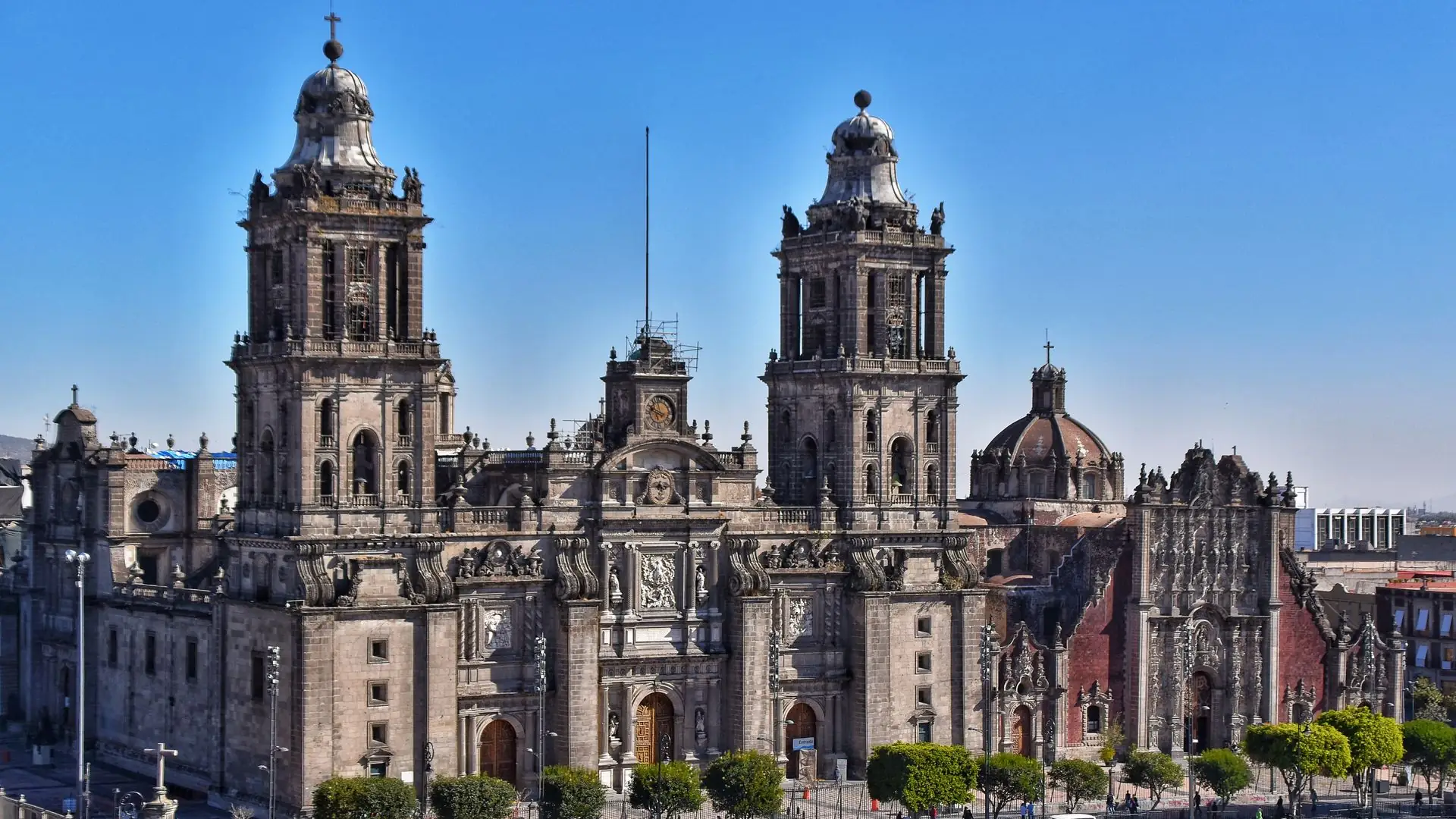
When the Spanish conquered Tenochtitlan, they simply built their new capital on top of the old one, using the stones of the Aztec sacred precinct to construct the Metropolitan Cathedral and the viceroy’s palaces. The physical reality of that suppressed city remained hidden until 1978, when utility workers digging near the cathedral accidentally struck the massive stone disk of the moon goddess Coyolxauhqui. That chance strike triggered the excavation of the Templo Mayor, revealing the ruins of the main Aztec temple sitting precisely where history had buried it.
The Sinking City
Because it is built on soft, drained lakebed clays, Mexico City is visibly sinking. You can see it in the pronounced tilt of historical buildings and the heavily braced floor of the cathedral. The city subsides because it relies heavily on extracting water from the aquifer directly beneath it, causing the ground to compress and settle under the immense weight of the masonry above.

The Lake That Remains
To understand what the landscape once looked like, head south to Xochimilco. The famous canals here are the last working remnant of the Aztec agricultural lake system. The chinampas (often mistakenly called “floating gardens,” though they are firmly anchored to the lakebed) are still actively farmed. The brightly painted passenger boats certainly host a busy party scene today, but they operate on watercourses that were once the primary arteries of the empire.

The Living Capital
The modern city operates at a relentless, fascinating pace. In the mornings, the Centro Histórico is a rush of deliveries and workers. Further south, the leafy, colonial streets of Coyoacán offer a quieter rhythm, though you must book well ahead if you wish to join the very real queues for Frida Kahlo’s blue house.
The food is an endlessly evolving history lesson. The famous tacos al pastor—pork marinated in Mexican spices and roasted on a vertical spit—is actually a direct adaptation of shawarma, brought to the country by Lebanese immigrants in the mid-twentieth century. To see the city feed itself, step into the intense, crowded aisles of the La Merced or Coyoacán markets.
It is worth noting the geography: Mexico City sits at an altitude of roughly 2,240 metres. Take your first day slowly while your body adjusts to the thinner air.
Safety in Mexico City requires the same honest appraisal as any global capital. Busy central neighbourhoods during the day are normal, functional city territory where standard big-city precautions apply. Specific outer areas and late-night transit systems require sensible local advice; neither fear-mongering nor total dismissal serves the visitor well.
Many visitors, including those from the UK, US, and EU, currently enter Mexico visa-free for short tourist stays. However, entry documentation processes are actively shifting towards digital systems, so check current requirements carefully before you book.
To feel the continuity of the place, wait in the Zócalo in the early evening as the massive flag is lowered for the day, listening to the organilleros cranking their brass barrel organs under the colonial arcades. It is the square of a vanished empire, operating seamlessly as the modern country’s living room.
Read also: Cheap flights to Mexico City: two airports (AICM vs AIFA), the altitude, and the transfer.
FAQ
Is Mexico City safe for tourists?
Yes, provided you apply standard big-city common sense. The central tourist and business districts are heavily policed and generally safe by day. However, you should rely on local advice for specific neighbourhoods and avoid wandering unfamiliar areas late at night.
How many days do I need in Mexico City?
Four to five days is a sensible minimum. The city is vast and heavily congested; attempting to cross town multiple times a day is exhausting. Group your plans by neighbourhood to understand the sheer scale of the capital.
What is the altitude of Mexico City?
The city sits at approximately 2,240 metres above sea level. Many visitors feel slightly breathless or easily tired upon arrival. Drink plenty of water, moderate your alcohol intake, and keep your first day’s itinerary relatively light.
Is Xochimilco worth visiting?
Yes, primarily because it is the only place to see the last remnants of the Aztec canal and agricultural system. While the brightly painted boats have a loud, party-focused atmosphere, the anchored chinampa islands themselves are a profound historical survival.


