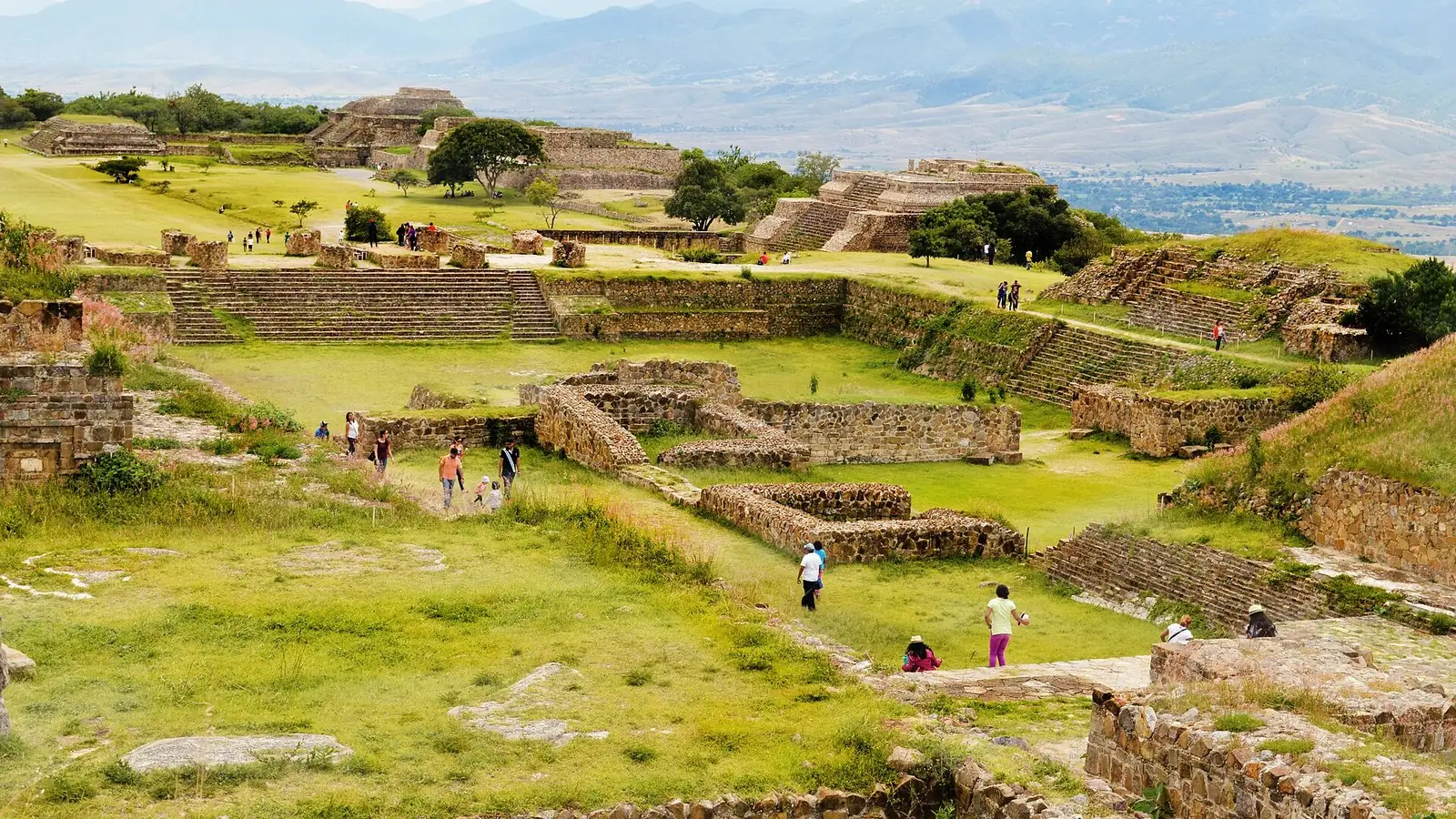

The Zapotec Layer: Monte Albán
That indigenous history is not a past-tense display; it is the foundation of the valley. Just a short drive above the city, on a flattened mountaintop, sits Monte Albán. Founded around 500 BC, it served as the Zapotec capital and remains one of Mesoamerica’s earliest and greatest cities. You can walk across its massive central plazas, stand beside the ancient ball courts, and examine the so-called Danzantes (carved stone figures depicting captives). Monte Albán sustained a continuous urban run of well over a thousand years before its eventual decline, making this civilisation older than imperial Rome. The valley’s deep history then continued at nearby Mitla, famous for its incredibly intricate, geometric stone mosaics.
The Colonial Layer
Down in the valley, the modern city centre is defined by its colonial grid, built largely from a distinctive pale green cantera stone. The great Dominican showpiece is the Santo Domingo church, featuring an interior so heavily gilded it seems to glow from within. The deep integration of these two eras was recognised in 1987, when UNESCO jointly listed the historic centre of Oaxaca and the archaeological site of Monte Albán together—protecting the two layers as one continuous story.

If anyone still believes the indigenous story was entirely erased by the colonial one, they only need to look at Benito Juárez. Born a Zapotec shepherd in the high Oaxacan sierra, he rose through the legal and political ranks to become one of Mexico’s most revered presidents.
The Food and the Mezcal
The culinary reputation of Oaxaca is entirely justified, built on the famous seven moles (though categorising them as strictly “seven” is itself a simplification; mole negro is the undisputed king). The entry point to this food should always be the markets rather than high-end restaurants. Eat massive, crisp tlayudas, try the chapulines (toasted grasshoppers), and drink hot chocolate served with pan de yema (yolk bread).
Alongside the food is the complex reality of mezcal. The recent global boom has turned the espadín agave into an international commodity and transformed small village palenques (distilleries) into busy pilgrimage sites. The rule for drinking mezcal responsibly is straightforward: treat it as an agricultural product with a face, not a cheap shot. Drink at small palenques or dedicated mezcalerías that explicitly name the maker and the agave variety used. Understand that wild agaves (like tobalá) take many years—sometimes decades—to mature in the harsh soil, and the current boom is putting those wild populations under intense strain.

The Guelaguetza and the Boom
Every late July, delegations from across the state’s various regions gather in Oaxaca city for the Guelaguetza, dancing in traditional dress. The tension here requires honesty: guelaguetza is a profound Zapotec concept of reciprocal giving and community support. The modern festival is a complex mix—it remains a genuine cultural gathering, but it is also a massive, state-run spectacle involving a dedicated stadium and expensive tickets, while parallel, more authentic celebrations happen quietly in the surrounding villages. If you attend the main event, book far ahead and remember to watch as a respectful guest rather than a consumer.

That tension extends to the city itself. In recent years, the beautiful centro has seen rents spike and cafés pivot sharply toward remote workers and international design tourism, prompting visible local protests. The reader is inevitably part of this boom, but the pressure can be mitigated by spreading out. Leave the centre and visit the village market days—each valley town has its own. Go directly to the artisan villages: see the barro negro (black clay) pottery in San Bartolo Coyotepec, the carved wooden alebrijes in San Martín Tilcajete, and the master weavers in Teotitlán del Valle. Eat where the menu is written in Spanish first.
Many visitors, including US, UK, and EU passport holders, can enter Mexico visa-free for short tourist stays. Rules change, so always check current requirements before you book.
To grasp the scale of the place, sit at a market counter for a first sip of hot chocolate, or stand on the Monte Albán plaza at dusk when the tour buses have finally gone. The two-thousand-year-old valley is still operating at its own enduring pace.
FAQ
How do I get to Oaxaca?
You can fly into Oaxaca International Airport (OAX), usually via a connection in Mexico City. Alternatively, taking a comfortable, long-distance highway bus from Mexico City is a classic and highly reliable ground option.
When is the best time to visit?
The dry season from November to April is generally best. The two massive cultural spikes are the Guelaguetza in late July and Día de Muertos (Day of the Dead) in late October and early November. If you plan to attend either, you must book accommodation many months in advance.
How do I drink mezcal responsibly?
Seek out small mezcalerías or visit village palenques that prioritise transparency. Look for bottles that name the specific maestro mezcalero (maker), the village of origin, and the exact agave species used. Sip it slowly, and remember that wild agaves take many years, sometimes decades, to grow.
Is Monte Albán easy to visit?
Yes. The ruins are just a short ride up the mountain from the city centre. Go early in the morning or late in the afternoon to avoid the fierce midday sun, and consider combining it with a wider trip out to Mitla and the valley villages.
Cover photo: Leslibautista, CC BY-SA 4.0, via Wikimedia Commons.


