
The Two Cities
The city’s diagram is entirely vertical. It is split between the Cidade Alta (the administrative, sacred, and residential upper town on the cliff) and the Cidade Baixa (the working port below). These two distinct halves are stitched together by the Elevador Lacerda, a towering art-deco public elevator. It serves as vital daily commuter infrastructure for locals, while simultaneously offering visitors the single best, sweeping viewpoint out over the bay.

The Reality of Pelourinho
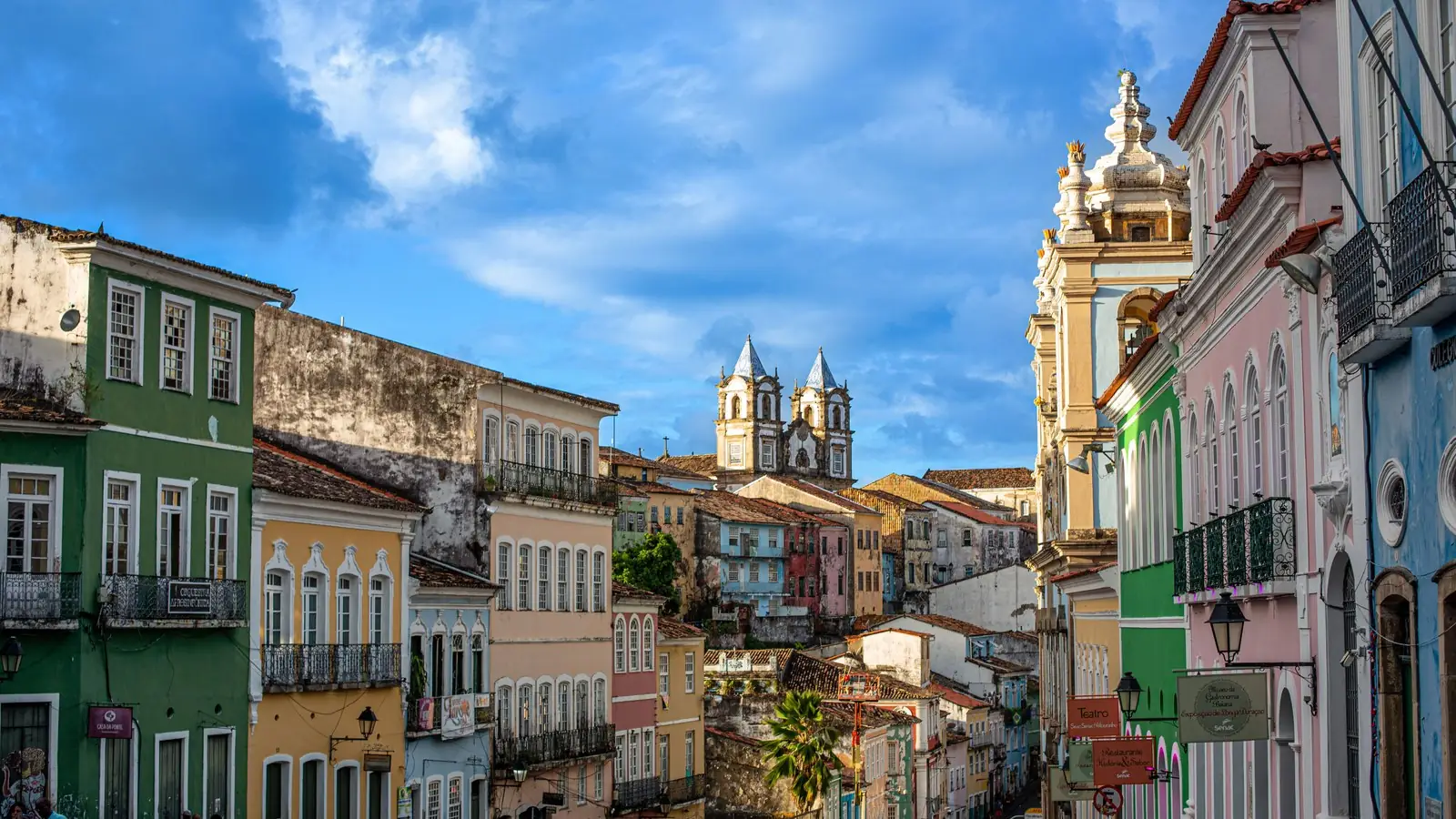
In the Cidade Alta sits the city’s most famous postcard quarter: Pelourinho. Listed by UNESCO in 1985, its steep cobbled streets lined with brightly painted colonial facades are genuinely beautiful. However, that beauty carries a heavy history. The name Pelourinho translates directly as “the pillory”—it was the square where enslaved people were publicly punished. Salvador operated as one of the largest slave ports in the Americas, and Brazil ultimately received more enslaved Africans than any other country in the hemisphere. The beauty of the colonial architecture and the brutality of its history are carved from the same stones. The living, dominant Black culture of modern Salvador is not a footnote to that history; it is the enduring answer to it.
The Afro-Brazilian Heart
That culture is the absolute core of the city. Capoeira—the fluid, acrobatic fight-dance born of enslaved resistance—is practised openly; watching a real roda (circle) is a profound experience if done respectfully. Candomblé, an Afro-Brazilian religion, is a deeply rooted, living faith rather than a cultural show. Its terreiros are functioning places of worship, though some welcome respectful visitors by prior arrangement.
On the streets, women known as baianas de acarajé, often wearing traditional white dress, fry black-eyed-pea fritters (acarajé) in rich, heavy dendê (palm) oil. This is street food as heritage; the trade itself is officially protected as national cultural patrimony. And when the sun goes down, it is the massive drum groups (blocos afro) whose intense, thundering rehearsals serve as the true nightlife of the historic centre.

The Golden Church and Syncretism
The colonial wealth that built the city is most visible inside the Igreja de São Francisco. Known as the “golden church,” its baroque interior is almost entirely sheathed in carved, heavy gilt. It is a staggering display of imperial wealth, and the contrast with the history outside its doors speaks for itself.
Further out sits the church of Senhor do Bonfim. The iron railings outside are completely covered in thousands of colourful wish ribbons, left by the faithful. It is the site of the clearest syncretism in Brazil, where the Catholic Lord of Bonfim fused entirely with the Candomblé orixá Oxalá. Every January, the Lavagem do Bonfim festival sees thousands dress in white to ceremonially wash the church steps, proving that this fusion of Catholic and African traditions is not historical trivia, but a fiercely living practice.

The Restored Quarter and the Night
Pelourinho underwent massive, controversial restoration in the 1990s to prepare it for tourism, a process that displaced many of its original residents. As a result, parts of the quarter can empty out after dark, while the city’s actual modern life shifts elsewhere—to the busy nightlife of Rio Vermelho, or outward along the beaches from Porto da Barra.
If you are walking in Salvador at night, use plain street sense: stick with the crowds in busy areas, carry very little of value, and take taxis between neighbourhoods rather than walking empty streets. It is the standard rule for any major Brazilian city, requiring caution rather than paranoia.
Entry rules for Brazil differ heavily by nationality. While UK and EU citizens currently enter visa-free for short tourist stays, some visitors (including US, Canadian, and Australian citizens) now require an e-visa. Requirements change, so always check the current rules well before you book.
To catch the real rhythm of the first capital, go down to Porto da Barra beach at sunset, where the entire neighbourhood gathers to clap as the sun drops into the ocean. Or simply stand on a corner in the Cidade Alta, eating an acarajé while the drums start up again somewhere uphill.
FAQ
How do I get to Salvador?
You fly into Salvador International Airport (SSA). Most international routings will connect through major hubs like São Paulo (GRU), Rio de Janeiro (GIG), or Lisbon (LIS).
Is Salvador safe for tourists?
Like most major Brazilian cities, it requires plain street sense. During the day, the tourist quarters are generally fine. At night, stick exclusively to busy, well-lit areas, take taxis or ride-shares between neighbourhoods, and do not carry unnecessary valuables.
When is the best time to visit?
The drier season from roughly September to March is best for enjoying the beaches. The massive caveat is Carnival (usually February or March), which completely takes over the city; unless you are specifically going for the party, avoid those dates or book many months in advance. The traditional June festivals (Festas Juninas) are also spectacular.
What food is Salvador known for?
The Bahian table is heavily influenced by African traditions. Look for moqueca baiana (a rich seafood stew made with coconut milk and dendê oil) and acarajé (deep-fried black-eyed-pea fritters stuffed with dried shrimp and spicy pastes), both ubiquitous across the city.


