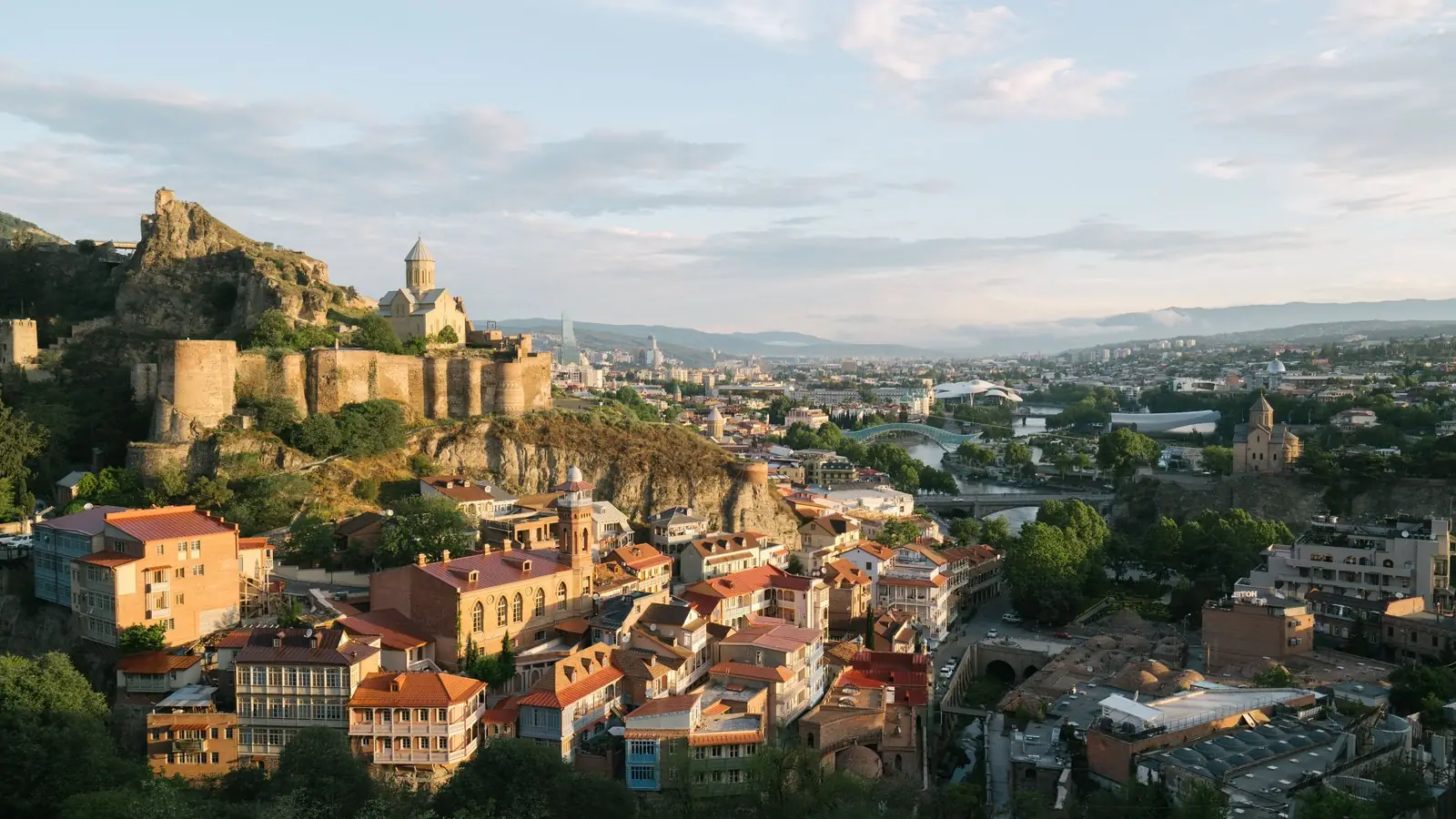


The scars of empire
Sitting directly on a major artery of the Silk Road, Tbilisi’s history is one of constant conflict. For centuries, the city was fought over and sacked by a succession of empires: Persians, Arabs, Mongols, and Ottomans all claimed it. In the nineteenth century, it was absorbed into the Russian Empire (as Tiflis), before enduring the Soviet period.
That violent, layered history is completely legible in the modern streetscape. You can walk from the Persian-style domed baths to medieval Orthodox churches, past a mosque and a synagogue standing only a short distance apart. A few streets away, the sweeping, nineteenth-century belle époque and Art Nouveau architecture of Rustaveli Avenue marks the Russian era, while heavy Soviet monumentalism still looms above the river.
An ancient, distinct culture
Despite centuries of foreign occupation, Georgian culture remains fiercely distinct. The language belongs to the Kartvelian family and is entirely unrelated to anything spoken by its neighbours. It is written in a unique alphabet — one of only a handful of independent writing systems in the world — featuring the beautifully rounded, UNESCO-listed Mkhedruli script.
The country adopted Orthodox Christianity in the early fourth century, making it one of the very first states to do so. However, its most profound cultural anchor is wine. Georgians use the qvevri method, fermenting wine in massive clay amphorae buried underground. It is a UNESCO-listed tradition that dates back roughly eight thousand years, making this plausibly one of the oldest known wine-producing regions in the world. This heritage is celebrated in the supra — a highly ritualised traditional feast directed by a tamada, or toastmaster.

The honest layer: decay and tension
The older centre is a compelling but complicated space. The old town is genuinely crumbling and heavily lived-in, and there is a visible tension between the dilapidated residential streets and the heavy-handed, polished restorations that sometimes verge on the artificial. The skyline is also marked by highly controversial modern additions, such as the glassy Bridge of Peace (opened in 2010) and the sprawling metal tubes in Rike Park, which many locals openly mock.
Driven by a tourism and digital-nomad boom, the centre is reshaping rapidly. Politically and culturally, Georgia sits uneasily between its massive northern neighbour, Russia, and its deep, long-standing pull toward Europe, a tension that defines much of the modern capital.
Georgia operates an unusually liberal visa policy; citizens of many countries (including the US, UK, EU, and Canada) can enter visa-free for long stays, sometimes up to a full year. Note that since January 2026 visitors must also carry travel medical insurance covering the length of their stay. Entry rules change, however, so always check current requirements before you book.
To see the city properly, climb up to the Narikala fortress at dusk. As the light drops over the mismatched roofs and the working city breathes underneath the postcard image, the sheer endurance of this Caucasus capital becomes entirely clear.

FAQ
How do I get from Tbilisi airport into the city?
Tbilisi International Airport (TBS) is located about seventeen kilometres south-east of the centre. The No. 337 city bus runs around the clock between the airport, Freedom Square and the central railway station; a cheap airport train also exists but runs only a couple of times a day. Otherwise, hail a taxi using a ride-hailing app like Bolt, which is reliable and affordable.
Why is Georgian wine such a big deal?
Georgia is considered one of the oldest known cradles of winemaking. The traditional method involves fermenting the juice, skins, and stems together in large, egg-shaped clay vessels called qvevri that are buried underground, a technique dating back roughly 8,000 years.
What should I see in Tbilisi?
The absolute essentials are the Abanotubani sulphur baths, the view from the Narikala fortress and the monumental Kartlis Deda (Mother of Georgia) statue, the winding lanes of the Old Town, the grand architecture of Rustaveli Avenue, and the massive Holy Trinity Cathedral.
When is the best time to visit?
Spring (May to June) and autumn (September to October) offer the most comfortable weather for exploring the steep hills. High summer in July and August is punishingly hot, while winter brings biting cold to the Caucasus.
