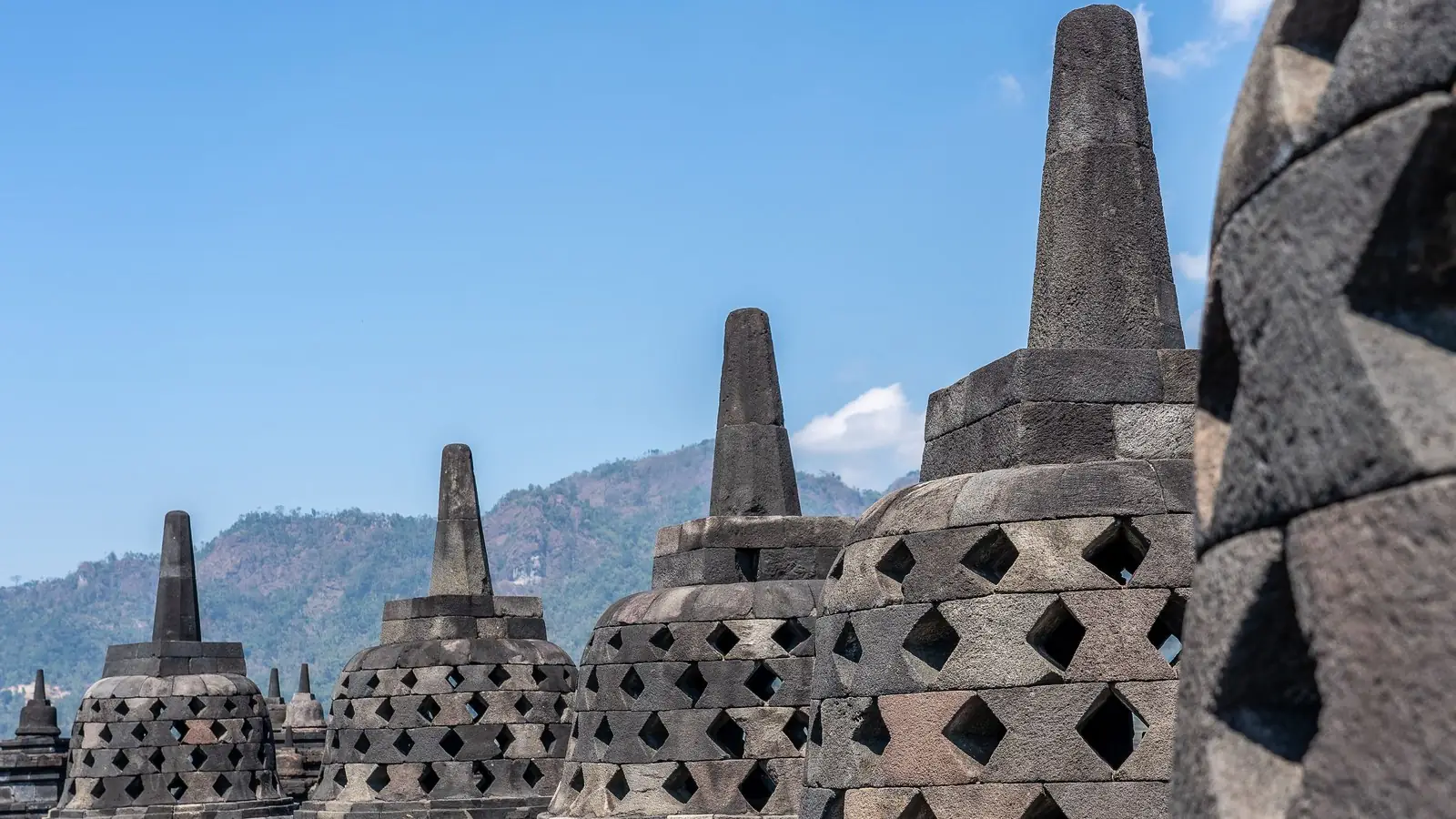

The Mountain of the Buddha
Borobudur, built around the ninth century under the Sailendra dynasty, is the largest Buddhist monument in the world. It is a massive, stepped mandala constructed from millions of volcanic blocks. The lower galleries feature thousands of intricately carved relief panels, rising up to the higher, circular terraces holding latticed stupas.
As Java’s centre of power and faith shifted eastward over the centuries, Borobudur was largely abandoned, buried under volcanic ash and thick jungle. In the early nineteenth century, it was brought back to global attention. (The colonial framing often calls this a “rediscovery,” though local Javanese communities never wholly forgot it existed.) The structure was saved from total collapse by a massive, UNESCO-backed restoration in the 1970s and 80s, eventually securing World Heritage status in 1991.
The Access Rules
If you plan to visit Borobudur today, you need to understand the current access rules. Since a major conservation reset a few years ago, climbing the monument itself is now strictly capped and controlled. Access requires a timed slot in a guided group, limited daily numbers, and the wearing of special bamboo sandals to protect the stone. These caps exist for a vital reason: the sheer volume of tourists was physically wearing away the ancient stairs. The vast, landscaped grounds and eye-level views remain open to all, but if walking up to the upper stupa terraces matters to you, book that specific ticket as early as the booking window allows—the daily quota regularly sells out days ahead.
The Other Ninth Century
Java’s religious history is deeply layered rather than strictly sequential. Just a short drive away stand the soaring, sharp-edged towers of Prambanan, a monumental Hindu complex built in exactly the same era as Buddhist Borobudur. The sites rose side by side. Today, the most vivid use of the complex is the evening Ramayana ballet, performed in an open-air theatre with the floodlit Hindu towers serving as the backdrop.

The Living Court and the Sacred Axis
Yogyakarta holds a legally unique position: the Sultan is the hereditary governor of the province, making it the only recognised monarchy operating within republican Indonesia—a status earned by the court’s crucial role in the country’s war of independence. The kraton (palace) at the centre of the city is not a quiet museum; it is a working court where hundreds of abdi dalem (traditional retainers) still serve daily, often seen walking the grounds in traditional Javanese dress.
The layout of that court is a deliberate cosmology. A straight, sacred axis runs directly south from the crater of Mount Merapi, through the Tugu monument, straight through the kraton, past the Panggung Krapyak hunting pavilion, and out toward the Indian Ocean. This profound spatial alignment, connecting the mountain, the court, and the sea, was UNESCO-listed in 2023 as the Cosmological Axis of Yogyakarta.

Volcanoes and Batik
That axis relies on an incredibly volatile anchor. Mount Merapi is one of the most active volcanoes on earth; a devastating eruption in 2010 killed hundreds of people and entirely reshaped the villages on its flanks. Today, locals run “lava tours” using old jeeps to drive visitors over the 2010 ash and debris flows. It is a stark experience—the guides are often survivors who rebuilt their economy on the ash field—and it should be approached with deep respect. (Note that the volcano operates on a strict alert-level system, and day-to-day life in the city remains completely normal.)
Back in the city, around the busy Malioboro district, you will inevitably encounter the classic Yogyakarta batik con: a friendly local insisting that a “student art exhibition is closing today” to funnel you into an overpriced gallery. Real, UNESCO-recognised Javanese batik exists and thrives here, but you find it at genuine workshops. A reputable maker will show you the canting (the tool used to apply hot wax), explain the dyeing process, name their artisans, and will never need a fake deadline to sell their work.

Most visitors can obtain a visa on arrival or an e-VOA for short tourist stays, and Indonesia now asks arriving travellers to complete an online arrival declaration before the flight. Entry rules do change, however, so check current requirements carefully before you book.
To understand Yogyakarta’s distinct rhythm, sit at a night warung for a plate of gudeg—the city’s famously rich, slow-cooked jackfruit stew. It takes hours to prepare and demands to be eaten slowly, mirroring a royal city that still keeps its own deliberate time between the volcano and the sea.
FAQ
How do I get to Yogyakarta?
You can fly into the newer Yogyakarta International Airport (YIA), located roughly forty-five kilometres west of the city; an efficient airport train connects it to the centre. Most international flights route via Jakarta, Kuala Lumpur, or Singapore. Alternatively, there are very comfortable, scenic train services from Jakarta.
Can I still climb Borobudur?
Yes, but access to the actual structure is now strictly capped, guided, and timed to prevent further wear on the ancient stones. Slots are limited and regularly sell out days ahead, so book as early as the booking window allows. The surrounding grounds and ground-level views remain open to general admission.
When is the best time to visit?
The dry season, running roughly from May to October, offers the clearest skies and the best chance of securing that classic misty dawn view over the Kedu Plain. The shoulder months are quieter but carry a higher risk of rain.
Is Merapi safe to visit?
The Indonesian government maintains a strict, highly monitored alert-level system for the volcano, and city life runs normally regardless of minor activity. Guided jeep tours operate safely on the old lava flows from previous eruptions, but you should always check the current status and heed local advice.


