
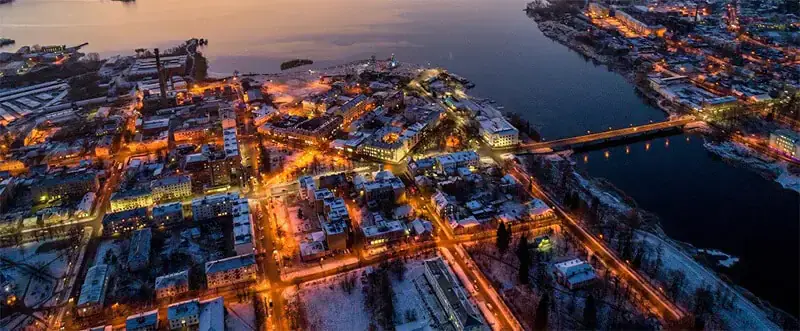
The Onega Embankment
The city’s pride is its lakefront promenade. The Onega Embankment is an open-air gallery of striking modern sculptures, gifts from Petrozavodsk’s sister cities around the world, set against the wide grey-blue sweep of the lake — the best place for a walk in the city.

The Gateway to Kizhi and Karelia
The real reason many people come is what lies beyond the city. From the Onega waterfront, hydrofoils run in summer to Kizhi Island, whose UNESCO-listed ensemble of wooden churches — crowned by the astonishing 22-domed Transfiguration Church, built without a single nail — is one of the wonders of Russia. Karelia also holds the marble canyons of Ruskeala Mountain Park, the Kivach waterfall, and the monastery island of Valaam on Lake Ladoga. Petrozavodsk is the natural launch pad for all of them.

Museums and Cathedrals
In town, the National Museum of the Republic of Karelia tells the region’s story from prehistory on, the Museum of Fine Arts gathers local painters, and the Cabin of Peter the Great recalls the tsar who founded the city in 1703 around an ironworks (the name means “Peter’s factory”). Two churches anchor the old centre: the eighteenth-century Spassky Cathedral and the elegant neoclassical Alexander Nevsky Cathedral.

Karelian Food and Souvenirs
Karelian cooking is worth seeking out: *kalitki*, little open rye pastries filled with potato or berries; hearty fish soups; and the layered Karelian fish pie. For souvenirs, look for objects turned from figured Karelian birch and jewellery made of shungite, the region’s distinctive black stone.


Getting There — the Honest Part
Petrozavodsk lies between Moscow and St Petersburg in Russia’s north-west, closer to the latter; it has its own small airport (PES) and frequent overnight trains from both cities. Getting to Russia itself, though, is the harder part in 2026: there are no direct flights from North America, the UK or most of the EU, so travellers connect through hubs such as Istanbul, Dubai or Doha and fly on via Moscow or St Petersburg. A consular visa is required in advance, foreign bank cards do not work inside the country, and several Western governments, including the US and UK, currently advise against travel to Russia — so check your own government’s guidance before making firm plans.
FAQ
Why visit Petrozavodsk?
For Lake Onega and its sculpture-lined embankment, and above all as the gateway to Kizhi Island’s UNESCO wooden churches and the wider wonders of Karelia — Ruskeala, Kivach and Valaam.
How do I reach Kizhi?
By hydrofoil across Lake Onega from the Petrozavodsk waterfront in summer; in winter it is reached by hovercraft or snowmobile.
What is the nearest airport?
Petrozavodsk’s own Besovets airport (PES); the city is also an easy overnight train from Moscow or St Petersburg. See the note above on reaching Russia from the West in 2026.