
That absence shapes everything else — how you leave the airport, how you reach the rest of the coast, and why the flight you book matters more here than in most of Europe. None of it is hard once you know it, and one piece of it is a genuine opportunity: the months when the route map thins out are also the months this city is cheapest and quietest to be in. Here’s the whole thing in order.
First, the structural fact: no railway, anywhere near
Dubrovnik was on the rail network once; the line closed in the 1970s and nothing replaced it. The nearest working railhead today is at Ploče, a couple of hours up the coast, and what runs from there heads inland rather than anywhere you’re going.
So delete “train” from your planning vocabulary here. Everything in southern Dalmatia moves by road, boat or air, which is why a region this famous still hangs off one small airport and one two-lane coastal highway — and why your arrival plan deserves more thought than the twenty seconds you’d give it in Vienna.
The airport is 22 kilometers away, and the drive is the point
The airport sits at Čilipi, southeast of the city. The airport’s own numbers: 22.5 km from Dubrovnik, 30 to 35 minutes on average — “but you should plan for up to an hour in the summer months.” That’s their sentence, not mine, and it’s the honest one. There is one road, it clings to the side of a hill above the sea, and in August it fills with everyone else’s transfer.
One naming quirk before you go looking for it: the airport was renamed Ruđer Bošković Airport in November 2023, after the Dubrovnik-born physicist. Booking sites still mostly say “Dubrovnik Airport,” the code is still DBV, and the signage says Ruđer Bošković. Same building.
The shuttle — and the gate it doesn’t stop at
The licensed airport shuttle is run by Platanus, and it works the way an airport bus should: it doesn’t run to a clock, it runs to your flight, leaving roughly 30 minutes after each arrival, first landing of the day to last. Journey times off the operator’s own page: about 30 minutes to the Old Town and about 35 to the main bus station at Gruž.
Here’s the detail that catches people, and it’s worth reading twice if you’ve already booked a room: the Old Town stop is at Ploče Gate, the eastern entrance — not Pile, the western one, which is the gate most guides and most hotel directions talk about. It’s a walk of about ten minutes between them, around the walls or through the middle. Not a disaster. Genuinely annoying with a suitcase and a hill in a Dalmatian afternoon.
The city bus, honestly
The airport lists public bus lines 11, 27 and 38 as serving it, and technically that’s true. Look at the bus operator’s own timetables and the picture changes: these are suburban Konavle routes. Line 11 runs three departures a day out of Dubrovnik, and nothing at all on Sundays and holidays — and the airport isn’t even a named stop on the line page.
Which is to say: a local bus that happens to pass an airport, not an airport bus. Land at the right hour on the right day, travel light, and it’s the cheapest way into town by a wide margin. Plan a trip around it and you’ll be sitting on a wall in Čilipi doing arithmetic.
Cars
There’s a taxi rank at the terminal, and both Uber and Bolt operate here — each has its own Dubrovnik Airport page, and each tells you to take your pickup point from the app rather than assuming the curb. This is a small, sharply seasonal market, though: driver supply in February at eleven at night is not driver supply in July at noon. Arriving late or off-season, book ahead rather than trusting the map to fill with cars.
One more piece of geography, because it decides your last mile: the main bus station is at Gruž, roughly two kilometers from the old town. Arriving there is not arriving.
Who flies there — and the season that switches half of it off
This is the part that separates a good Dubrovnik fare from a fantasy. In summer this is a busy airport — it cleared three million passengers for the first time in 2025 — with a route map that looks like a mid-sized European hub’s. In January it looks like a regional field with a handful of lines out.
Summer, from the airport’s own 2026 schedule: Ryanair is the base carrier with 24 routes, adding Budapest and Gdańsk; Wizz Air adds Budapest, Gdańsk and Cluj-Napoca; Croatia Airlines adds Stuttgart twice weekly; Aegean opens Thessaloniki; KLM adds frequencies; Tel Aviv runs late May to late September. From the UK it’s a wall: British Airways from London, easyJet from Gatwick plus Bristol, Edinburgh and Manchester, Jet2 from Stansted and a long list of regional bases, Ryanair on top of all of it.
Winter, exhaustively, because this is where guides get vague:
- Croatia Airlines is the year-round spine: Zagreb, plus Frankfurt and Rome, which it upgraded to year-round service. The Zagreb leg is the one that quietly matters — it’s how you connect to the rest of the world in February.
- Ryanair holds a year-round presence — the condition of its base here — but it rotates which routes survive the winter. For winter 2026/27 it is upgrading Kraków and Dublin to year-round, twice weekly each, and these replace Vienna and Charleroi, which won’t run this coming winter after a weak 2025/26.
- Discover Airlines (Lufthansa’s leisure arm) runs Frankfurt year-round, around three times a week.
- Austrian flew Vienna into the winter season but with a break over the turn of the year, and LOT operated part of the season.
- The UK leisure carriers stretch and stop. British Airways, easyJet and Aer Lingus pushed into November last season, and Jet2 sells Dubrovnik across eight UK airports in season. They are a summer product here, sold twelve months a year.
Read that list again and the practical rule falls out. From November to March, “compare a few airlines” isn’t the move, because there aren’t a few airlines — there’s Zagreb, Frankfurt, Rome, and whichever pair Ryanair keeps year-round. Pick your hub first, then the dates, and winter Dubrovnik is one of the better-value short breaks in the Mediterranean.
From the US: one door, and it’s open five months
The airport’s own summer 2026 announcement puts it plainly: the transatlantic link is a daily connection with New York (Newark) from early May to late September, with four additional rotations in October. That’s the whole US nonstop picture — one city, one season.
Delta flew JFK–Dubrovnik in past summers and is not in this year’s picture. Apply the rule that goes for every seasonal transatlantic route: don’t book off a memory, or off a route map someone published two years ago. Check the specific weeks you want on the carrier’s own site before you build a trip around a nonstop.
Outside that window — and often inside it — the answer is a one-stop through a European hub. That’s not a downgrade here; it’s the normal way to reach a small seasonal airport.
The other doors: Split and Tivat
Two alternative airports are worth pricing, and one thing changed the math on the first of them.
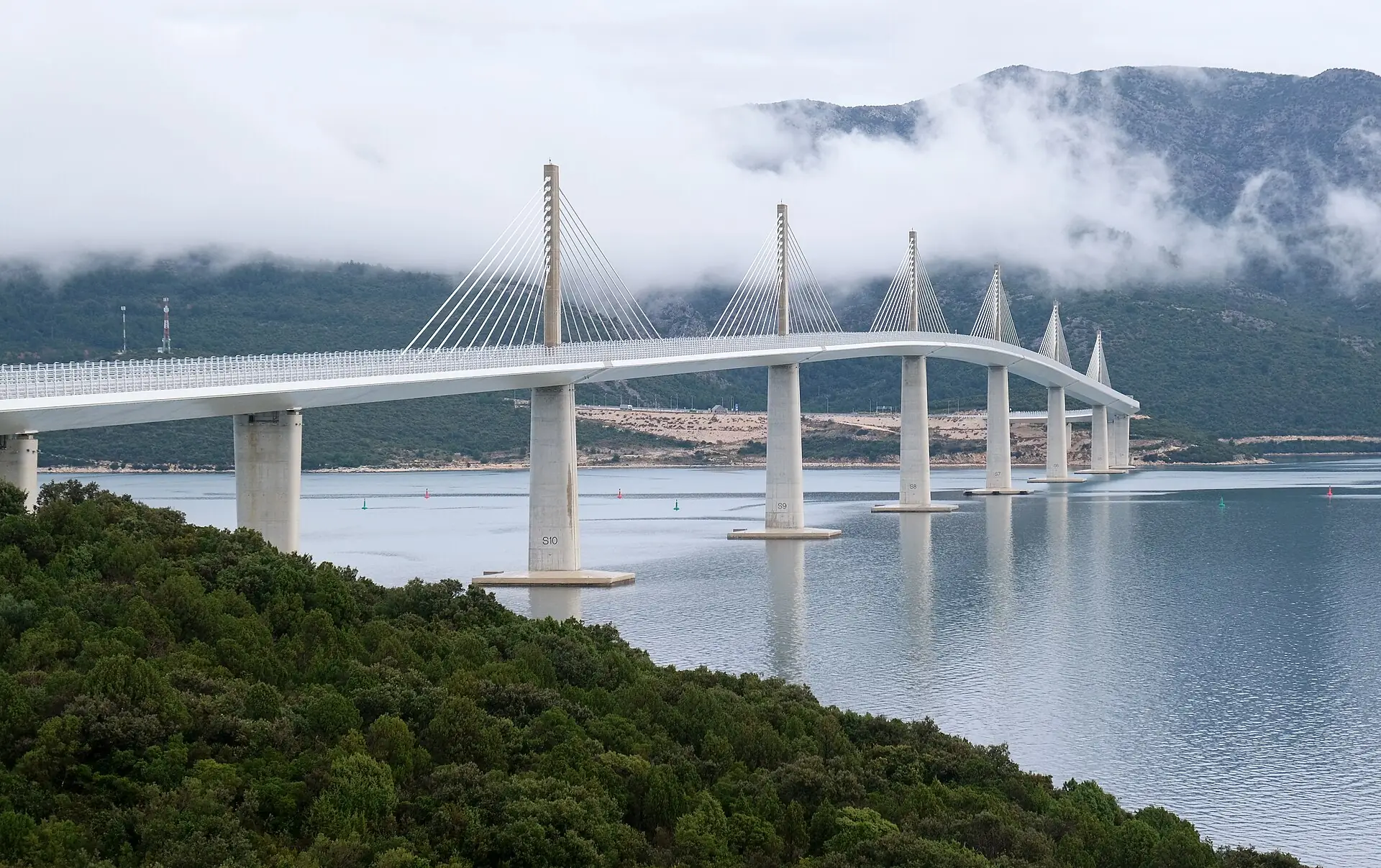
Split. Fly into Split, take the coast south. For decades the catch was that Croatia isn’t continuous — Bosnia and Herzegovina owns a short stretch of coastline at Neum, so the drive meant two border controls in the middle of your afternoon. The Pelješac Bridge ended that: opened 26 July 2022, running from Komarna across to the Pelješac peninsula, no toll, border crossings gone. The European Commission put the saving at 37 minutes; buses and trucks joined when the Ston bypass opened in April 2023. Today it’s a straight run of roughly 224 km — the fastest operator advertises 3 hours 45, another quotes about 4 hours 30 depending on traffic, and in August I’d believe the second one.
Tivat, in Montenegro, is closer than Split — call it 80 kilometers of road — and it’s the option that looks smartest on a map and worst in July. Montenegro is outside the EU and outside Schengen, so the crossing at Debeli Brijeg is a genuine external border, and in high season the queue there is the single least predictable hour of your trip. Nobody publishes a wait time, so I’m not going to invent one. Treat it as: fine in May, a gamble in August.
The honest conclusion: fly to Dubrovnik unless the fare gap is genuinely silly. A second airport plus a four-hour coach plus a border isn’t a saving, it’s a day.
Two calendars: what you pay and what you can reach
In most cheap-season destinations you trade money for weather. Here you trade it for choice, which is a stranger deal and worth understanding before you congratulate yourself on a January fare.
- July and August — peak on every axis. Peak fares, peak heat, peak everyone; the city is small and walled and it fills. If the crowding side of that is what you want, our guide to the republic that bought its freedom covers it properly. As a booking question, it’s simply the most expensive way to buy this trip.
- May, and September into October — the value window. The full route map is still up, the sea is still warm at the back end, and the fares stop behaving like an auction. If someone made me pick one month for this city, it’d be late September.
- November to March — the cheap seats, and the city to yourself. Fares fall because demand does, and a walled town in winter with nobody in it is a genuinely good thing to have booked. The catch is choice, not quality: you’re not comparing six airlines, you’re taking Zagreb or Frankfurt or Rome or one of Ryanair’s two year-round routes, and connecting. Budget the connection time along with the fare and it works nicely.
- 3 February — the one winter date with a reason to be here. The Feast of St Blaise is the city’s patron-saint day and its City Day, held on 3 February since the tenth century and on UNESCO’s intangible heritage list since 2009. If you’re coming in the dead season anyway, that’s the week to pick.
Euro and Schengen: what actually changed for you
Croatia did both at once on 1 January 2023 — adopted the euro and joined Schengen. Land and sea border checks came down that day; the air borders followed on 26 March 2023. Three consequences, and the third is the one people get wrong:
- Prices are in euros. No currency to change, nothing left over at the end.
- Arriving from another Schengen country, there’s no border formality at Dubrovnik — you walk off like a domestic passenger.
- Your Schengen days are pooled. That week in Paris on the way over counts against the same 90-day allowance as your fortnight in Dalmatia. Croatia is no longer the bonus country that sat outside the count.
Entry requirements
The Schengen rule applies: 90 days in any rolling 180, counted across the whole area. I checked the two passports separately rather than assuming they move together — the UK government puts British citizens at visa-free for up to 90 days in any 180-day period, and the Croatian foreign ministry and the US embassy both put American visitors in the same 90-in-180 category with no visa. Your passport must have been issued within the previous ten years and stay valid at least three months past your planned departure from the Schengen area.
Two current items. The EU’s Entry/Exit System has been fully operational across all Schengen countries since 10 April 2026 — a digital record with fingerprints and a facial image in place of a stamp. ETIAS, the pre-travel authorization and a separate thing entirely, is scheduled to start in the last quarter of 2026, with the exact date still to be officially communicated. That timeline has slipped before; treat it as a schedule, not as a rule already in force.
One Croatian specific worth a line: short-stay visitors must have their accommodation registered, normally by the hotel or host within a day of arrival. In a small apartment where nobody mentions it, ask — it’s their job, but it’s your record. And as always: check current requirements before you book, and again before you fly.
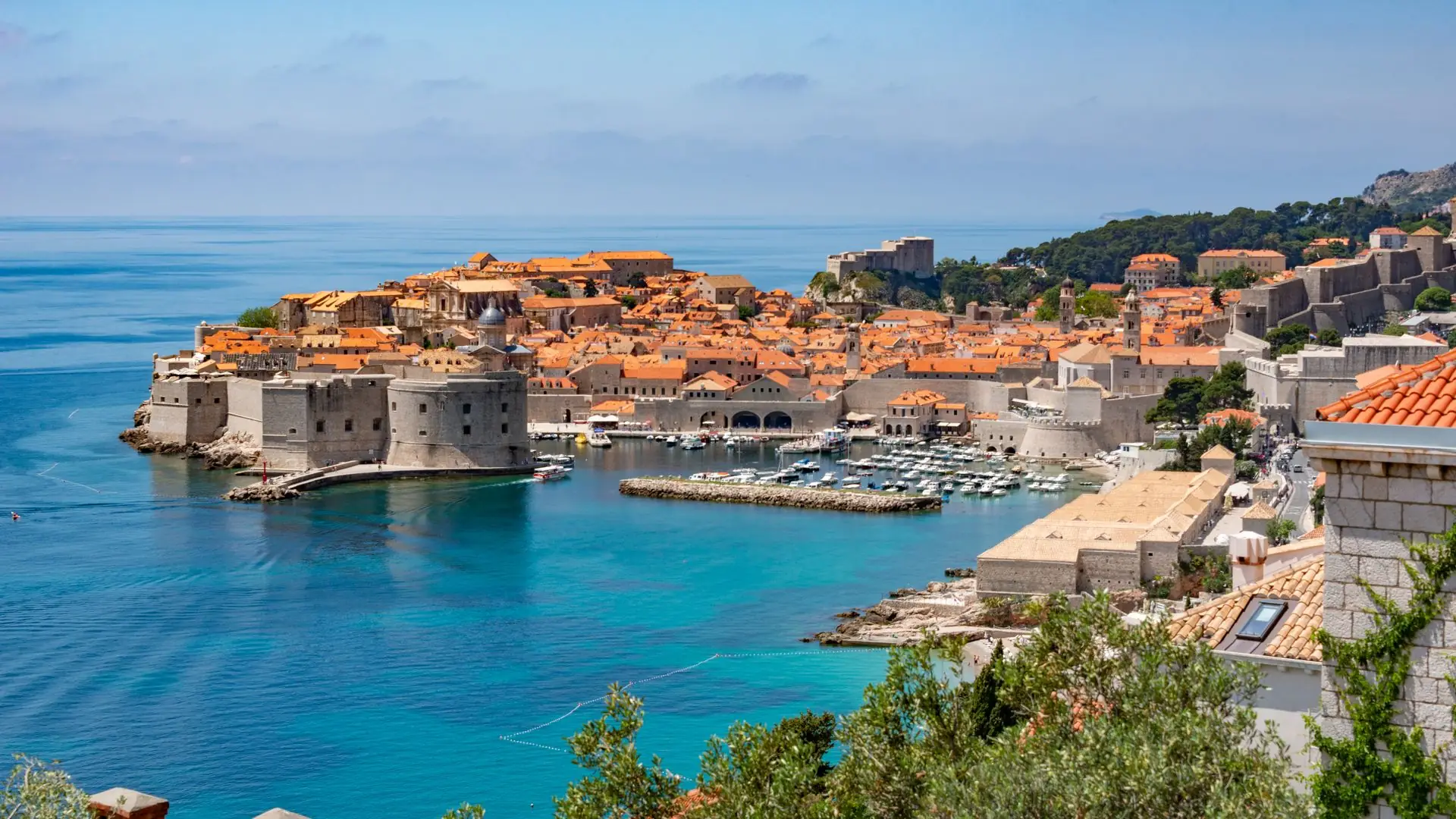
Last thing, and it’s why I don’t mind the drive. Coming in from the north on a clear day, the road turns around the shoulder of the hill and the old town appears below you all at once — walls, roofs, sea, islands stacked up behind. Every guide reproduces that view from a helicopter. You get it from a bus window, for free, twenty minutes before you check in.
FAQ
How far is Dubrovnik Airport from the old town?
22.5 kilometers, per the airport itself, which puts the drive at 30 to 35 minutes on average and tells you to allow up to an hour in summer. The Platanus shuttle takes about 30 minutes to the Old Town and about 35 to the main bus station at Gruž, and it leaves roughly half an hour after each flight lands. Note the Old Town stop is at Ploče Gate, not Pile — about a ten-minute walk apart.
Is there a train to Dubrovnik?
No — and not a partial no. Dubrovnik has no railway station; the old line closed in the 1970s and nothing replaced it. The nearest railhead is Ploče, a couple of hours up the coast. In practice you arrive by air, or by coach along the coast from Split, or by boat — all three are easy, and the coastal run is one of the better drives in Europe. Plan road times, not rail times.
When is the cheapest time to fly to Dubrovnik?
November through March — with a caveat bigger than the saving. In winter the route map collapses to Croatia Airlines’ Zagreb, Frankfurt and Rome services, Discover’s Frankfurt run, and the two routes Ryanair keeps year-round (Kraków and Dublin for winter 2026/27, replacing Vienna and Charleroi). Cheap fares, few options, and a connection in most itineraries. For value with the full map still running, take May or late September.
Can you fly to Dubrovnik from the US nonstop?
In summer, from one city. The airport’s 2026 schedule has a daily New York (Newark) connection from early May to late September, plus four extra rotations in October. Delta operated JFK–Dubrovnik in past summers and isn’t in this year’s picture. Outside the season there is no US nonstop at all, so plan on a one-stop through a European hub — and check the exact weeks with the carrier before you build a trip around a seasonal route.
Photos: dronepicr (CC BY 2.0), Tiia Monto (CC BY 4.0), kallerna (CC BY-SA 4.0), Joanbanjo (CC BY-SA 3.0), via Wikimedia Commons.


