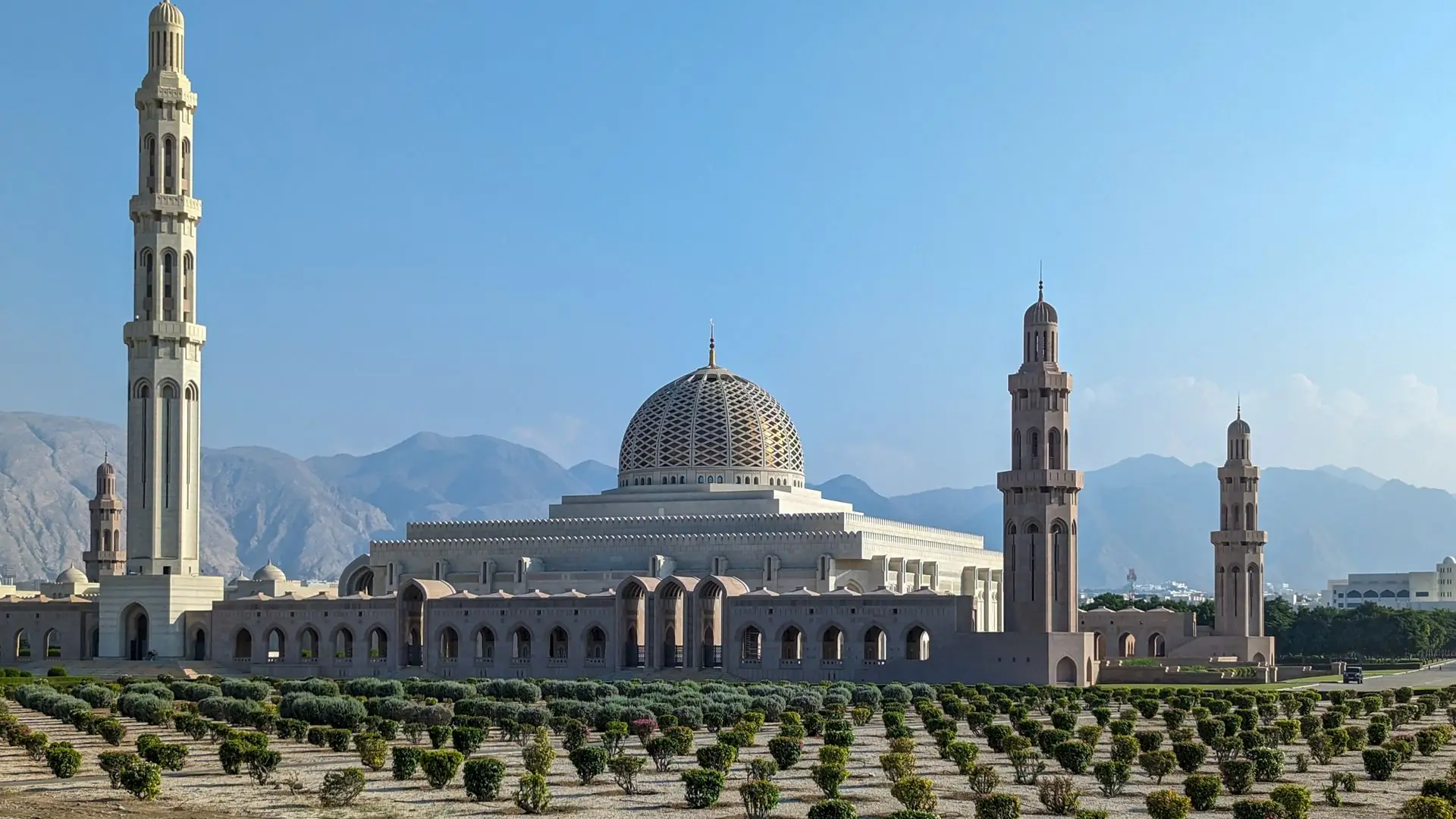

That’s the whole of the difficulty here — telling this year’s rule from last year’s. And it’s a fair introduction to the place, because the reason things keep getting reorganized is the same reason people end up liking Oman: this is a country that regulates the queue rather than letting it become a scrum. If you know Dubai and Doha as the vast, glittering machines you change planes in, Muscat is the third option — smaller, newer, considerably calmer, and the only one of the three that seriously invites you to stop.
Getting there: one nonstop from London, and none from the US
From the UK there is exactly one nonstop, and it’s Oman Air’s. The carrier flies London Heathrow to Muscat on the Boeing 787-9, at around eleven flights a week through the winter season and building toward twice-daily in summer — a level it last held in 2020. The second daily rotation lands at Heathrow in the morning, which is a deliberate piece of scheduling rather than a coincidence.
British Airways is not the answer here, whatever your search results say. BA’s Heathrow–Muscat service went during the pandemic and has not come back as a scheduled route; the airline’s own Oman page routes you via Doha on Qatar Airways. If you see a BA flight number on the Muscat–London pairing, check what it is before you get excited — the airline operated a run of relief flights out of Muscat in March 2026 to get customers home during a period of regional disruption, and those still surface on flight trackers, flagged as operating irregularly. A relief flight is not a route.
From the United States there’s no nonstop at all, which surprises nobody who has looked at a map. You’ll connect — and here’s the development that makes that materially better than it used to be: Oman Air joined the oneworld alliance on 30 June 2025. For an American reader that means the Muscat leg now sits inside the same alliance as American Airlines, British Airways and Qatar Airways, so a New York or Dallas itinerary can be built on one ticket with the miles and the baggage rules behaving themselves. For a British reader it means the Heathrow connection finally plugs into the network you probably already collect points in.
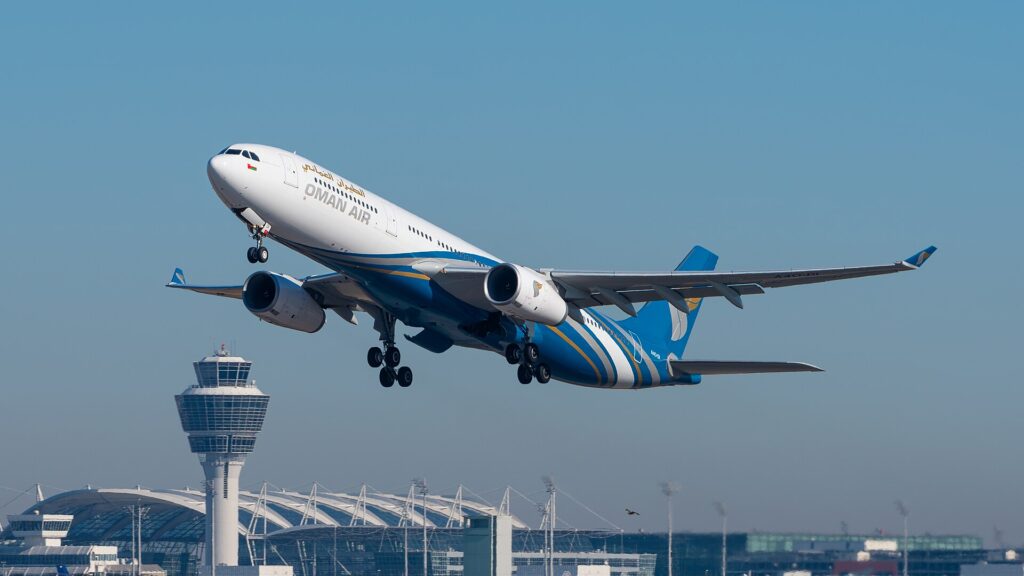
Who actually flies to Muscat
The full board, because “who serves this airport” is the question a fare search can’t answer for you:
- The Gulf neighbors, in force. Emirates and flydubai from Dubai, Qatar Airways from Doha, Etihad from Abu Dhabi, Gulf Air from Bahrain and Air Arabia from Sharjah. Muscat is an hour or so from all of them, which makes these the easy repositioning flights if a Gulf mega-hub is where your long-haul lands.
- Turkey. Turkish Airlines from Istanbul and Pegasus from Sabiha Gökçen — the standard European workaround, and Turkish’s map means almost anywhere in Europe reaches Muscat in one stop.
- India, which is the densest market here by a distance. IndiGo flies Hyderabad, Kochi and Mumbai; Air India Express serves Delhi, Mumbai, Kochi, Kozhikode, Kannur, Mangaluru, Thiruvananthapuram and Tiruchirappalli. If you’re combining Oman with India, the connections are frequent and cheap.
- Africa and the wider region. Egyptair, Ethiopian Airlines, Air Tanzania, Biman Bangladesh, US-Bangla, Pakistan International, Iraqi Airways, China Eastern, plus several Iranian carriers on the short hop across the water.
- The home pair, and they matter. Oman Air is the full-service hub carrier, now up to around 49 destinations after a run of launches this summer. SalamAir is the Muscat-based low-cost airline and it is quietly the budget map of this whole region — five domestic destinations and something near forty international ones across a couple of dozen countries, including eight cities in India. If a route looks expensive on the legacy carriers, check SalamAir before you conclude anything.
One note on what isn’t there, since the point of a list like this is to be complete: some Gulf carriers you might expect — Kuwait Airways and Jazeera among them — don’t appear on the airport’s current destination board. Check before you assume a Kuwait routing exists.
The airport, and the transfer rule that catches everyone
Muscat International’s current terminal opened in March 2018, and that single fact does most of the work in the “calm hub” argument. It is genuinely new, genuinely large, and — because Oman handles a fraction of its neighbors’ transfer volume — it rarely feels under strain. The high white halls are the closest thing in the Gulf to an airport you don’t mind being early for.
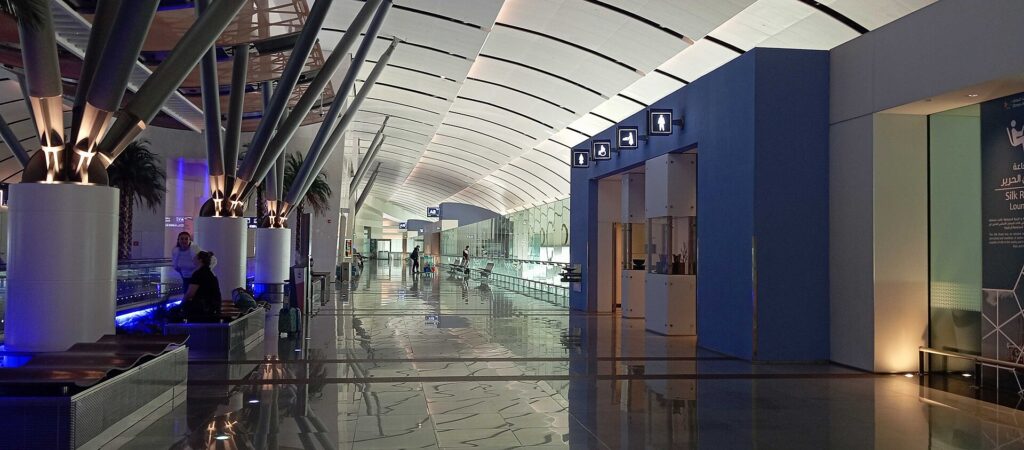
On distance, be careful which number you trust. The airport is roughly 32 kilometers from old Muscat and the Mutrah corniche, which is where the postcard is and quite possibly where you’re staying. It’s much closer than that to the modern districts strung along the coast — Al Khuwair, Qurum, the business end of the city — which is why some guides quote figures half that size. Both are true; they’re measuring to different places in a capital that is unusually spread out.
Taxis, buses, and the app restriction
There’s no rail link, so it’s road transport. Three options, in order of how reliably they work on arrival:
- The official airport taxis. Metered, regulated, arranged at counters in the arrivals hall, and they always work. This is the default for a late landing or a first arrival with bags.
- The apps — and where the stale advice comes from. Since October 2023 the airport’s taxi service has been licensed by the transport ministry to the ride apps themselves: OTaxi, the app residents use everywhere — since folded into Yango through a partnership sealed with the same ministry — and the government-licensed OmanTaxi, with fixed fares set below the old airport rates and a counter in arrivals that will order the car for you if you don’t have the app. Many guides still print the pre-2023 version, in which OTaxi was barred from airport pickups; that rule is gone, and knowing it’s gone explains the contradictory advice you’ll read elsewhere. Two cautions survive: sources disagree about whether Careem works in Muscat at all, so don’t build an arrival around it — and the local apps may want an Omani mobile number to register, with the telecom desks in the arrivals hall.
- The bus, if you’re traveling light. Mwasalat runs public buses from a stand on the ground floor outside the terminal — route A1 toward Ruwi, route 8 toward Al Khuwair and the central districts. It’s the cheap option by a wide margin. Two honesty notes: the stop is a short walk from arrivals with thin signage, and sources disagree on frequency, with some describing a half-hourly service and others something much sparser. Fares are cash to the driver, so keep small notes.
The upside of all this regulation: there’s no negotiation, no scrum at the doors, and the airport buses are documented as running around the clock — so a 3 a.m. arrival here is an ordinary event rather than the small adventure it becomes elsewhere.
The visa is a formality — and it’s what makes the stopover work
British and American citizens enter Oman visa-free for up to 14 days. No application, no portal, no fee — you arrive and you’re in. Oman extended this to well over a hundred nationalities, and it is the single change that turned Muscat from a place you passed through into a place you can decide to stop in three weeks before departure.
The conditions are real but ordinary, and the UK government spells them out: a ticket for return or onward travel, proof of your accommodation such as a hotel booking, and proof of travel health insurance. Your passport needs an expiry date at least six months after you arrive. Staying longer than 14 days, or coming for work or study, means a visa — applied for online in advance through Oman’s official government portal, choosing the unsponsored visit visa if you’re a tourist. Apply on the official site rather than a lookalike; the intermediaries add a fee for the same form. Check current requirements before you book.
What the stopover programme actually is now
You may have read about Oman Air giving stopover passengers a free hotel night. That was real, and it’s over: it was a limited promotion that closed to bookings at the end of November 2024. Anyone still describing it as a standing perk is quoting an expired offer, which is worth knowing before you build a trip around a freebie.
What replaced it is arguably more useful and definitely more honest: a joint programme between Oman Air and Visit Oman, the country’s own booking platform, offering customizable packages from four hours to four days — hotels at three, four and five stars, plus transport, tours and experiences — bookable alongside your flight at the airline’s site. The four-hour end of that range is the interesting one: it’s built for people with a long connection rather than an actual holiday.
And if you’d rather not buy a package, the DIY version is trivial precisely because of the visa. Book the two legs as a multi-city itinerary with a few days in the middle, walk through immigration with no paperwork, and you’ve turned a connection into the first chapter of the trip. That’s the pitch, and unlike most airline stopover marketing, the arithmetic actually holds.
Where Muscat is on the way to
A stopover is only worth anything if the airline goes somewhere you were headed. Oman Air’s eastward map currently reaches Bangkok, Phuket, Kuala Lumpur, Jakarta, Manila and — newly — Singapore, which returned on 2 July 2026 after a nine-year absence, four times a week on the 737-8. Southbound there’s Dar es Salaam and Zanzibar, which makes the London–Muscat–Indian Ocean routing a real itinerary rather than a theoretical one. This summer also brought Sochi, Tashkent and Abu Dhabi onto the map in a single month.
One caveat, and it’s the reason to check rather than assume. Oman Air spent 2023 onward in a hard restructuring, cutting roughly 30 percent of its network capacity and dropping routes across Asia before returning to growth — it reported its first operational profit in fifteen years in 2025. The airline that emerged is smaller and more focused than the one in older guides, and it’s now adding again. So the map is moving in your favor, but it is moving: verify your specific city on the airline’s own site rather than trusting a route list someone wrote three years ago.
Salalah, and the season that runs backwards
Here’s the fact that stops anyone dismissing Oman as a winter-only country. Down in the far south, Dhofar catches the tail of the Indian Ocean monsoon — the khareef — and turns green and misty and cool during precisely the months the rest of Arabia is unbearable. The 2026 season ran 21 June to 20 September. Hillsides that are bare rock in February are grass; the temperature drops; waterfalls appear.
The aviation response tells you how big this is domestically: in season, Oman Air and SalamAir between them run Muscat–Salalah at up to a couple of dozen flights a day, and this year Oman Air added a Dubai–Salalah service from 3 July, three times weekly and year-round. Salalah is a short domestic hop from Muscat, and if you’re reading this for an autumn or winter trip, the khareef will be over — but the beaches are excellent in the cool months too, and the flights keep running.
The honest calendar
- October to April is the season, and it isn’t a close call. Daytime temperatures across that window run from the high teens to the mid-thirties Celsius — the sixties to the mid-nineties Fahrenheit — which means swimmable sea, walkable cities and mountain air that’s actually pleasant. October and November are the sweet spot; December and January are the coolest; April is warm and brings the rose harvest on Jebel Akhdar.
- May to September is seriously hot, and I’m not going to dress that up. The interior and the coast both bake, outdoor plans compress into early morning and evening, and this is the cheap end of the year for exactly that reason. The Salalah exception above is the honest workaround, and it’s a good one.
- One date to plan around if you’re traveling in the first quarter of 2027: Ramadan falls roughly from 7 or 8 February to 8 or 9 March next year, which lands squarely inside the good-weather window. It’s a lunar calendar, so the dates shift with the moon sighting and should be confirmed nearer the time. The practical effect for a visitor is on daytime opening hours and the rhythm of the day rather than on whether you can travel — but it’s better known about in advance than discovered on arrival.
Money and time, briefly
The currency is the Omani rial, and it comes with a genuine mental-arithmetic trap: it is one of the highest-valued currency units in the world — third, on the usual reckoning, behind the Kuwaiti and Bahraini dinars. It divides into a thousand baisa rather than a hundred of anything, so the small notes are fractions of a rial. The practical consequence is that a number that looks trivially small on a menu or a meter isn’t necessarily, and the habit your brain has built in other countries will mislead you for the first day. Slow down on the first few transactions.
One specific thing to check: banknotes issued before 2020 stopped being valid at the start of 2025. If you have rials left over from an old trip, or you’re handed change that looks unfamiliar, that’s the reason. Cards work broadly in hotels, malls and restaurants across the capital; carry cash for souks, taxis and the smaller towns. ATMs are easy to find in the cities and at the airport. And Oman runs on UTC+4 with no daylight saving — the same offset as the UAE, an hour ahead of Doha and Riyadh, and it doesn’t move seasonally, which makes it one of the simpler connection calculations in this series.
Which is the closing argument, really. The approach into Muscat comes in over the Hajar range — bare, folded rock the color of dried clay, dropping straight into a very blue sea — and then you land at a five-year-old terminal, walk past an immigration desk that wants nothing from you, and are in a low white city that decided not to build towers. It is the least stressful arrival in the Gulf, and the only one where the layover is a reason rather than a cost. What to do with the days once you’ve stopped is another article — ours, the guide to the capital that chose not to build up. My job was the door, and this one opens quietly.
FAQ
Is there a direct flight from London to Muscat?
Yes — one, operated by Oman Air from London Heathrow on the Boeing 787-9, at around eleven weekly flights in winter and building toward twice daily in summer. British Airways does not fly the route: its Heathrow–Muscat service ended during the pandemic and has not returned as a scheduled flight, and BA’s own Oman pages route customers via Doha with Qatar Airways. If a BA flight number appears on the Muscat–London pairing in a search, check what it actually is — the airline ran a series of relief flights in March 2026 that still show up on trackers. From the United States there is no nonstop; you’ll connect, though Oman Air’s oneworld membership since June 2025 makes a single-ticket itinerary with American or British Airways straightforward.
Do US or UK citizens need a visa for Oman?
No, not for a short trip. Both nationalities enter visa-free for up to 14 days, as part of a scheme covering more than a hundred countries. You will need a return or onward ticket, proof of accommodation, travel health insurance, and a passport valid for at least six months beyond your arrival date. For stays longer than 14 days, or for work or study, apply online in advance through Oman’s official government visa portal and choose the unsponsored visit visa if you’re a tourist — and use the official site rather than a lookalike that adds a service fee. Check current requirements before you book.
Is Muscat a good stopover?
It’s one of the best in the Gulf, mainly because the visa-free entry means a stopover costs you no paperwork at all. Oman Air runs a joint programme with Visit Oman offering customizable packages from four hours to four days — hotels, transfers, tours — bookable alongside your flight. Note that the free hotel night you may have read about was a promotion that ended in November 2024, so don’t plan on a freebie. You can also just book a multi-city itinerary and do it yourself. It works best eastbound: Oman Air reaches Bangkok, Phuket, Kuala Lumpur, Jakarta, Manila and Singapore, plus Zanzibar and Dar es Salaam southbound.
When is the best time to fly to Muscat?
October to April, comfortably — warm, dry and swimmable, with October–November and March–April the pick of it. May to September is genuinely hot and priced accordingly, with one real exception: the khareef monsoon turns the far southern region around Salalah green and cool from roughly late June to late September, running the opposite way to the rest of the country, and both Omani airlines pile capacity onto that route in season. If you’re traveling in early 2027, note that Ramadan falls roughly from 7 or 8 February to 8 or 9 March, shifting with the lunar calendar — confirm nearer the time.
Photos: Izeberg007 (CC0), Julian Herzog (CC BY 4.0), YangApinat (CC BY-SA 4.0), via Wikimedia Commons.


