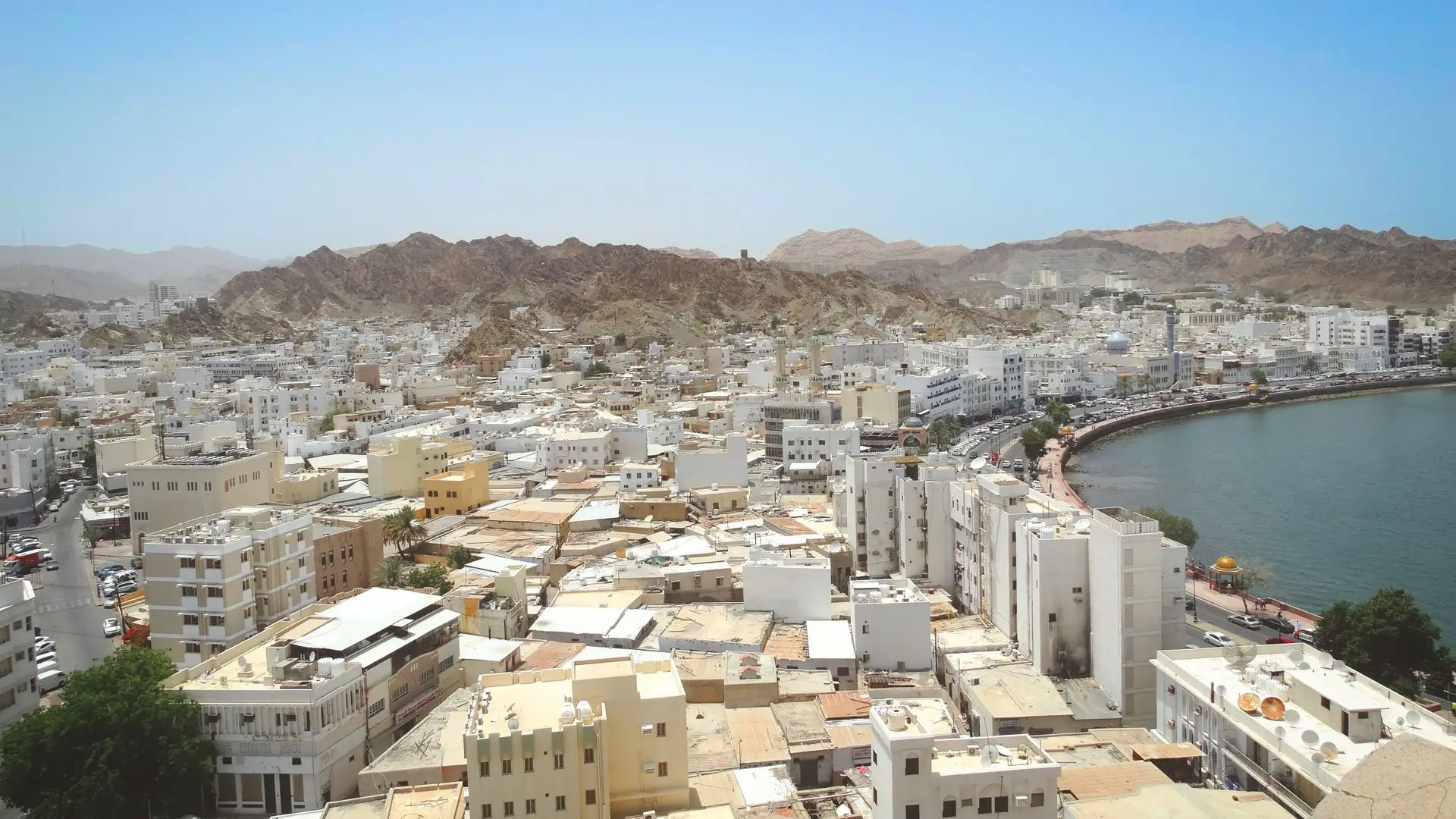

Muscat is the Gulf capital that went the other way. Not because it couldn’t afford towers — it has oil money and a marina full of proof — but because somebody decided the mountains were the better skyline and wrote that preference into the rules. Everything else in this article is downstream of that decision.
Why nothing is tall
The honest version first, because the story usually gets told as a headline. There is no single law titled “no skyscrapers”. What there is: a building code — Muscat Municipality’s Local Order 23/92, amended since — setting heights zone by zone, on top of royal direction that design should combine Omani, Arab, Islamic and contemporary character. Alongside it runs a colour convention: white dominates, and what isn’t white is meant to be modest and earthy so it sits with the landscape rather than against it.
The result is a capital where sources can’t quite agree how tall the tallest building is — you’ll see five storeys, ten, twelve and seventeen quoted, because the answer genuinely differs by district. What is quotable is the intent, and it came from a former chairman of Muscat Municipality, Sultan bin Hamdoon al-Harthy, who put the working guidance at around forty metres and explained it in one line: we do not want skyscrapers to compete with our mountains. That is the whole planning philosophy of a national capital, in eleven words.
You can watch it hold. The Grand Mosque’s main minaret rises ninety metres and is the vertical event of the city; the tallest structure anywhere in Muscat is a flagpole, raised in 2025, and everybody seems quite pleased about that. The city has spread sideways instead — strung along the coast for tens of kilometres in a chain of low districts joined by one highway, which is why Muscat feels less like a city with a centre than a series of villages that agreed on a colour.
None of this is a snub to the neighbours — Dubai is a magnificent thing and does what it does better than anyone. Muscat is the same regional wealth making the opposite call, and restraint turns out to be a luxury good: you cannot buy back a view once you have built on it.
The Grand Mosque, and the trouble with records
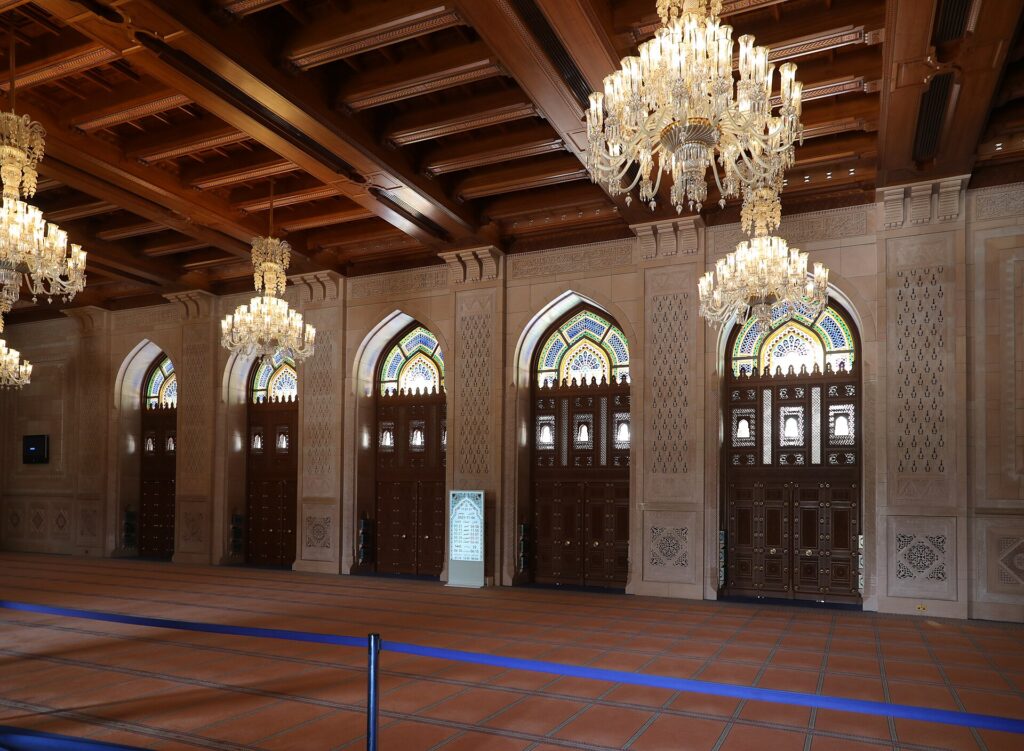
The Sultan Qaboos Grand Mosque is the one building everybody photographs, and the way it is usually sold does it a disservice. You will be told about two record-breakers inside — the carpet and the chandelier — and both records have moved on. The prayer-hall carpet was the largest single-piece carpet in the world for a few years and has not held that title since 2007, when Abu Dhabi’s Sheikh Zayed Grand Mosque commissioned a bigger one. The chandelier likewise once held its record and has since been overtaken elsewhere in the Gulf; the sources disagree about which mosque took it, which tells you how briskly this particular arms race moves.
Now the version that doesn’t expire. The carpet was woven by around six hundred women in Iran over four years, in one piece: something like 1.7 million knots, twenty-eight natural vegetable dyes, twenty-one tonnes of it, covering more than four thousand square metres of floor. The chandelier is fourteen metres tall, weighs eight and a half tonnes, and carries six hundred thousand Swarovski crystals over more than a thousand bulbs. Neither number needs a record attached to be worth crossing a city for, and the craft is the actual subject: the carpet took longer to weave than the building took to finish.
The rest of the mosque is quieter and better. Five minarets, one for each pillar of Islam. Marble courtyards crossed barefoot in the early sun, arcades that stay cool, and a scale that never becomes a boast. Built in the 1990s under the late Sultan Qaboos, whose name it carries, it is the newest thing in this article that already feels permanent.
Practicalities matter here more than usual. Non-Muslim visitors are welcome in the mornings, roughly eight until eleven, Saturday through Thursday; not on Fridays, which belong to worship. Entry is free. Women need hair covered and arms and legs covered to wrist and ankle, in clothing that isn’t see-through; men need long trousers and sleeves that cover the shoulder. Scarves and abayas can be hired on site if you arrive unprepared, and shoes come off before the prayer hall. Go at opening: the light on the marble is at its best and the courtyards are nearly empty.
Mutrah, the harbour that stayed a harbour
If the mosque is the set piece, Mutrah is the reason to stay a week: the old port district curled around a bay, a corniche running the length of it, the rock standing straight up behind. Dhows sit at anchor. Fishing boats come in. In the evening the whole town walks the seafront, which is the most convincing argument for low-rise cities I know.
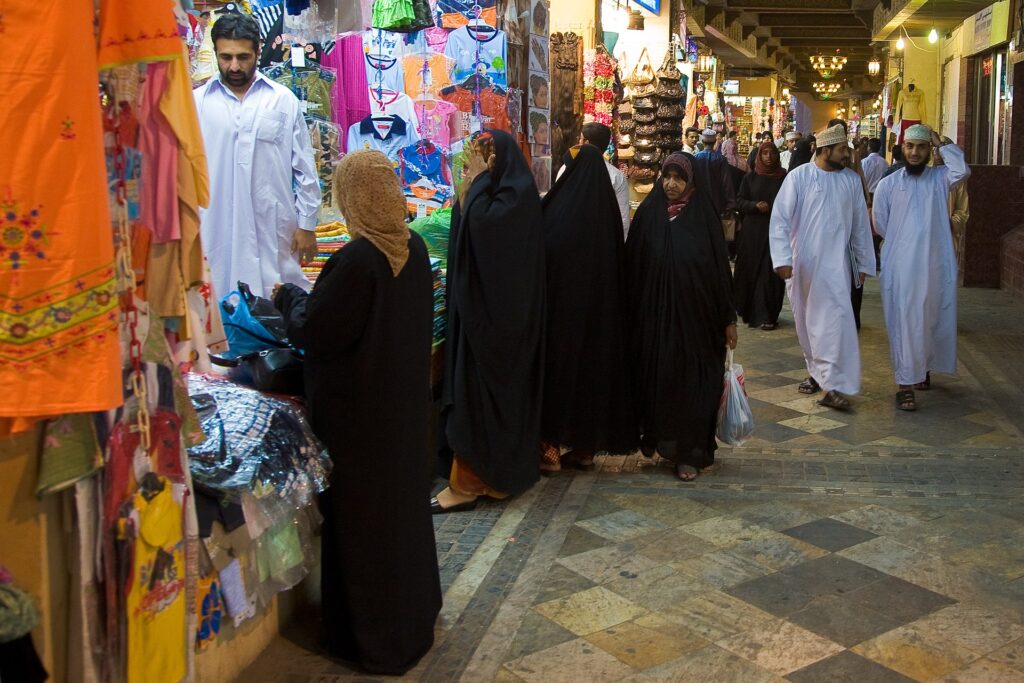
The souq opens off the corniche through an arched gate, and it is the good kind: still a working market, not a heritage reconstruction. It dates from the 1820s under Said bin Sultan, and its Omani name is Souq Al Dhalam, the market of darkness — the lanes were roofed so tightly against the sun that people once needed lamps to shop at midday. Inside: frankincense in paper cones, incense burners, silver, curved khanjar daggers, textiles, spice sacks, and the smoke of the stuff being burned in doorways as advertising. Haggling is expected, in the polite rather than the gladiatorial style. Come after five, when it reopens for the evening and the heat has stopped being a factor.
A little along the corniche is the fish market, worth the detour even if you have no interest in fish. Designed by the Norwegian practice Snøhetta for Muscat Municipality, opened in 2017 and shortlisted for the Aga Khan Award for Architecture two years later, it curves with the bay under a canopy of angled aluminium fins whose shape was taken from the flow of Arabic calligraphy, sitting deliberately beside the modest 1960 market it replaced. This is the quiet way this city does modern architecture: no height, no spectacle, just very good building. A fish market is a morning business, so go early — or go up to the rooftop restaurant instead.
Two forts stand on the headlands over the harbour entrance, Al Jalali and Al Mirani, put up by the Portuguese in the 1580s when this was their base on the Arabian coast. Neither is open to visitors. They are skyline rather than sightseeing, and the thing to do with them is notice how comfortably the town lives underneath them.
Old Muscat, the front room
A few headlands east, the original walled town is a surprise: small, formal and almost silent — the country’s ceremonial quarter rather than anywhere anyone shops. Al Alam Palace stands at the end of a short avenue behind a facade of flared gold and blue columns that looks like nothing else in the region; it is a working royal residence, so you view it from the gates, and that is the whole visit.
Facing it across the avenue is the National Museum, which opened in 2016 and is the best-organised museum in the country: fourteen permanent galleries covering the land, the sea, arms, the falaj irrigation channels, Islamic art and intangible heritage. It was the first museum in the region to install Arabic Braille throughout, which tells you what kind of institution it means to be. Two hours here explains more of Oman than a week of driving.
The opera house instead of the observation deck
Here is the thesis with a roof on it. When the money arrived, every other Gulf capital built something to look down from. Muscat built an opera house.
The Royal Opera House opened in October 2011 with a production of Puccini’s Turandot conducted by Plácido Domingo — the first opera house on the Arabian Peninsula, and it exists because the late Sultan Qaboos was a serious lifelong devotee of classical music and simply decided the country should have one. The building follows the same rules as everything else: low, in local stone, Omani in its architectural language, with landscaped gardens and an arcade around it. From the outside it could be a palace. Inside it is a properly engineered modern theatre.
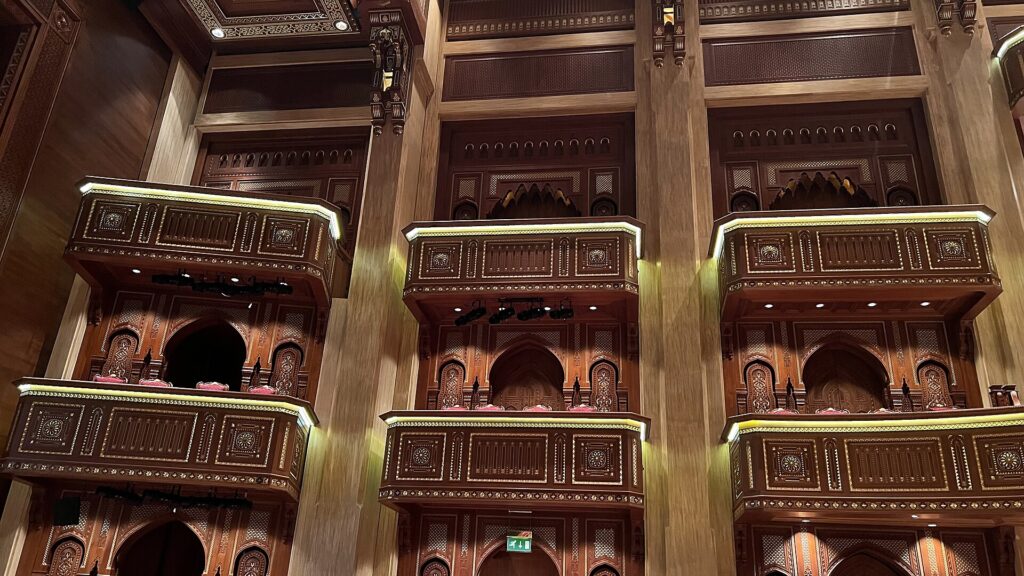
The season runs from October into spring, exactly when you want to be here anyway, and it is not a museum piece: recent seasons have carried more than fifty performances across opera, ballet, orchestral concerts, jazz and Arab music, and the house now commissions its own — a full-length grand opera in Arabic, on the Omani sailor Sindbad, had its world premiere here. If your dates land in the season, book something and go. If they don’t, guided tours run most mornings and early afternoons, Saturday to Thursday.
Frankincense, which is the smell of the whole country
You will notice it within an hour of landing and still be noticing it a week later: frankincense, burning in doorways, shops, hotel lobbies and homes, in a way that has nothing to do with tourism.
The resin comes from Boswellia sacra, a scrubby tree growing wild in Dhofar in the far south, where the trees, the caravan sites and the old frankincense ports are inscribed together on UNESCO’s list as the Land of Frankincense. That is a different trip. What reaches Muscat is the trade: the souq sells the resin graded by the cone, from pale, almost lemony crystals down to the cheap dark stuff, and every seller will let you smell the difference.
The unexpected stop is a perfume factory. Amouage, the Omani house founded in the early 1980s, has its manufacture out at Seeb with a visitor centre attached, and the guided walk-through — glass walls onto the extraction and bottling, then the full range to sample — is free and takes about half an hour. It closes a couple of days a week, so check the day before rather than driving out on spec. Whatever you think about perfume, watching a country’s oldest export become its most modern one is time well spent.
The table
Start with the ritual, because you will meet it before you meet any meal. Omani hospitality opens with kahwa — coffee with cardamom, often saffron and rosewater — in a small handleless cup, with dates alongside. Hand the cup back and it gets refilled. When you have had enough, give it a little shake as you return it; that is the signal, and using it correctly earns you a look of open approval.
Omani halwa is the national sweet and a genuine craft: a slow, dense, gelatinous confection worked over heat for hours with ghee, sugar, saffron, cardamom, rosewater and nuts until it pulls away from the pan. The rosewater comes from the mountain villages of Jebel Akhdar, where roses are distilled every spring. There are lighter saffron versions and dark ones built on dates, recipes are guarded within families, and every celebration involves a tray of it.
The dish to know about is shuwa, and you should know it as festival food. Meat is marinated for up to two days, wrapped in banana leaves and sacking, and lowered into a covered pit in the ground — often a communal one for a whole neighbourhood — where it cooks for a day or more before being lifted out for Eid. Muscat restaurants serve versions year-round and it is worth ordering, but the real thing belongs to a family courtyard on a feast day.
Day to day, eat mishkak — skewers grilled over charcoal at roadside stands in the evening — and eat fish. This is a coast with serious kingfish, hamour and prawns, and the simplest treatment always wins.
Water and rocks
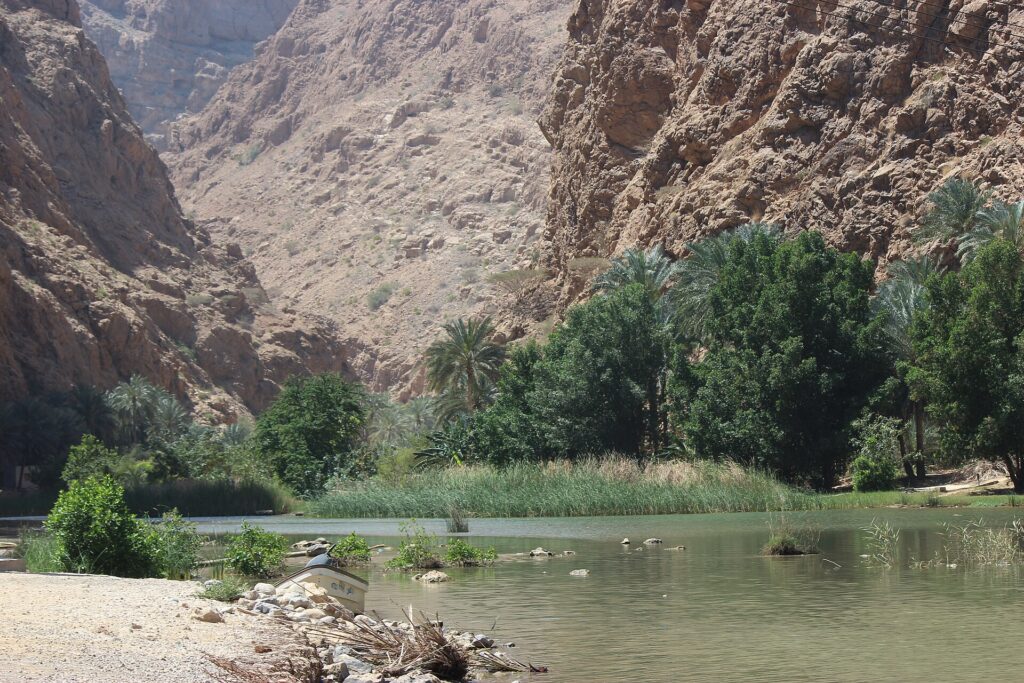
Muscat’s other advantage over a skyline city is that you can leave it in an hour and be somewhere geological. Wadi Shab, down the coast, is the classic: a short boat crossing at the mouth, then a walk up a canyon between pale cliffs and date palms to a chain of green pools, the last of which is entered by swimming through a gap in the rock into a cave with a waterfall in it. Wear shoes you can walk and swim in, start early, and treat it as most of a day.
Nearby, the Bimmah sinkhole is a limestone collapse filled with startlingly clear turquoise water, reached down a staircase and swimmable if you are confident in deep water. The local story that a meteorite made it is a good one and untrue; the geology is a cave roof giving way.
Offshore, the Daymaniyat Islands are a protected reserve of coral and clear water, and here is a distinction worth having exactly right, because guides routinely get it wrong. The islands are not closed in summer. What is prohibited between 1 May and 31 October is landing on them, and camping — a restriction protecting one of the world’s more significant hawksbill turtle nesting grounds. Diving and snorkelling run all year. From 1 November landings and camping open again, which means the season this article is written for is the only one in which you can actually stand on the beaches. Permits go through licensed operators.
Inland, Nizwa — round fort, Friday livestock market — is the classic day out into the interior, and deserves its own article rather than a paragraph here.
When to come
October to April, and it isn’t a close call. The days are warm rather than punishing, the evenings are the reason people live here, the sea is swimmable, the wadis are comfortable to walk, everything outdoors is open — and it is also the opera season, which is a happy alignment.
Summer is honest work: from roughly May to September the heat is severe and life moves indoors and into the late evening, humid on the coast and brutal inland. There is one gorgeous exception at the other end of the country — the far south catches a monsoon that turns Dhofar green in high summer, and getting down there is covered in our guide to the quiet stopover between the mega-hubs.
One date to have in mind if you are booking into the winter: Ramadan is expected to begin in early February 2027, confirmed as always by the sighting of the moon. Travelling then is entirely possible and can be lovely — the evenings are sociable in a way they never otherwise are — but daytime eating and drinking in public is restricted and some sites shorten their hours, so arrive informed rather than surprised.
On entry: Oman has opened visa-free entry to a long list of nationalities in recent years, with conditions attached — our guide to the quiet stopover between the mega-hubs carries the detail. Check current requirements before you book.
Low lights on the water
Finish on the Mutrah corniche after dark. The souq has reopened for the evening and is breathing frankincense smoke out of its gateway across the road. Families are walking the seafront. Dhow lights sit low on the black water, and behind the whole scene the rock face goes up into the dark, unlit, unbuilt and entirely in charge.
Every other city in the region shows you what money can put up. This one shows you what it can decide not to. Give me a fortnight anywhere in the Gulf and I know which harbour I want to be walking round at nine in the evening.
FAQ
Is Muscat worth visiting?
Yes, and particularly if the Gulf’s tower-and-mall version has never appealed to you. Muscat is a low, white, walkable capital with a working harbour souq, one of the great modern mosques, an opera house with a real season, and canyons and clear water an hour out of town. Three days does the city comfortably; five lets you add the wadis and the islands. It also works well as a short stopover.
Why are there no skyscrapers in Muscat?
Because the city’s planning rules keep it low and white on purpose. Muscat Municipality’s building regulations set height limits district by district, alongside royal direction that buildings follow Omani, Arab and Islamic architectural character and a colour convention favouring white and earthy tones. A former municipality chairman summed up the reasoning: they did not want skyscrapers competing with the mountains. It is not a single dramatic ban so much as a code applied consistently for decades — the tallest structure in the city today is a flagpole, and the tallest thing you actually look at is a minaret.
Can non-Muslims visit the Sultan Qaboos Grand Mosque?
Yes. Non-Muslim visitors are welcome in the mornings, roughly eight to eleven, Saturday to Thursday; the mosque is not open to visitors on Fridays. Entry is free. Women should cover their hair and wear clothing that covers arms to the wrist and legs to the ankle and isn’t see-through; men need long trousers and sleeves covering the shoulder. Scarves and abayas can be hired at the mosque, and shoes come off before the prayer hall. Hours can shift around Ramadan and public holidays.
When is the best time to visit Muscat?
October to April. The days are warm without being punishing, the evenings are excellent, the sea is swimmable, the wadi walks are comfortable and the opera season is running. May to September is very hot, with life moving indoors and into the late evening. One quirk worth knowing: landing and camping on the Daymaniyat Islands is only permitted from 1 November to 30 April, because the beaches are turtle nesting grounds all summer — so the cool season is the only one in which you can set foot on them.
Photos: Andrew Moore (CC BY-SA 2.0), Francesco Bini (CC BY-SA 4.0), Andries Oudshoorn (CC BY-SA 2.0), Chief National Guard Bureau (CC BY 2.0), Uhooep (CC BY-SA 4.0), via Wikimedia Commons.


