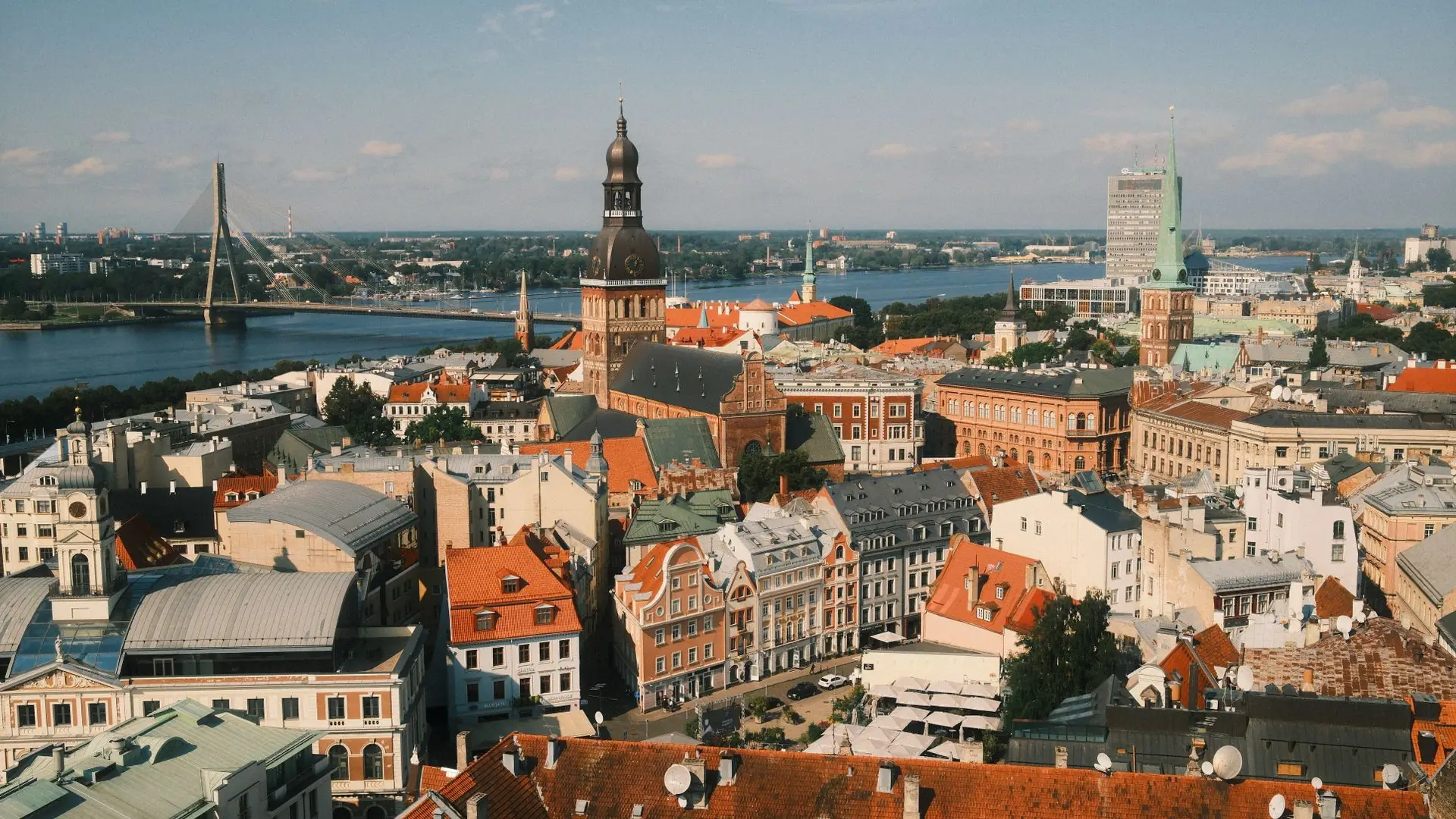

That’s the only genuinely annoying thing about arriving in Riga, and it takes one paragraph to fix. Everything else here is easy — this is the least stressful airport arrival in the Baltics, one airline shapes almost every fare you’ll see, and the city sits in the middle of a string of three capitals you can do on one trip. Here’s the whole thing.
The airport is close, and the transfer is a solved problem
Riga Airport sits about ten kilometers southwest of the center. The airport itself prefers to talk in minutes rather than kilometers, and the minutes are the friendly part: a taxi runs roughly 15 to 25 minutes, the city bus about 40 by the airport’s own reckoning, 30 to 45 by the city’s. By the standards of European capitals this is nothing — no ridge, no motorway epic, no second airport pretending to be the first one.
Bus 22, and the night bus that changed its number
Route 22 is the workhorse: every 10 to 20 minutes, from around 05:25 in the morning to 00:40 at night. The stop you want in town is 11. novembra krastmala, directly across from the Old Town; the line also passes Autoosta, which is the international coach station and the central railway station in one spot — remember that stop, because the three-capitals section below runs through it.
Then the bit that catches people. Overnight, route 22 hands over to N22, introduced on 18 April this year. It runs hourly: out of the city from Stacijas laukums at midnight, 1:00, 2:00, 3:00 and 4:00, and back from the airport at 12:30, 1:30, 2:30, 3:30 and 4:30. It follows the daytime route and uses the same stops — but the stops are served on request, so put your hand out rather than assuming the driver has seen you. The old 322 that every other guide still names was introduced back in 2019 and described by the operator at the time as a temporary solution. It lasted six years. It’s now the wrong number to be looking for.
One more operator quirk worth knowing, because it’s genuinely useful: bus 22 is the only route in the city where you can buy a ticket from the driver — and the driver takes bank cards only, no cash. Tickets bought in advance are cheaper and are sold at the airport, so if there’s a machine or a kiosk in front of you before you board, use it. If there isn’t, you’re fine as long as you have a card.
Taxis and apps
Licensed taxis wait at the arrivals exit, with their tariffs displayed on the car doors. Read them. Latvia lets each company set its own fare and there’s no maximum, which is exactly why the tariff is printed where you can see it before you open the door — the airport’s own advice is to settle the fare before the ride starts, and that’s the whole trick. Bolt is the app of choice in this market and picks up from a marked area in the short-term parking lot rather than the curb; the app will point you at it. Both routes are fine. The only bad version is getting in without looking at the number.
There’s no train to the airport — for now
Not today. A mainline station is physically being built at the airport as part of Rail Baltica — the concrete frame of the station building is up, the platforms are in, and the viaducts that will carry the tracks across the airport are going in now. That’s the current state, and it’s as far as I’ll go: I’m not handing you an opening date for a project whose schedule isn’t mine to promise. Plan your trip on the bus and the taxi. If a train is running when you get there, treat it as a bonus.
airBaltic doesn’t fly to Riga. Riga is airBaltic
Understand this one thing and the rest of your fare research gets easier. The Latvian flag carrier is a hybrid — network airline structure, low-cost pricing instincts — and it has bent this whole airport around itself. Airbus’s own words from its order announcement: airBaltic “is currently the largest A220 customer in Europe and the largest A220-300 operator in the world,” and “since 2020, the airline has operated an A220-exclusive fleet.” One aircraft type, nothing else, which is why every flight you take with them feels identical.
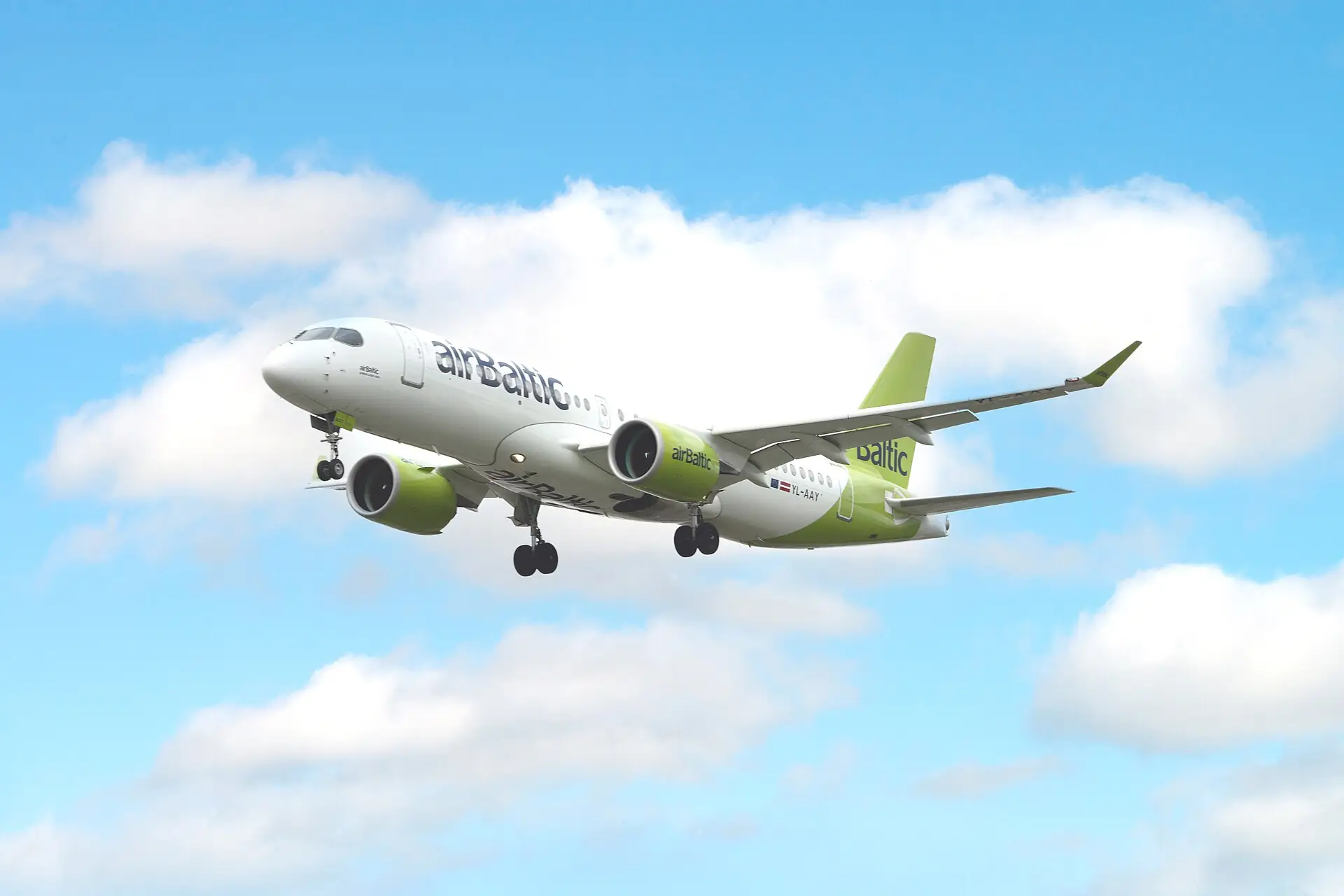
The network follows the same logic: Riga as the hub, with crew bases in Tallinn and Vilnius too, and around 130 routes across Europe, the Middle East, North Africa and the Caucasus. The practical consequence for you: for a great many European cities, the cheap way to Riga is the airline’s own site, and the shape of the fare map is the shape of one carrier’s network. Search there first, then check whether anyone else even flies your city pair. Often nobody does.
Who else flies there — and who just left
This is where a guide written two years ago will actively mislead you, so here’s the current board. Alongside airBaltic, the airport’s own destination list has Ryanair, Finnair, Norwegian, SAS, LOT Polish Airlines, Lufthansa, Turkish Airlines, flydubai, Aegean and Uzbekistan Airways, plus a tail of leisure and charter operators. For summer 2026 the airport is growing — flights and seats both up year on year, with airBaltic, flydubai, Norwegian, LOT and SAS all adding.
And the departures, which matter more to your search box:
- British Airways is gone. Its last Heathrow–Riga flight operated on 27 March 2026, at the end of the winter season, as part of a wider round of route cuts. If you have a mental note that BA does Riga from Heathrow, delete it.
- Wizz Air is gone too. It closed its Riga base years ago and wound the route list down to nothing, leaving the airport entirely in May 2025.
- Ryanair is still here but smaller, having cut its planned movements sharply for this summer against last.
So the London answer today is short and clean: airBaltic from Gatwick, Ryanair from Stansted. Two airlines, two airports, and a two-and-a-half-hour flight. That’s a simpler comparison than most European city pairs give you, and it’s genuinely competitive.
From the US, the answer is plain: there is no nonstop. Not seasonal, not summer-only, none. You connect through a European hub — Frankfurt, Amsterdam, Copenhagen, Helsinki, Istanbul, London, take your pick — and airBaltic has codeshare deals with Delta and Air Canada among others, which is usually how a single North American through-ticket to Riga gets built. That’s not a hardship; it’s how you’d reach most cities this size.
One ticket, three capitals
Here’s the reason I’d put Riga first on a Baltic trip rather than treating it as a standalone weekend. It sits in the middle of the string, and both neighbors are a comfortable half-day away on the ground. Fly into one capital, out of another, and you’ve turned one fare into three cities without ever backtracking.
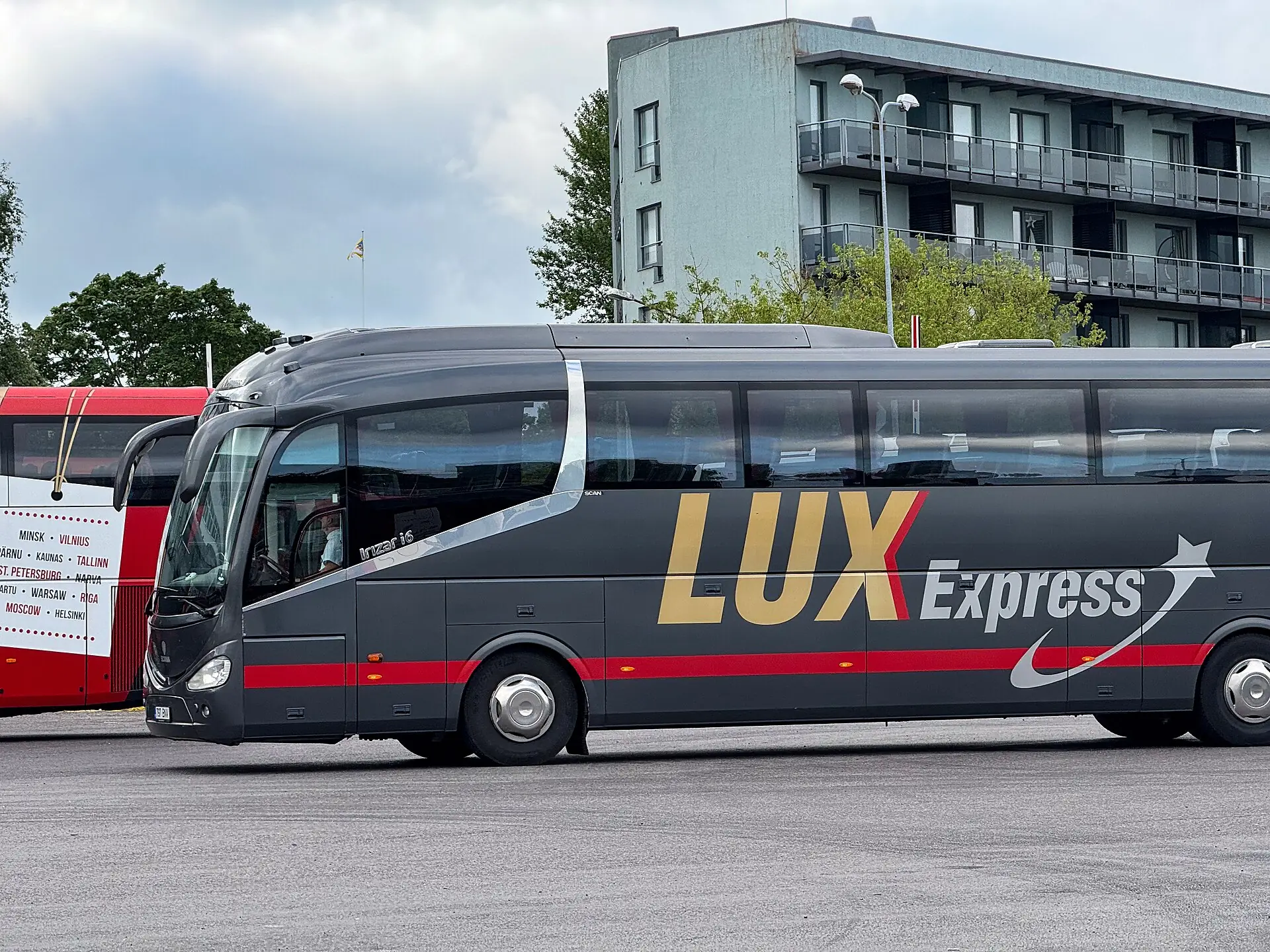
- Coach is the workhorse. Lux Express runs Riga–Tallinn in roughly four and a half hours, with 13 daily departures on the summer schedule, and Riga–Vilnius in about four to four and a half, seven times a day. Ecolines works the same corridors. These are proper intercity coaches — wifi, sockets, screens — not a school bus with ambitions.
- Rail is now a real option, once a day. LTG Link runs a direct Vilnius–Riga train, no transfers, at 4 hours 04 minutes — out of Vilnius at 7:30, back out of Riga at 16:55. Northbound, Elron sells a single ticket from Tallinn through to Riga or Vilnius, running once a day with a change of trains at Valga on the Estonian–Latvian border, with three operators stitched into the one booking.
- Or fly the hops. airBaltic bases aircraft in all three capitals, so the short legs exist if your time is worth more than your fare.
- Carry your passport on these hops. All three countries are in Schengen and there’s no routine border control, but the official advice for travel between the Baltic states is to have your passport on you even on a day trip — spot checks happen. It lives in your pocket, not your suitcase in the hold.
The open-jaw is the move: into Riga, out of Tallinn or Vilnius, or the reverse. Riga’s coach station and central railway station sit together at Autoosta, one bus stop from the airport line, so the handover from plane to onward ticket is about as painless as this gets.
Two calendars: light and price
Riga sits far enough north that the year has two completely different personalities, and the fares follow.
- June — about 18 hours of daylight. At the solstice the day runs close to eighteen hours, roughly eleven hours longer than the December low. The city is at its best and the fares are at their peak, though peak here is modest by Western European standards.
- Jāņi, 23–24 June — plan around it. Midsummer is the big one, and the practical consequence is that Latvia leaves town: the national tourism board’s own advice notes that locals head out of the cities, rural accommodation is booked well in advance, and the highways fill. If those are your dates, book beds early and don’t plan a long drive on the 23rd.
- December — short days, Christmas-market demand. Under seven hours of daylight around the solstice, and the markets pull a crowd into a small old town. If it’s the markets you’re after, our guide to the city one boom built covers what’s actually on.
- January to March — the cheap seats. Cold, dark, and the best value of the year, with the whole route map still running because airBaltic is home here and doesn’t go anywhere for the winter. That last part matters: this is a cheap season where you still get choice, which is rarer than it sounds.
- May and September — the sweet spot. Long days without midsummer pricing, and the coaches and trains to the other two capitals aren’t full.
Euro and Schengen, briefly
Latvia has been in Schengen since 21 December 2007 — with the air borders opening the following March — and on the euro since 1 January 2014. Old news locally, three consequences for you: prices are in euros with nothing to change; arriving from another Schengen country there’s no border formality; and your Schengen days are pooled, so the two nights you spent in Amsterdam on the way over come off the same 90-day allowance.
Entry requirements
The Schengen rule: 90 days in any rolling 180, counted across the whole area. I checked the two passports on their own sources rather than assuming they move together — the UK government has British citizens traveling visa-free to the Schengen area including Latvia for up to 90 days in any 180-day period, and the Latvian foreign ministry says US citizens need no visa for a stay of up to 90 days in 180 as long as they’re not working. Your passport must have been issued within the previous ten years and stay valid at least three months beyond the day you leave the Schengen area.
Two moving parts, both re-checked today. The EU’s Entry/Exit System has been fully operational across all Schengen countries since 10 April 2026 — fingerprints and a facial image on a digital record instead of a stamp in the book. ETIAS, the pre-travel authorization and a separate thing entirely, is scheduled to start in the last quarter of 2026, with the exact date still to be officially communicated. Treat it as a schedule rather than a rule already in force, and check current requirements before you book and again before you fly.
Last thing, and it’s the argument for this whole trip. The descent into Riga comes in over pine forest and the flat grey-blue of the gulf, and then you’re down, and then — because the airport is ten kilometers out and the bus goes every quarter of an hour — you can be standing under the roofline of the Zeppelin hangars with your bag dropped before the afternoon is over. Not many capitals let you land and be somewhere worth being inside an hour. This one does.
FAQ
How do you get from Riga Airport to the city center?
Bus 22 runs every 10 to 20 minutes from about 05:25 to 00:40, taking roughly 30 to 45 minutes; get off at 11. novembra krastmala for the Old Town. Overnight it’s N22, hourly from midnight, and note the stops are on request. Bus 22 is the only city route selling tickets from the driver, and the driver takes cards only — advance tickets are cheaper. A taxi or a Bolt takes about 15 to 25 minutes; check the tariff on the car door before you get in, because operators set their own fares.
Which airline flies to Riga?
Mostly airBaltic — the Latvian flag carrier, which Airbus calls the largest A220-300 operator in the world and which has flown a single aircraft type since 2020. It’s the hub carrier with around 130 routes, so start your search there. Also flying: Ryanair, Finnair, Norwegian, SAS, LOT, Lufthansa, Turkish Airlines, flydubai, Aegean and Uzbekistan Airways. Note two recent exits — British Airways ended Heathrow–Riga in March 2026, and Wizz Air left the airport in May 2025. From London today it’s airBaltic from Gatwick and Ryanair from Stansted.
When is the cheapest time to fly to Riga?
January through March. It’s cold and the days run under seven hours around the solstice, but unlike most cheap seasons the route map stays up, because the hub airline is based here year-round. June is the peak — around eighteen hours of daylight — and Midsummer on 23–24 June is worth planning around, since the country heads to the countryside and rural beds go early. May and September are the best balance of light and price.
Can you visit Tallinn and Vilnius from Riga?
Easily — it’s the best reason to fly into Riga rather than either of the others. Lux Express coaches reach Tallinn in about four and a half hours and Vilnius in about four to four and a half, several times a day; Ecolines runs the same corridors. By rail, LTG Link has a direct Vilnius–Riga train at 4 hours 04, and Elron sells one ticket from Tallinn through to Riga or Vilnius with a change at Valga. Book an open-jaw — in to Riga, out of Tallinn or Vilnius — and carry your passport on the hops, since spot checks happen even inside Schengen.
Photos: Ikars (public domain), Robert Cutter (CC BY-SA 4.0), Tony Webster (CC BY 2.0), Pierre André Leclercq (CC BY-SA 4.0), via Wikimedia Commons.


