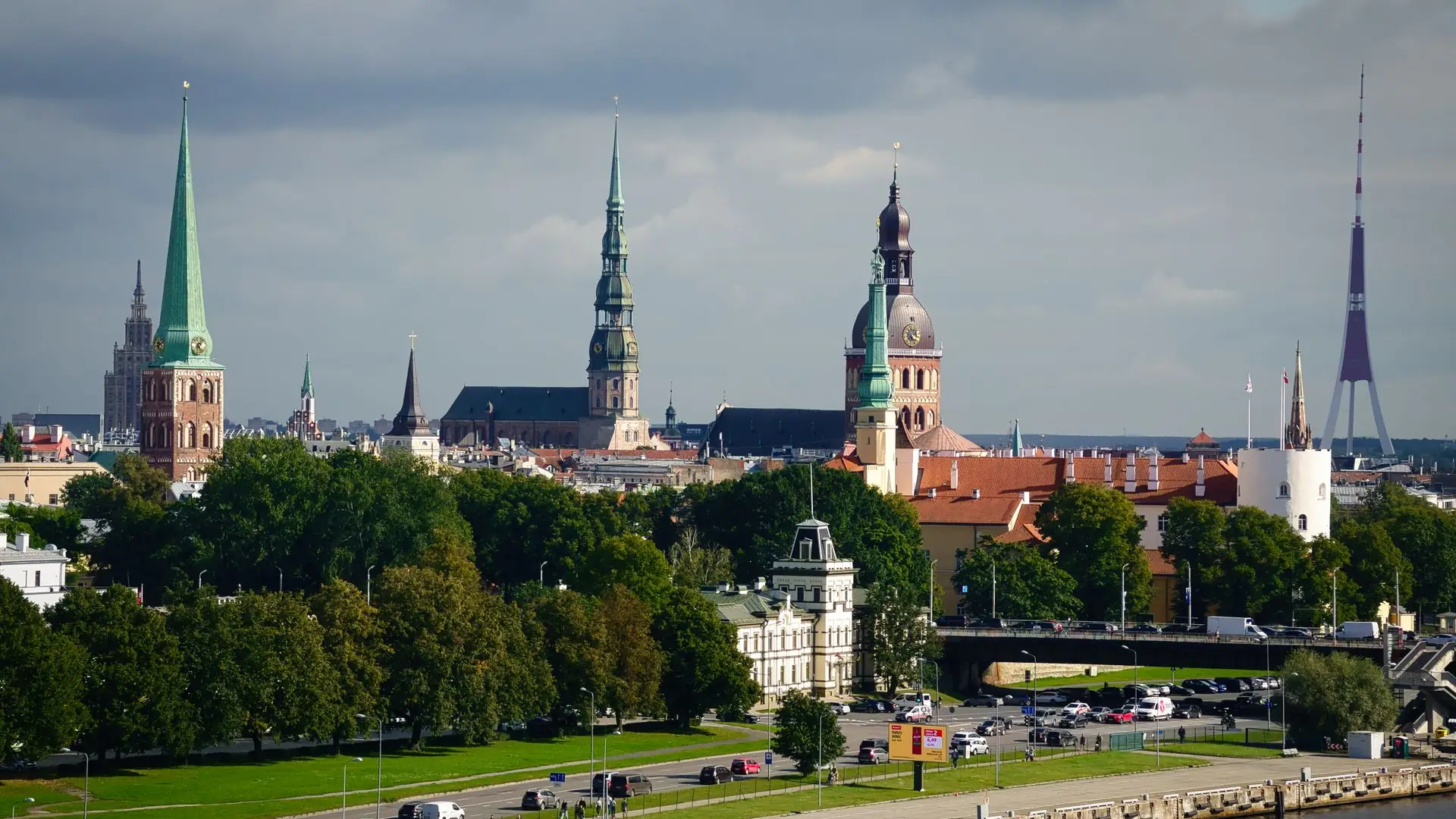

That is the thing to understand about Riga. Most cities collect their finest buildings gradually, a good century here, a fashionable decade there. Riga bought its in one go, with one fortune, at one moment — and because that moment happened to be the height of Art Nouveau, the whole city is dressed in the same confident outfit. The money eventually moved on. The wardrobe stayed.
The boom that built it
Around 1900 Riga was one of the fastest-growing cities in Europe. The census of 1897 counted a shade under 283,000 people; by 1913 the figure had grown by about 88 per cent, and the city stood at half a million — the fifth largest in the Russian Empire, bigger than Stockholm or Copenhagen at the time. It was a working port with railways behind it and factories along the river, and by 1900 it employed more industrial workers than anywhere else in the Baltic.
Two other things had to line up. The rules that had restricted building outside the old fortifications to timber were relaxed, which opened the ring of land around the medieval town to brick and stone. And in 1901 Riga threw itself a 700th-birthday exhibition, at which the new style from Vienna and Munich was the star turn. After that, Jugendstil was simply what Riga built. Between 1910 and 1913 the city was putting up somewhere between three and five hundred new buildings a year.
You are walking through a very short, very rich decade. That is why it all rhymes.
Look up: the Art Nouveau
The claim you will see on every poster is worth quoting from the people who actually made it. UNESCO’s own description of the site says: “It is generally recognized that Riga has the finest collection of art nouveau buildings in Europe.” The committee’s formal justification for listing goes further and says the quality and quantity of the city’s Art Nouveau architecture is “unparalleled anywhere in the world”. Roughly a third of the buildings in central Riga are in the style — something like 800 of them.
Alberta iela is the parade ground. Six of its facades — numbers 2, 2a, 4, 6, 8 and 13 — are the work of Mikhail Eisenstein, whose day job was chief road engineer for the province and whose son Sergei grew up to make films you have probably seen. Eisenstein’s buildings are the extroverts: blue tiles, gold, faces, animals, ornament pushed to the edge of what a facade can carry. The screaming head over the entrance at number 4 is the most photographed object in Latvia. Round the corner on Elizabetes iela, number 10b is the one with the peacocks and the stern women watching from the top floor.
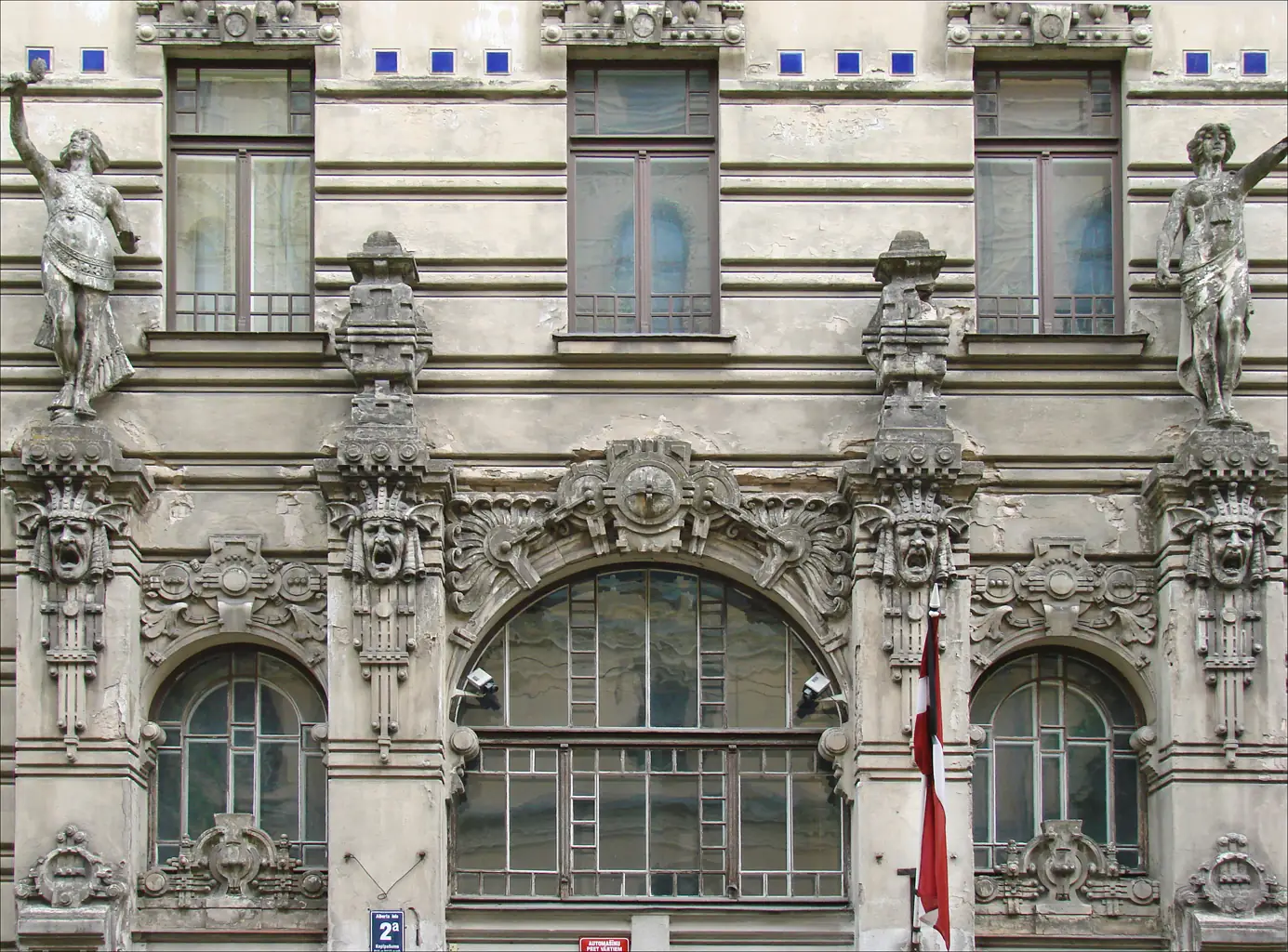
My practical advice is dull and it works. Cross the road — the best material is on the third floor and up, and from the pavement below you will see none of it. Come in the morning, when the sun is on the east side of the street and the tour groups are still at breakfast. And walk the ordinary residential blocks in the streets behind, where the same architects were working without an audience.
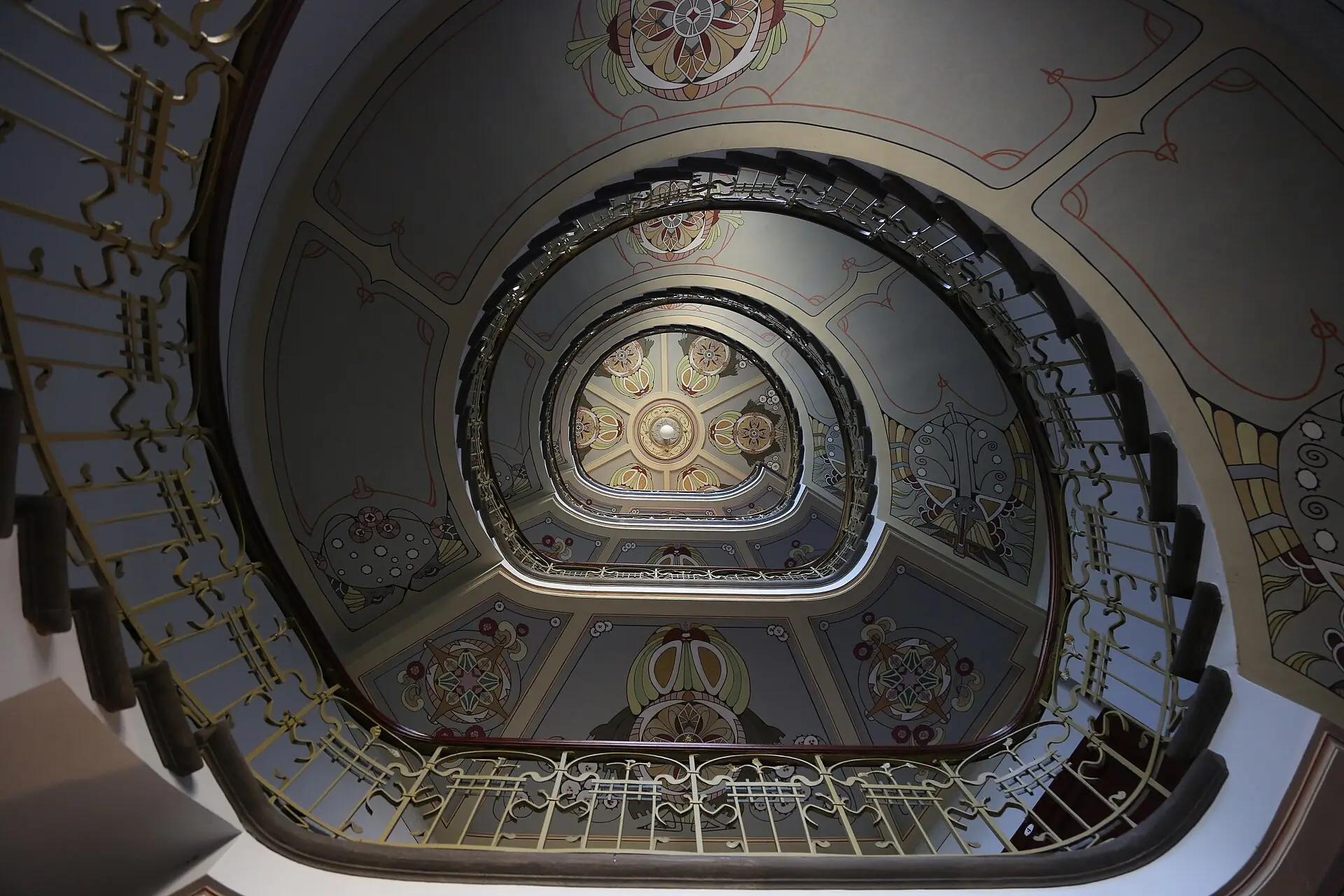
Then go into number 12. It was built in 1903 by the architect Konstantīns Pēkšēns as his own house, with Eižens Laube, and it now holds the Riga Art Nouveau Centre — the only museum in the Baltics devoted to the style. The apartment has been put back room by room: sitting room, dining room, bedroom, kitchen, maid’s room, all of it. But the thing you must see is in the entrance hall, and the museum’s own site calls it one of the most magnificent staircases not only in Riga but in Europe: a painted spiral winding up through the whole building, with ceiling decoration attributed to the painter Jānis Rozentāls. You can look at the staircase without a ticket. Buy one anyway.
The old town, and the house that got built twice
Riga’s historic centre went on the UNESCO list in 1997, and unusually the listing covers 438 hectares — the medieval core and the ring of Art Nouveau streets around it, treated as one thing, which is exactly right.
The medieval part is small and walkable in an afternoon. Take the lift up St Peter’s church tower to the gallery at 72 metres, which gives you the whole picture in one turn: red roofs, the wide brown Daugava, the port cranes, the sea somewhere out beyond. Downstairs and across the square stands the House of the Blackheads, the extravagant stepped-gable hall of a guild of unmarried merchants, first recorded in 1334.
What you are looking at, though, is not 1334. It is 1999. The building was reconstructed in the 1990s from photographs, drawings and archaeology, reproducing the house as it stood after its seventeenth-century Dutch Renaissance remodelling, and it opened on 9 December 1999. Some of the money came from residents buying a brick each. And the building says so itself: carved on the front, “Anno 1334” on one side and “Renov. Anno 1999” on the other. A city that liked a building enough to build it twice, and honest enough to date both.
Two streets away is the Cat House, from 1909, with two black cats up on its turrets, backs arched. The story goes that the owner was refused entry to the Great Guild and had the cats installed with their tails pointed at the guild’s front door, and that a court case eventually persuaded him to turn them round. Treat it as a legend — it is told in several versions, with the target variously the guild or the city council — and enjoy it anyway.
A market inside airship hangars
This is the fact that makes people put their coffee down. In the 1920s Riga needed a market hall, and the city bought the metal frames of two enormous airship hangars standing at an airfield down in Vaiņode, took them apart, brought them across the country and used the upper sections — the great arched roofs — as the skeletons of five new pavilions. Built between 1924 and 1930, they came with central heating, electricity and cellars connected to the river for deliveries.
The result is one of the largest markets in Europe, and it is not a heritage exercise: this is where Riga does its shopping, tens of thousands of people a day. The five halls are dairy, meat, fish, vegetables and gastronomy, and the fish hall is the one to see — the vaulting overhead, the smoked eel and bream laid out in rows underneath.
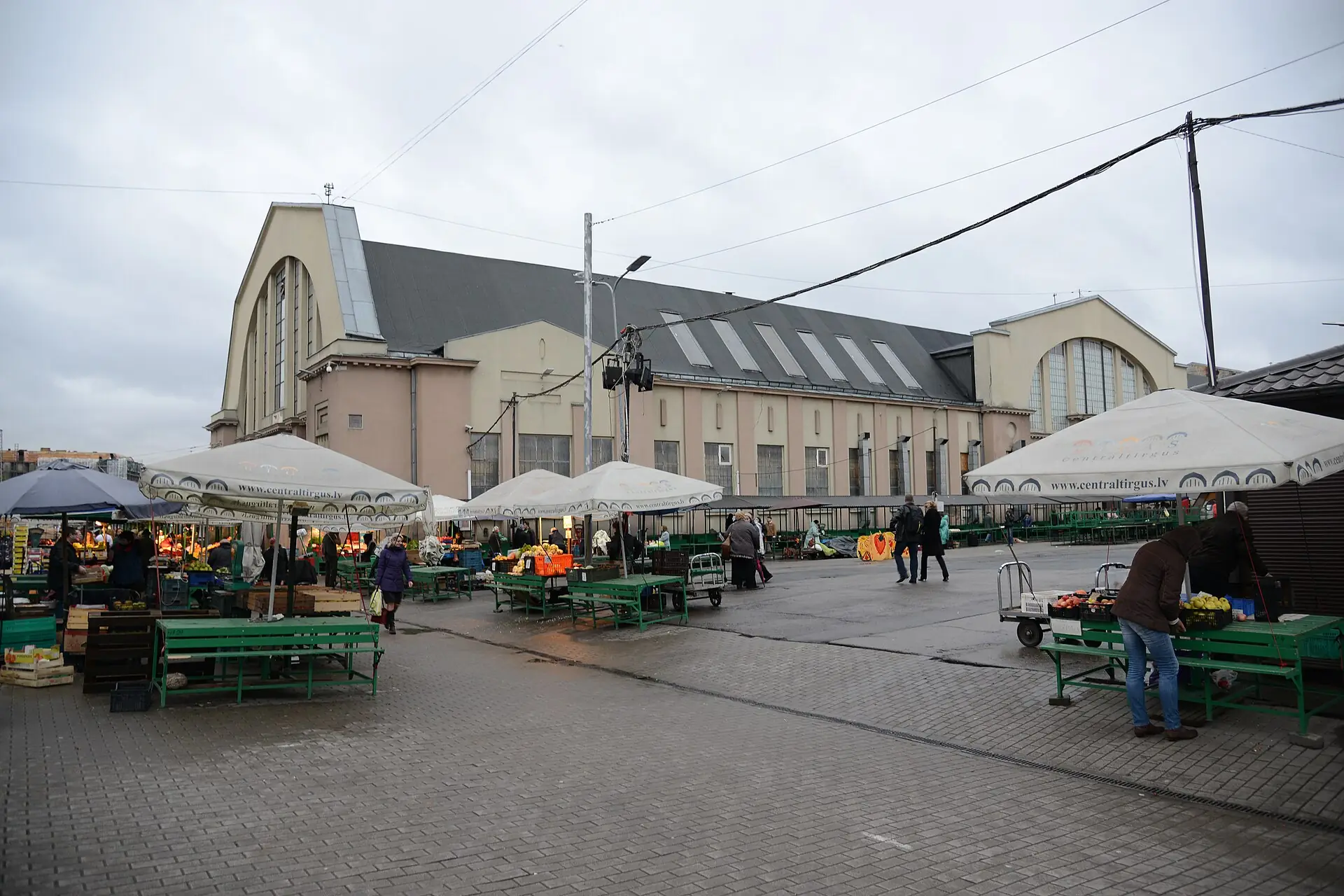
Eat as you go. Dark sour rye bread, which is a national identity as much as a loaf. Smoked fish. Fresh curd cheese with caraway. In summer, whatever berries are on the trestle tables outside — strawberries in June, then bilberries, then the small hard cranberries in autumn. And a cup of kvass, which is bread that has become a drink and tastes better than that sounds.
The other Riga, which is made of wood
The stone city gets the attention; the wooden one is where I would spend a slow morning. Riga still has thousands of timber buildings, and the ones that have been restored are a real pleasure — carved eaves, shutters, painted boards, apple trees in the yard.
Cross the river to Ķīpsala, a former fishing settlement now a five-minute walk from the centre, and follow Balasta dambis along the water: restored nineteenth-century houses in ochre and green on one side, and on the other the whole old-town skyline laid out across the river. Further out in Āgenskalns, the Kalnciema Quarter is a block of nineteenth-century wooden houses brought back from a bad state by a private restoration project, now holding a gallery, a wine shop and a courtyard. Its farmers’ market runs on Saturday mornings — produce, bread, crafts, cheese — and through the summer there are free open-air concerts in the courtyard on Thursday evenings.
What to drink while you are at it
Riga Black Balsam is the local herbal bitter: black, sticky, forty-five per cent, made to a recipe dated 1752 from a couple of dozen plant ingredients including wormwood, gentian, linden, ginger and bilberry. It is named for the pharmacist Abraham Kunze, and the story you will be told is that it cured the Empress Catherine the Great of a stomach complaint on a visit here. Take that as a legend — no one has produced the paperwork, and Catherine turns up in a suspicious number of these stories — but do try it, ideally in coffee or with blackcurrant juice rather than neat, which is a lot at any hour.
Beyond that: the lunch tradition is your friend. Ordinary places do a midday meal that is quick, hot and cheap relative to anything you will pay for dinner, and the canteen-style rooms with a counter are usually better than they look. The coffee scene has arrived properly too, mostly in the streets between the old town and the Art Nouveau district.
Twenty-five minutes to the sea
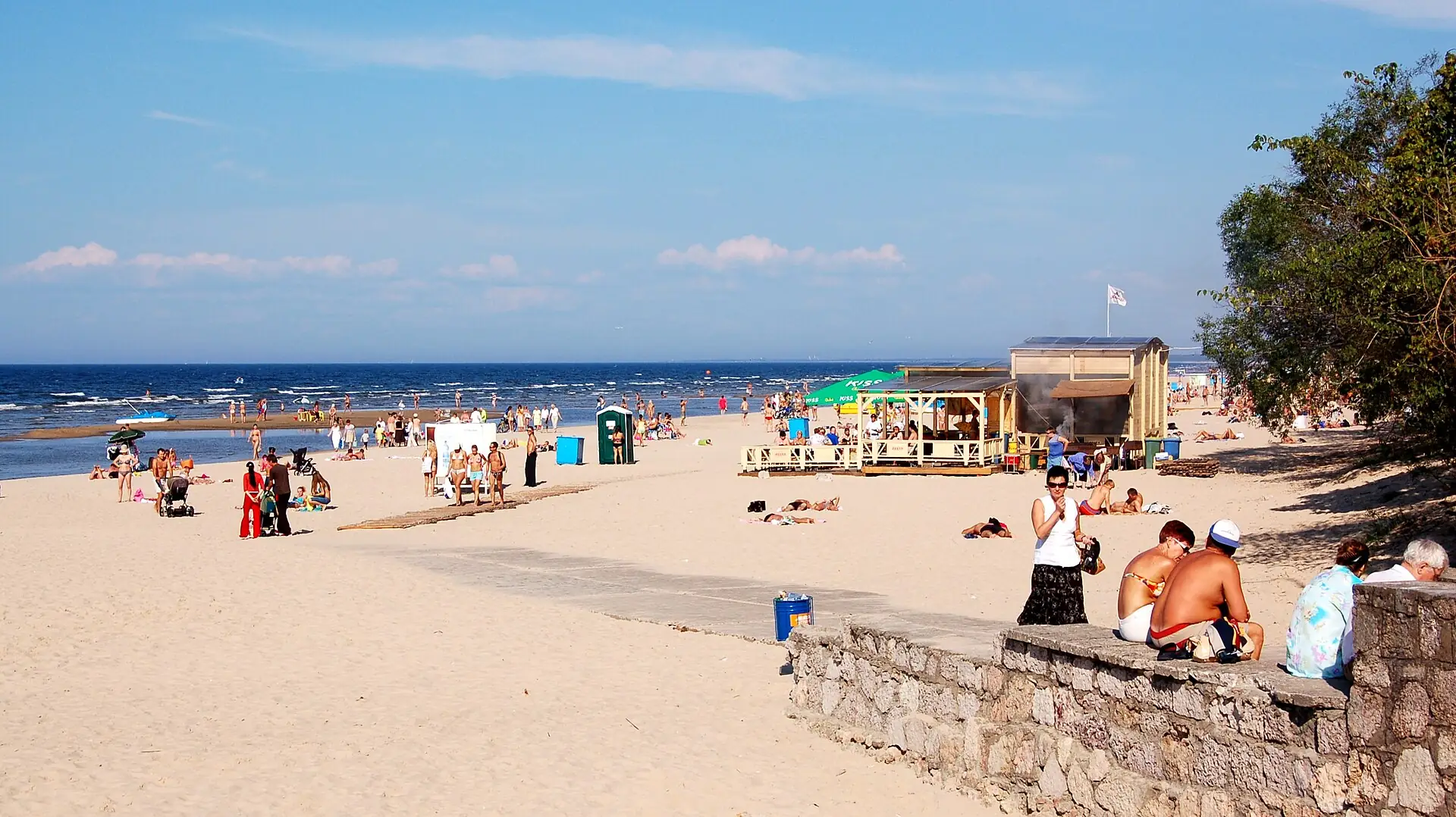
Then there is the part nobody mentions when they describe Riga as a city break. A short suburban train ride — around twenty-five minutes — puts you at Majori, in the middle of Jūrmala, which is twenty-five kilometres of white sand with pine forest immediately behind it.
Permanent building is not allowed on the beach itself, so the sand runs clean and open with seasonal cafés on it in summer and nothing at all the rest of the year. The streets behind hold hundreds of ornate wooden summer villas from the resort’s grand era, some immaculate, some peeling, all worth a wander — the concentration around Majori and Dzintari is the best of it. Get off the train, walk ten minutes through the pines, and the Baltic is in front of you: shallow, cold-ish, extremely flat. Bare feet, warm sand, that particular smell of hot pine needles. Come back on the evening train with sand in your shoes.
When to come
June is the reason to plan ahead. Around the solstice — 21 June this year — the sun goes down close to midnight and the sky never gets properly dark before it comes back up in the small hours. If you have only ever had summer evenings that end, it is genuinely disorientating in the best way.
Which brings you to Jāņi, on 23 and 24 June, both public holidays and the biggest thing in the Latvian year. Women wear flower crowns, men wear oak leaves, bonfires burn all night, there is caraway cheese and beer and a great deal of singing, and everyone stays up to meet the sunrise. The catch for a visitor is that Latvians celebrate it in the countryside, so the city itself thins out and a lot of things close. Do not fight that — either join a public celebration in one of the parks, or, better, take up any invitation you are offered to go out of town, which is where the real thing happens.
December is the other case for coming. The Christmas market fills Cathedral Square, and Riga will tell you — with a plaque set into the cobbles of Town Hall Square, in eight languages — that the world’s first decorated Christmas tree stood here in 1510, put up by the same Brotherhood of Blackheads. Tallinn claims 1441 and has never conceded an inch, and historians point out that the Riga record may describe something closer to a tree-shaped wooden candelabrum hung with dried flowers and fruit. Both cities enjoy the argument enormously and neither is going to stop. Buy the mulled wine and take a side.
If you want the straightforward answer: May and June, or September. Long light, warm-enough sea, everything open, and the facades at their best in low sun.
On entry: Latvia is in the Schengen area, so US and UK passport holders visit without a visa for up to 90 days in any 180, with passports now recorded in the EU’s biometric Entry/Exit System rather than stamped — check current requirements before you book. Our guide to the airBaltic hub fifteen minutes out covers getting here.
Evening on Alberta iela
Come back to that street at the end of the day, when the sun is low enough to come straight down it. The facades turn the colour of honey, and every one of those carved faces picks up a shadow it does not have at noon — the calm ones look thoughtful, the shouting ones look worse.
These buildings were put up fast, at enormous expense, by people who had made a great deal of money in a hurry and assumed the good times would keep going. The good times did not. The buildings did. A whole city still dressed for a party that ended a century ago, and quite happy to have you at it.
FAQ
Is Riga worth visiting?
Yes, and for more than the weekend-break reputation it has been carrying around. In one compact city you get the largest concentration of Art Nouveau architecture in Europe, a medieval old town you can cross in twenty minutes, a food market built inside airship hangars, whole districts of restored wooden houses, and a white-sand beach twenty-five minutes away by suburban train. Three days is comfortable; two is enough if you are decisive.
Why is Riga famous for Art Nouveau?
Because the city got rich exactly when the style was fashionable. Riga’s population grew by around 88 per cent between 1897 and 1913, building rules opened up the land around the old town, and between 1910 and 1913 the city was putting up three to five hundred buildings a year — most of them in Jugendstil. Around a third of the buildings in the centre are in the style today. UNESCO’s description of the site says Riga has “the finest collection of art nouveau buildings in Europe”, and the listing decision calls the quality and quantity “unparalleled anywhere in the world”. Start on Alberta iela and look above the first floor.
What is the Central Market in Riga?
The city’s main food market, and one of the largest in Europe — five big pavilions built between 1924 and 1930 using the arched metal frames of two former airship hangars, bought from an airfield at Vaiņode and reassembled here. The halls are dairy, meat, fish, vegetables and gastronomy. It is a working market rather than a museum piece: come in the morning for smoked fish, dark rye bread, curd cheese and whatever berries are in season.
When is the best time to visit Riga?
May and June, or September. June is the spectacular one — around the solstice the light barely leaves, and the Jāņi holidays on 23 and 24 June are the country’s great midsummer festival, though Latvians keep it in the countryside and the city goes quiet for it. December brings the Christmas market on Cathedral Square. Deep winter is short on daylight and long on café afternoons, which is a fair trade if you like a city quiet.
Photos: Dan RaizPhoto (CC BY-SA 4.0), Jean-Pierre Dalbéra (CC BY 2.0), Hans A. Rosbach (CC BY-SA 3.0), Jorge Láscar (CC BY 2.0), Bahnfrend (CC BY-SA 4.0), via Wikimedia Commons.


