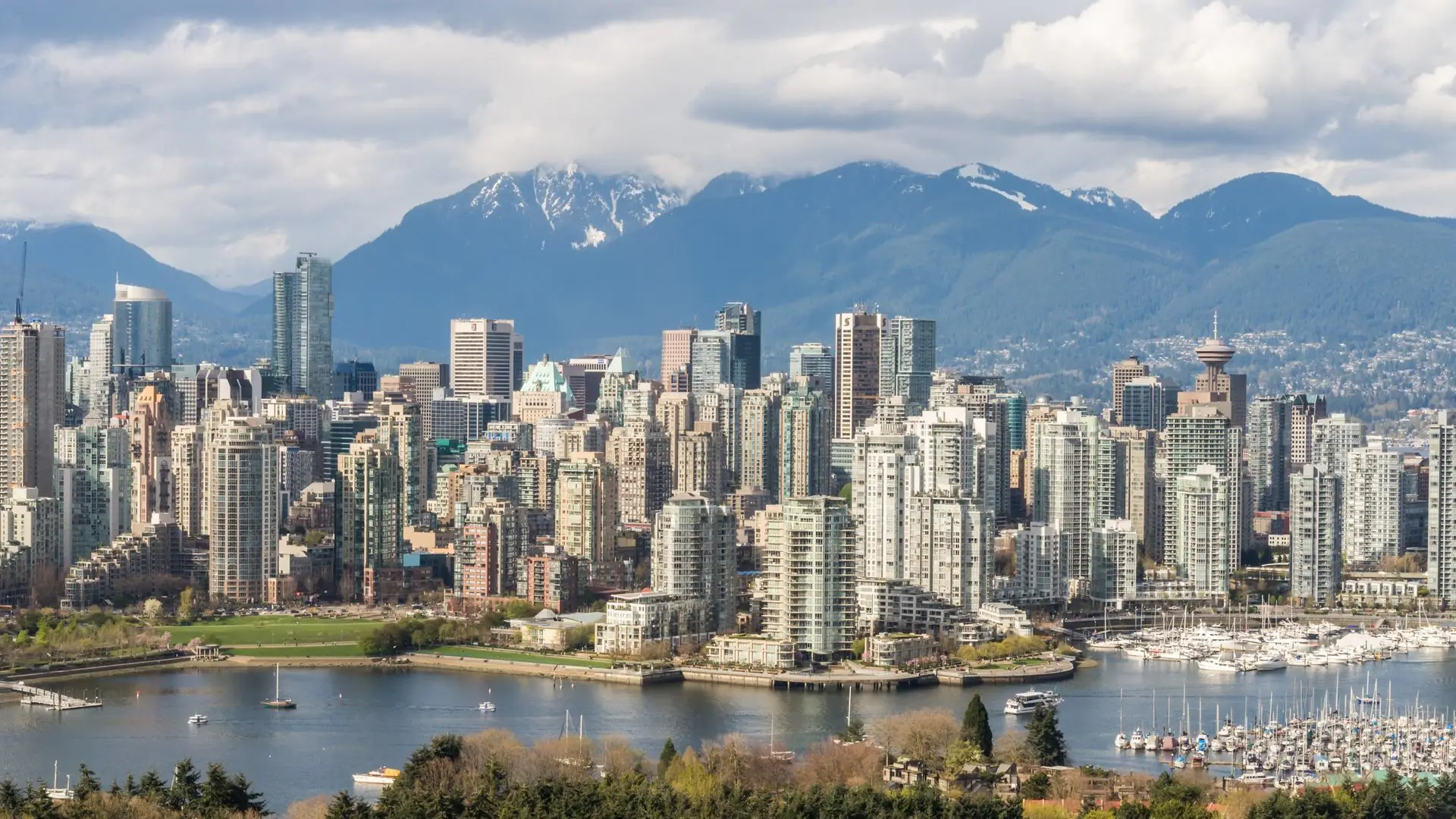

That is the shape of this piece. Vancouver is the destination in this series most readers think they already know: the mountains behind the towers, the water on three sides, the reputation for rain. Fine. Assume all of that. The things that actually change what you book are the paperwork, the ground transport and the calendar — and every one of them has a detail in it that the guidebooks get wrong or leave out. Here they are, checked this week.
The train is inside the terminal, and the surcharge only runs one way
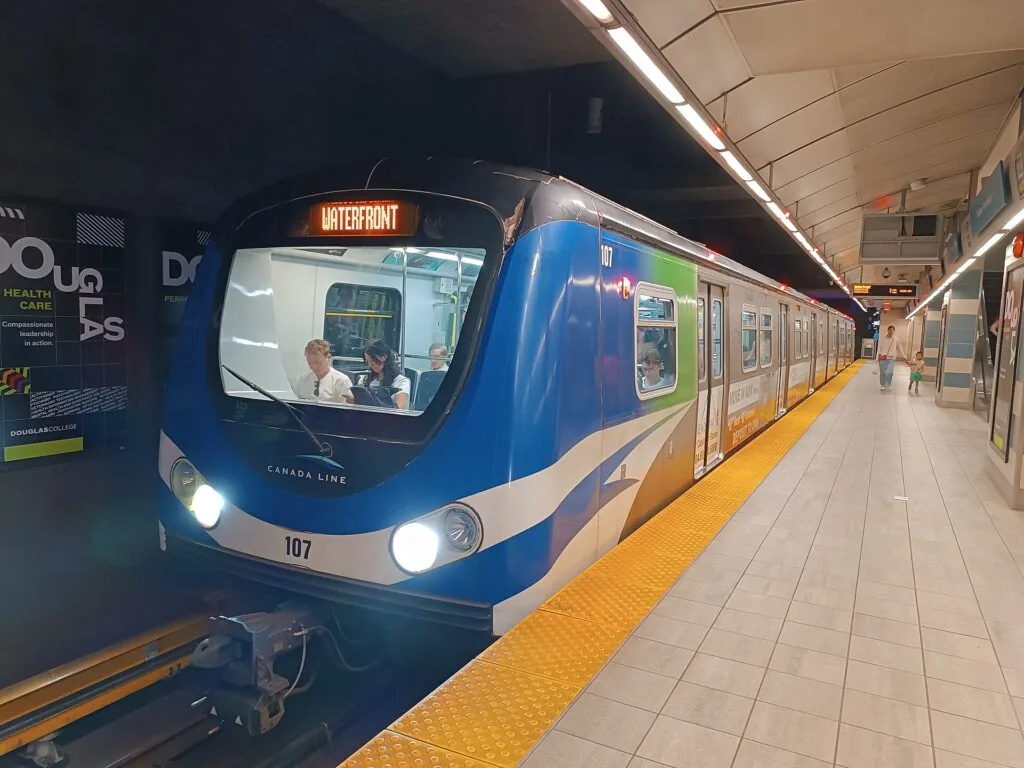
The Canada Line connects YVR Airport station to Waterfront station downtown in roughly 26 minutes. TransLink runs it at least seven times an hour, which works out at a train every six to seven minutes through the day and around every twenty minutes late at night. The first departure from the airport is a little after five in the morning, and the last leaves just before one. Every train from YVR Airport station goes downtown, so there is no wrong platform to stand on — a genuinely rare thing in an airport rail link.
Now the catch, and it is worth reading twice because it is the reverse of what people assume. TransLink’s own fares page states that the AddFare “is charged on eastbound trips that start at YVR Airport, Sea Island Centre, or Templeton” and travel to any station from Bridgeport onwards. Then the sentence that saves you money: “There is no YVR Airport AddFare for journeys to the airport.” The supplement is a departure-from-the-island charge, not an airport charge. Going out to catch your flight, you pay a normal fare like anyone else on the network.
It applies to single-use tickets and DayPasses bought at those three Sea Island stations, to Compass stored value and to tap-to-pay with a contactless bank card. The documented ways around it are the interesting part, and they are all official:
- Monthly Pass holders are exempt outright.
- A ticket or DayPass bought anywhere off Sea Island is exempt — so if you are coming back out to the airport and looping through again later, the purchase location is what matters.
- Travel entirely within Sea Island is exempt, which covers hotel-to-terminal hops.
- Residents of Burkeville, the small neighborhood on the island itself, are exempt.
One live warning about published figures. The AddFare rose on 1 July 2026, the first increase since 2010, and at the time of writing the airport’s own web pages were still quoting the previous figure. This is exactly the pattern that has bitten me on other files: the rule changes at the operator, and everybody downstream keeps publishing the corpse. Read the number off the machine at the station or off TransLink’s page, not off a guide — including this one, which is why there is no number in it.
Luggage: there is no formal restriction on the Canada Line. TransLink’s guidance is that there is room for skis, snowboards and golf clubs, which tells you more about local priorities than any tourist board could. Practically, avoid the two commuter peaks with a full trolley if you can, but nobody is going to stop you boarding with a hold bag.
The eTA: the rule British passports get wrong
British citizens flying to Canada need an Electronic Travel Authorisation. It is not a visa and it is not complicated, but it is a document you must hold before you board, and gov.uk states it plainly for air arrivals. Americans do not need one: US citizens are exempt, and US lawful permanent residents have been exempt since 26 April 2022, though they need to travel with proof of that status.
Three details do the actual work here.
Apply before you book, not before you fly. The Canadian government’s own guidance is to get the authorization before you buy the ticket. Most approvals land in minutes; a minority get referred for extra checks and take longer, and the referral is the scenario that ruins a short-notice trip. An approved eTA is valid for up to five years or until your passport expires, whichever comes first — so check the expiry on the passport you are actually traveling with, because the authorization is tied to that document and not to you.
Transit counts. gov.uk is explicit: “If you are travelling through Canada (transiting) by air, you must have an eTA or a transit visa.” If your cheap routing to somewhere else changes planes in Vancouver, Toronto or Calgary, you are inside the rule even though you never leave the airport. That single sentence catches more people than the tourist case does.
Buy it from the government, and only from the government. gov.uk warns that “Some unauthorised websites charge for submitting visa applications. These websites are not associated with the Canadian government.” This is the same mechanism I flagged on the Colombian arrival form last week: a lookalike domain, a professional-looking form, a handling fee for something you can do yourself on the official portal. The official route is the Canadian government’s own eTA page under canada.ca. If a site is charging you a service fee on top, you are on the wrong site. Sponsored search results are where these live, so type the address rather than clicking the first thing that appears.
Other passports vary: some nationalities need the eTA, some need a full visitor visa, and the split is set by nationality rather than by route. If you hold anything other than a British, Irish or US passport, check the Canadian government’s own tool before you assume which category you are in.
Who actually flies to Vancouver
This is a big board, and the completeness is the point. Vancouver is a hub for two Canadian carriers and the North American gateway of choice for a long list of Asian ones. This publishes in August, for people flying in autumn and winter, so I have flagged what stops.
From the UK
Air Canada and British Airways both fly London to Vancouver nonstop, and Air Canada treats YVR as a main hub, so the frequency and the connecting options behind it are theirs. British Airways’ Heathrow service is year-round. There is a discrepancy I could not resolve cleanly on the Gatwick side: one schedule source marks a Gatwick rotation as seasonal, while the airline’s own route information reads as though both London airports are served. I am flagging that rather than guessing — if Gatwick is the one that suits you, check it on the airline’s site before you build a trip around it. WestJet and Air Transat both operate the transatlantic market to Western Canada, and Air Transat’s UK flying in particular is heavily seasonal. Lufthansa via Frankfurt, Air France via Paris, KLM via Amsterdam, Turkish via Istanbul and Icelandair via Reykjavík all give you one-stop options that are frequently cheaper than the nonstop and cost you the better part of a day.
From the United States
All three US majors serve Vancouver — American, Delta and United — and so do JetBlue and Sun Country. The carrier that matters most for the west coast is Alaska Airlines, which runs the Seattle, Portland and California shuttles at a frequency the others cannot match, and which is the practical answer for anyone connecting from a smaller US city. Canadian domestic and near-international flying adds Flair, Porter, Air North out of the Yukon and Pacific Coastal for the British Columbia coast. Aeroméxico covers Mexico City.
From Asia and the Pacific — Vancouver’s real distinction
No other city on the west coast of North America has this range. Cathay Pacific from Hong Kong, Japan Airlines and All Nippon Airways from Tokyo, Korean Air from Seoul, EVA Air and China Airlines from Taipei, T’way and Zipair as the low-cost entries, Philippine Airlines from Manila, and a full slate of mainland Chinese carriers — Air China, China Eastern, China Southern, Hainan, Sichuan, XiamenAir and Hong Kong Airlines. Qantas and Air New Zealand connect the South Pacific, Fiji Airways runs the island routing, and Air India links the subcontinent directly, which is a bigger deal in Vancouver than in most North American cities.
What will have stopped by the time you fly
Seasonality is the single most common way a Vancouver fare search misleads you in autumn. Search a date in October and you will see a route; search the same route in January and it does not exist, because it was never meant to.
- Condor from Frankfurt — a seasonal leisure route, not a winter option.
- Edelweiss from Zurich — same pattern, and the obvious Swiss-market answer only for part of the year.
- All Nippon Airways from Tokyo Narita — flagged as seasonal in the schedules I could check, which matters if you were planning a Japan open-jaw over the winter.
- Air Transat’s UK and European flying — a summer-weighted program throughout.
- The British Airways Gatwick question above — unresolved, and seasonal if that source is right.
The year-round spine you can plan around is Air Canada, WestJet, British Airways from Heathrow, the US majors, Alaska, and the major Asian carriers. Everything else deserves a check on the operating airline’s own site before it goes into your plan.
The Seattle question, answered honestly
Seattle-Tacoma is roughly 230 km south of Vancouver, and it is sometimes materially cheaper, especially on transatlantic and transpacific fares. So readers ask the obvious question: fly into Seattle and cross the border overland? The honest answer is that it is a real option that has just improved, and it still is not free.
The improvement is genuinely significant and it is new. As of 2026, Amtrak Cascades has US preclearance at Vancouver’s Pacific Central Station — the first rail preclearance operation in North America. Passengers on US-bound trains clear American immigration in Vancouver before departure rather than stopping at the border, and Washington State’s transport department puts the saving at around ten minutes and, more usefully, removes an unpredictable stop. The Vancouver–Seattle rail journey now runs at about four hours, with four trains a day.
Read that carefully, though, because preclearance applies to the southbound leg. Arriving from Seattle into Canada, you clear Canadian entry the normal way. Buses — Quick Shuttle, Amtrak Thruway coaches, FlixBus, Greyhound — average a little over four hours, with the quickest scheduled runs closer to two and a quarter when the border behaves. And the detail that undoes the whole plan for a lot of people: there is no direct bus from the Seattle airport itself. You land at SeaTac, get yourself into downtown Seattle, then start the four-hour leg. Add a border queue that varies from minutes to a substantial chunk of an afternoon depending on the day and the holiday calendar, and a bag you have to keep hold of throughout.
The verdict: worth doing when the fare difference is large and you are traveling light, on a weekday, with a flexible afternoon. Not worth doing to save a modest amount on a short trip, and firmly not worth doing if the Seattle flight lands late, because the last useful northbound departure will beat you to it. Also remember that a land crossing has its own entry requirements — the eTA is an air-arrival document, and if you enter Canada by land or sea the paperwork you need is different, so check your own status rather than assuming the two are interchangeable.
Bellingham, the small Washington airport an hour south of the border, is still alive as a budget play but it is quieter than its reputation. Two airlines serve it — Alaska Airlines and Allegiant — reaching fourteen airports as of June 2026, and Allegiant has been trimming: Oakland went in May 2026 and Los Angeles has gone too. Allegiant announced it will close its Bellingham crew base in November 2026 while confirming it “will continue operating all existing routes and maintaining its current flight schedule at BLI.” The port authority attributed the decision partly to changes in cross-border demand among Canadian passengers. Translation for you: the airport works, the route list is short and shrinking, and Allegiant treats routes as seasonal by design. Check its live route map rather than a list of what used to fly.
Most Vancouver trips are two trips
The onward map is why people overbuild Vancouver itineraries, so here is what is actually usable.
Victoria and the islands. Vancouver has a second airport in the middle of downtown: CXH, the harbour airport, a set of docks and a terminal on Coal Harbour. Harbour Air operates up to 200 flights a day from the region to fifteen destinations, which is a scheduled transport system rather than a sightseeing product. You walk from a downtown hotel to a floatplane and land in the middle of Victoria. For a short trip it beats the ferry comfortably on time, and it is the single most enjoyable domestic hop in the country. Seasonality applies here too: the Vancouver–Whistler floatplane runs 15 May to 30 September, Tofino and Comox run into late October, and some coastal services are summer-only, with the winter Victoria link switching to wheeled aircraft from the airport’s south terminal.
Whistler. There is no airport. It is a road transfer, about two hours up the Sea to Sky Highway, on a scheduled coach or a private car, and it is one of the more scenic drives you will take to reach a ski resort. Budget the time properly at both ends of the trip, particularly on a same-day departure in winter.
The Rockies. The standard move is an open jaw: into Vancouver, out of Calgary, or the reverse, with the mountains driven in between. Both are served nonstop from the UK and both are Air Canada and WestJet points, so the fare construction usually works without a penalty. It converts a long backtrack into a straight line.
Alaska cruises. Vancouver is a major turnaround port and the terminal is Canada Place, in the downtown core a few minutes’ walk from the harbour airport. The 2026 season is a record one — close to 360 ship calls and more than 1.4 million passengers — with the main schedule reported as running from the start of May into the first half of October, after an isolated repositioning call back in February. I will not state the season’s exact end date: the port authority’s own page was unreachable when I checked, and the two trade reports I could read give slightly different last-ship dates. Treat the window as roughly May to early October and verify against the port’s own calendar. The reason this matters even if you are not cruising: on peak weekends the city absorbs tens of thousands of extra passengers, and hotel prices downtown behave accordingly.
The honest calendar
Summer is peak and priced like it. The value window is narrower than the usual advice suggests, and the numbers are clear about where it sits.
September is the month. Highs around 19°C, roughly 53 mm of rain spread over about nine wet days, school holidays finished, and the light on the North Shore at its best. October is where the honest version diverges from the brochure: rainfall close to doubles and daytime highs slide from the mid-teens at the start of the month to around 12°C by the end. October is a fair gamble rather than a reliable one. If you want a single recommendation, it is the first three weeks of September, with the last week of August as the expensive-but-certain alternative — August has the fewest rainy days of the year, while July is the driest by total rainfall.
Winter deserves better framing than it gets. November is the wettest month and the sea-level city is mild, dark and damp — no argument. But the thing that makes Vancouver unusual is what that same weather is doing two thousand feet up. Grouse Mountain and Cypress are inside the city’s own transit and taxi geography, not a day trip: you can be on a chairlift within an hour of a downtown hotel, ski under lights into the evening, and be back for dinner. Opening dates move with the snow and the variation is real — Grouse and Cypress opened in the third week of December for the 2025/26 season, and in the fourth week of November the year before. Grouse typically runs to late April or early May. No other major city offers a lift-served ski afternoon on a weekday and a seafood dinner at sea level the same night, and 2026 is Grouse Mountain’s centennial year.
Which is the argument for a winter city break here rather than against one. The rain is a sea-level phenomenon. Take the elevation and it becomes the reason you came.
Money and time
Canadian dollars. Cards work everywhere and contactless is universal, including on the Canada Line, so you can arrive with nothing in your pocket and be fine.
Two conventions surprise British visitors, and both are about the gap between the price you see and the price you pay. First, sales tax is added at the till: British Columbia stacks a 5% federal goods and services tax and a 7% provincial sales tax, both calculated on the pre-tax price, so the shelf label is never the total. Second, tipping is expected in restaurants and bars at somewhere in the mid-to-high teens as a percentage, and card terminals routinely present their suggested options calculated on the post-tax figure rather than the pre-tax one. Nobody is doing anything improper; it is simply a different default from the UK. Read the screen before you tap, and pick the percentage yourself.
Time: Vancouver is on Pacific Time, UTC−8 in winter and UTC−7 on daylight saving. The connection-planning note is the mismatch. Canada and the US switch on the second Sunday in March and the first Sunday in November; the UK switches on the last Sunday in March and the last Sunday in October. In 2026 that means daylight saving began in Vancouver on 8 March and ends on 1 November. For a couple of weeks in March and again at the end of October, the offset between London and Vancouver is one hour different from the eight you are expecting. If you are booking a connection, calling home, or joining a work call from the coast in those windows, check the actual local times rather than doing the arithmetic from memory.
The short version
Get the eTA before you buy the ticket if you hold a British passport, and check it against the passport’s expiry date. Take the train from inside the terminal, and know that the surcharge is charged leaving the island, not arriving at it. Book September if you can and December if you want the mountain. Treat the Seattle routing as a real option on a light bag and a weekday, and as a false economy otherwise. Then read our guide to the city with a rainforest at the end of the bus route, because the flight is the easy part here — the rest of it is the trip.
FAQ
How do I get from Vancouver airport to downtown?
Take the Canada Line from YVR Airport station, which is attached to the terminal by a covered walkway. It reaches Waterfront station downtown in about 26 minutes, runs at least seven times an hour, and every train from the airport goes downtown. A supplement called the YVR AddFare applies to tickets bought at the airport for journeys off the island; there is no equivalent charge on journeys to the airport, and Monthly Pass holders and anyone using a ticket bought elsewhere are exempt. There is no formal luggage restriction on the line.
Do UK or US citizens need a visa for Canada?
Neither needs a visitor visa for tourism, but British citizens flying to Canada need an Electronic Travel Authorisation, and US citizens do not. Apply for the eTA on the Canadian government’s own site before you book, not before you fly — most approvals are quick but some are referred for further checks. It stays valid for up to five years or until your passport expires, whichever comes first. The rule also covers air transit: changing planes in Canada on the way somewhere else still requires an eTA or a transit visa. Avoid third-party sites that charge a fee to submit the application for you.
Are there direct flights to Vancouver from the UK?
Yes. Air Canada and British Airways both fly London to Vancouver nonstop year-round from Heathrow, with Air Canada using Vancouver as a hub. WestJet and Air Transat also operate the transatlantic market to Western Canada, with Air Transat’s program weighted toward summer. Whether a Gatwick service runs year-round is the one point I could not confirm cleanly, so check the airline’s own site if Gatwick is the airport you need. One-stop options through Frankfurt, Paris, Amsterdam, Istanbul and Reykjavík are frequently cheaper than the nonstop.
When is the cheapest time to fly to Vancouver?
Fares and hotel rates fall away after the summer and after the cruise season, which runs roughly from May into early October. September gives the best combination of price and weather — about 19°C and nine wet days on average. October is cheaper again but rainfall roughly doubles and temperatures drop through the month. Winter is the lowest season at sea level and is mild rather than cold, and it is also when the local mountains are open, which makes it better value than its reputation suggests.
Photos: Ueutyi (CC BY-SA 4.0), Sikander Iqbal (CC BY-SA 4.0), Kyah117 (CC BY 4.0), via Wikimedia Commons.


