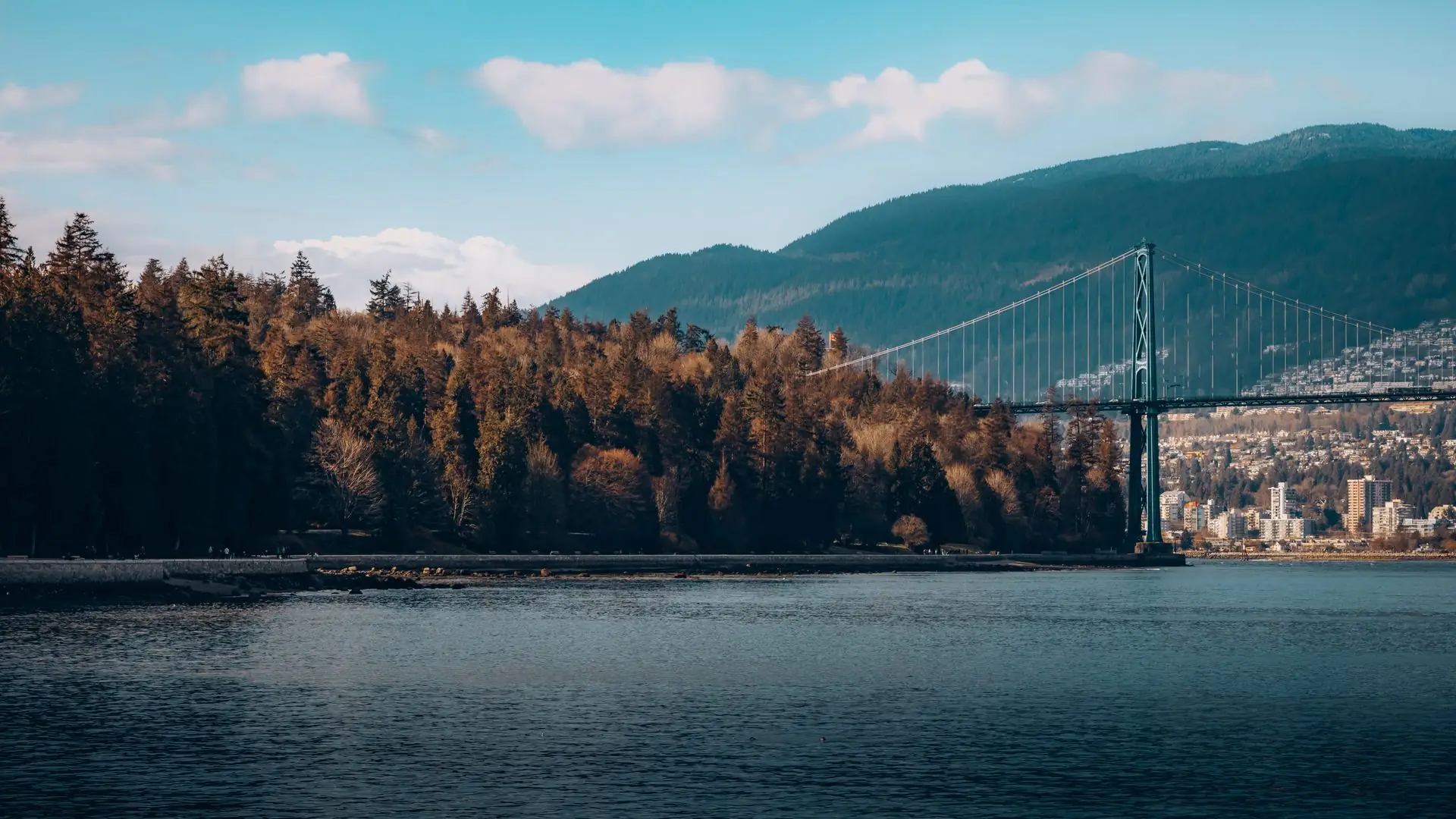

That is Stanley Park, and the fact that it exists — a thousand acres of forest inside the peninsula that holds the business district — is the fact that explains this city.
The line around the forest
The park runs to about 405 hectares, a shade over a thousand acres, which makes it roughly a fifth larger than Central Park. It was set aside in 1888, when the city was two years old and had every commercial reason to log it, and what makes it unusual among great urban parks is that it was largely not designed. Central Park is a made landscape. Stanley Park is mostly second-growth coastal rainforest with a road round the outside: cedar, hemlock and Douglas fir, trails that are properly dark at midday, herons nesting in the trees near the tennis courts, and raccoons with the confidence of animals that have never been hunted.
Round the water’s edge runs the seawall, about 8.8 kilometres for the park loop, and that loop is one section of a continuous waterfront path that the city bills as the longest uninterrupted one in the world. Sources differ by kilometres on the total length, which tells you the claim is a boast rather than a measurement, so take the boast and enjoy the path. It is the single best thing you can do here with an afternoon: flat, car-free, busy with cyclists and joggers and people pushing prams, with container ships at anchor on one side and forest on the other.
One more thing about this ground, and it belongs at the front rather than in a footnote. Vancouver sits on the unceded shared territories of the xʷməθkʷəy̓əm (Musqueam), Sḵwx̱wú7mesh Úxwumixw (Squamish) and səlilwətaɬ (Tsleil-Waututh) Nations — unceded meaning never signed away — and the Nations say so themselves, in exactly those names, in their own joint welcomes to visitors. It is a live fact about the city you are standing in, not a historical note.
The thesis of Vancouver is here: a city that drew a line around what was already on the ground and built up to the edge of it. Everything else follows.

The poles at Brockton Point, honestly
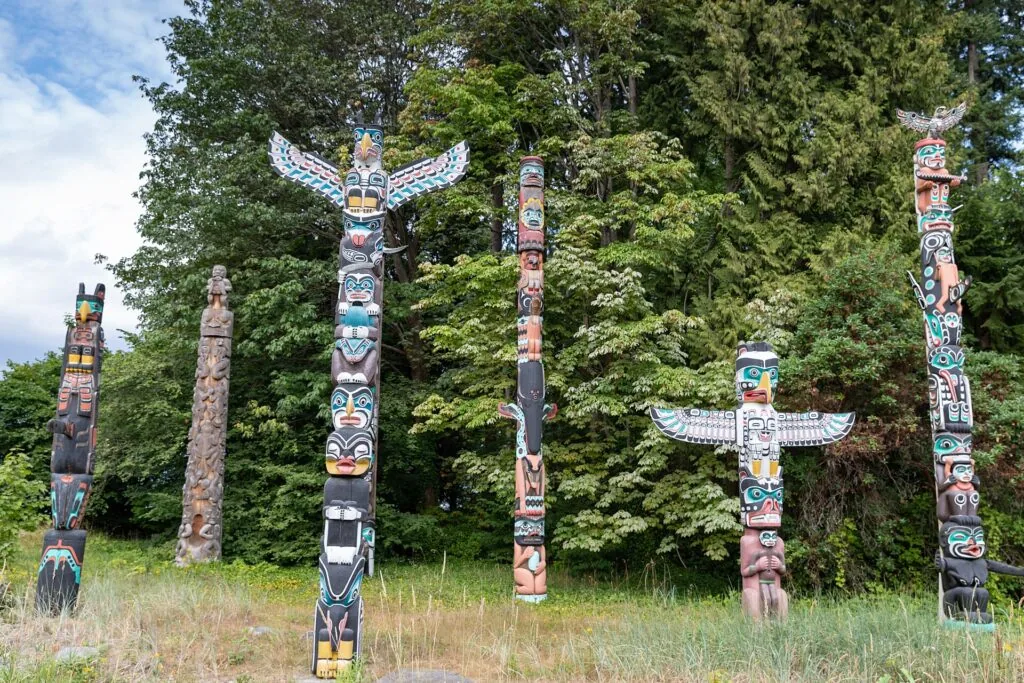
Eight carved poles stand at Brockton Point on the park’s eastern shore — the City of Vancouver’s own parks pages still say nine, for a reason that will become clear in a moment — and those pages call them the most visited attraction in British Columbia. They are also the thing most visitors get wrong, and the true version is more interesting.
They are not ancient monuments standing where they were raised. The collection was assembled by the city from the 1920s onward, with poles bought from Alert Bay and later from Haida Gwaii and Rivers Inlet and brought here — so the carving traditions on display come from peoples further up the coast, on land that is Coast Salish. Then, by the late 1980s, the original cedar was weathering badly; the historic poles were moved into museum collections for preservation and the Park Board commissioned replacements. The Chief Wakas pole you photograph is a replica carved by the ʼNamgis artist Doug Cranmer in 1987. The Skedans mortuary pole is a replica; its original went home to Haida Gwaii. Kakasoʼlas, carved by the Kwakwakaʼwakw artist Ellen Neel — a pioneer of modern Northwest Coast carving and one of very few women working in the form in her generation — stood here from 1985 until 2024, when it was returned to the museum collection that owned it.
So what you are looking at is a contemporary art collection with a complicated provenance, which is a better story than a row of antiquities. And the newest pole is the one to walk to first: the Rose Cole Yelton Memorial Pole, raised in 2009, carved by Robert Yelton of the Squamish Nation in memory of his mother, who was the last surviving member of the community that lived at Brockton Point. It is the only pole here made by an artist from this territory.
Then go and see the living scene, because it is one of the strongest in the world. The Museum of Anthropology at the university reopened on 13 June 2024 after its Great Hall — Arthur Erickson’s glass-and-concrete masterpiece from 1976 — was taken down and rebuilt as a seismic replica sitting on base isolators, engineering that most visitors will never notice and should. Bill Reid’s The Raven and the First Men, the Haida creation sculpture carved from laminated yellow cedar over two years, is in its own rotunda there. Downtown, the Bill Reid Gallery of Northwest Coast Art shows his work alongside contemporary carvers, weavers and printmakers who are very much working now.
Granville Island, which is not an island
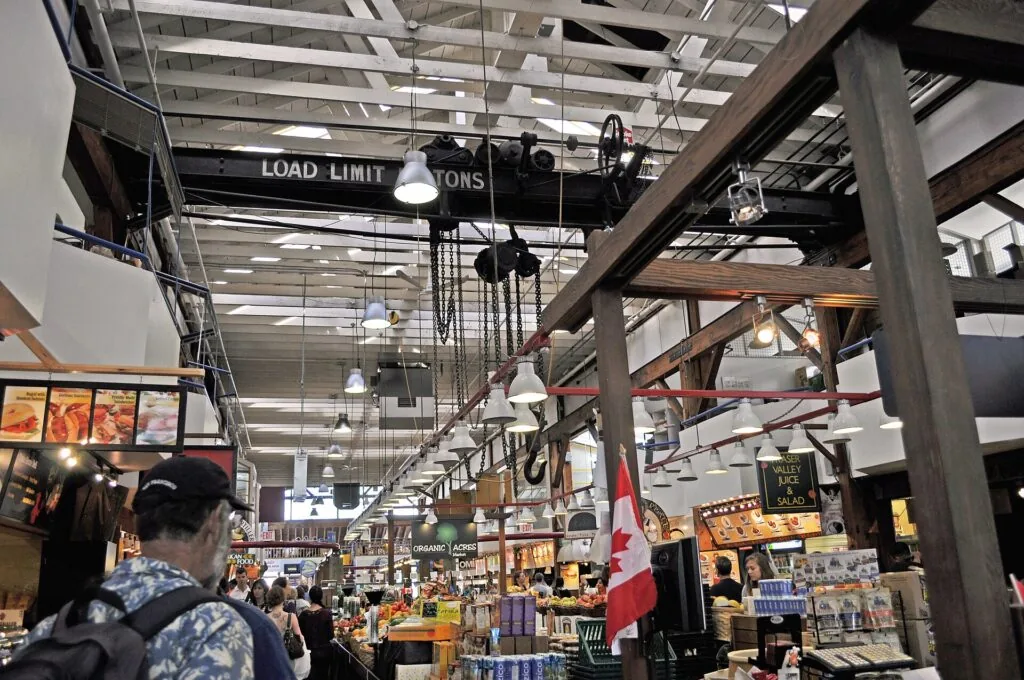
It is a peninsula, and it is man-made: a sandbar built up with dredged fill from False Creek in 1915 and named Industrial Island, filled with sawmills, foundries and shipyards, and left largely derelict by the 1960s. Rather than clear it, the federal housing agency turned it over to a public market, artists’ studios and theatres, keeping the sheds, the rail tracks, the cranes and the corrugated siding. The market opened on 12 July 1979 with twenty-one tenants and was half empty.
It is not half empty now. Go for the produce hall — the stone fruit in August is worth a detour on its own — the doughnut queue, the cheese counters, the smoked salmon, and the fact that you walk past a working concrete plant to reach a glassblower’s studio. Arrive on one of the little passenger ferries that scuttle across False Creek: they are small, round, sit about a dozen people, and the ride is about four minutes of feeling like you are in a bathtub with an outboard. Do not take a taxi. The boat is the point.
The food, which is the surprise
Be precise about the famous claim, because it belongs partly to somebody else. The formulas you will have read — the New York Times calling it the best place for Chinese food outside Hong Kong, the Seattle Times calling it the source of the best dim sum in North America — are about Richmond, the municipality immediately south, where something like four hundred Chinese restaurants operate and roughly half the population is of Chinese descent. Vancouver proper eats very well indeed and its Cantonese and Sichuan kitchens are serious; the record-breaking version is next door. Both facts are worth knowing before you book a table.
The Japanese layer is the city’s own. Hidekazu Tojo arrived from Osaka in 1971 to a city that was not ready for raw fish, and reworked the form to suit it — turning rolls inside out to hide the seaweed, and inventing, among a great deal else, the BC roll: barbecued salmon skin with cucumber, made because good unagi was hard to get here. He also named a roll after the Californians who kept ordering it. The result is a city where a neighbourhood sushi counter is held to a standard that would embarrass most capitals.
Then the water. Learn the salmon by name, because the menus assume you have: sockeye is the deep red one with the strongest flavour, spring — chinook — is the fat, rich one, coho is lighter, and the difference is not marketing. If you can come in the second half of May or the first part of June, come then: the spot prawn season runs about six weeks, the prawns are sold live off the boats, and the city loses its mind about it in a way that is very endearing. Nanaimo bars — chocolate, custard icing and a coconut-crumb base, no baking involved — are the sweet, and their origin is a genuinely unsettled question: the earliest known printed recipe appears in a 1952 hospital auxiliary cookbook from Nanaimo, the name shows up in print in 1953, and rival versions have been claimed for Alberta and elsewhere. Treat the origin as folklore and the bar as fact.
Three neighbourhoods
Gastown is the oldest street grid in the city, cobbled and lamplit and full of furniture showrooms, and its most photographed object is a joke that has been running for nearly fifty years. The steam clock looks Victorian. It was built in 1977 by the horologist Raymond Saunders with the metalworker Doug Smith, to cover a steam vent in the pavement that the city found unsightly; the hands are driven by an electric motor because steam turned out to be a poor timekeeper, and the whistles go off on the quarter hour to a crowd of people who believe they are watching something from the 1890s. Saunders died in 2024, having built something like a hundred and fifty clocks. The truth is funnier than the myth, and the clock is good company either way.
Chinatown is one of the oldest in North America and it has had a hard decade, which makes it more worth your custom rather than less. What is open and working: the Dr. Sun Yat-Sen Classical Chinese Garden, the first classical Chinese garden built outside China, opened in 1986 with craftsmen and materials from Suzhou, a National Historic Site since 2016 and marking its fortieth year in 2026 — a walled acre of rock, pine, water and covered walkway that is one of the most effective quiet rooms in any city I know. Alongside it, the Chinatown Storytelling Centre, which turned five in 2026 and opened a learning lab to mark it; the summer street festivals that fill Columbia Street; and bakeries, barbecue shops and herbalists that have been trading for generations. Go, eat, buy something.
Kitsilano is the beach cliché and the cliché is simply accurate. Wooden houses, a long sandy beach facing back at the downtown skyline with the mountains behind it, an enormous heated saltwater pool along the seafront, and a population that appears to own only technical outerwear. Come at seven in the evening in July, when half the city is on the sand watching the sun go down behind the peninsula, and try to be cynical about it.
The mountains are not an excursion
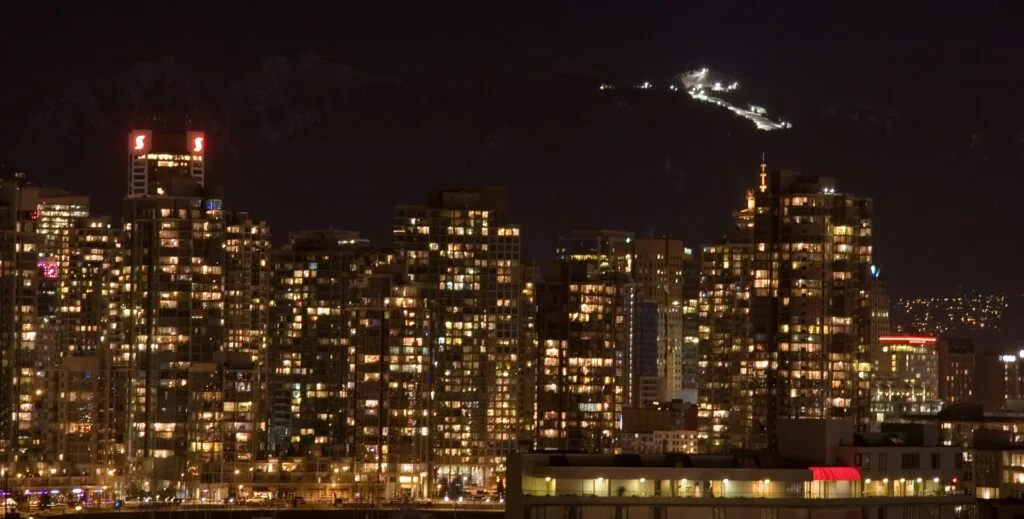
The North Shore mountains are visible from most of the city, which does something to how people here live: they are not a trip, they are the end of the street. The passenger ferry across the harbour — a squat, glass-sided thing that crosses in a few minutes — is an ordinary commuter service with one of the great short journeys in world transport, and if you ride it in both directions at dusk nobody will judge you.
Grouse and Cypress sit on the slope above, close enough that people ski after work; Cypress markets a spring season pass under the name Beach Pass, which is the local self-image in two words. On the same slope are the two suspension bridges, and the useful distinction is this: Capilano is a private attraction with a substantial admission charge, a longer, higher bridge and treetop walkways to match, and it is genuinely well done. Lynn Canyon is a public park with a bridge from 1912 hanging over a gorge with swimming pools below it, and it is free — you pay only for parking, and only between March and October. Lynn Canyon’s bridge closed in the autumn of 2025 while its east approach was rebuilt and reopened that December; some trail apps still carry the closure notice, which is worth ignoring.
When to come, and about the rain
Let’s deal with the reputation. Downtown Vancouver takes roughly 1,190 millimetres of rain across about 168 wet days a year, which places it around ninth among Canada’s rainiest cities — behind, among others, Halifax and St John’s. What makes the reputation is not the volume but the distribution: it is heavily concentrated between November and March, and it arrives as persistent grey drizzle rather than as storms. In November it rains on about seven days in ten. In July it rains on about two.
So: July and August are the driest months and the busiest. September is the window I would book — warm days, cool evenings, the water still swimmable if you are brave, and the summer crowds gone. October is the beautiful one and the wetter one: the maples turn, the light goes long and gold, the forest smells extraordinary, and you will need a coat. The film festival fills the end of September into October and is a serious one.
Winter is the rain, and the honest case for it is strong. It is mild — snow in the city is an event, not a season — the hotels are cheap, the mountains are twenty minutes up and in snow while the seawall is merely wet, and the rainforest is doing precisely what a rainforest does: everything is green, the moss is luminous, the creeks are loud, and Lynn Canyon in January with nobody in it is better than Lynn Canyon in July with everybody in it. Spring brings the cherry blossom, tens of thousands of trees across the city with a festival attached in April, and the Lunar New Year celebrations that are among the largest anywhere outside Asia.
On entry: most travellers need either an electronic travel authorisation or a visa to fly to Canada — our guide to the airport with the train inside it carries the detail. Check current requirements before you book.
Six o’clock on the seawall
End on the north side of the park, on the water, at the hour when the light gets low. The mountains across the inlet go from grey to rose. A container ship sits at anchor with its lights coming on. Cyclists go past in both directions and a heron stands in the shallows being unhelpful about it.
Behind you, thirty metres away and a hundred feet up, is a forest that was here first, still doing its job in the middle of a city of two and a half million people who decided not to cut it down. That decision is the whole place. Everything else is a good restaurant.
FAQ
Is Vancouver worth visiting?
Yes, and for more than the postcard. It has a thousand acres of temperate rainforest inside its downtown peninsula, a flat car-free waterfront path you can walk for hours, one of the world’s strongest Northwest Coast art scenes across the Museum of Anthropology and the Bill Reid Gallery, food that is far better and far less Canadian than expected, and mountains close enough to be part of an ordinary evening. Four days does the city comfortably; a week lets you add the North Shore and the islands.
What is there to do in Stanley Park?
Walk or cycle the seawall, which loops the park in about nine kilometres and is flat the whole way. Get off it into the interior trails, which are proper rainforest and far quieter than the shore. See the carved poles at Brockton Point — eight of them now, though most sources still say nine — with the honest context that most are replicas or recent commissions rather than antiquities in place. Swim at Second or Third Beach in summer, and eat somewhere with a view of the water. Half a day is the minimum; a full one is better.
Is it always raining in Vancouver?
No, and the reputation is a question of timing rather than volume. The city takes about 1,190 millimetres a year over roughly 168 wet days, which makes it around the ninth rainiest city in Canada rather than the first. The rain is concentrated between November and March, when it falls as persistent light grey drizzle; July and August are genuinely dry, and September is usually excellent. What the winter rain buys you is the reason to come at all — the rainforest, the moss, the green in February, and snow on the mountains twenty minutes above a city that has none.
When is the best time to visit Vancouver?
September, if you can choose freely: dry enough, warm enough, and without the July and August crowds. July and August are the driest and sunniest months and the busiest and priciest. October is gorgeous and noticeably wetter — autumn colour, long gold light, take a coat. Winter is mild, wet and cheap, and is the best value of the year if you like mountains and empty forests. April brings the cherry blossom, which is a genuine event here.
Photos: Guilhem Vellut (CC BY 2.0), Dietmar Rabich (CC BY-SA 4.0), dronepicr (CC BY 2.0), Joe Mabel (CC BY-SA 3.0), Kimon Berlin (CC BY-SA 2.0), via Wikimedia Commons.


