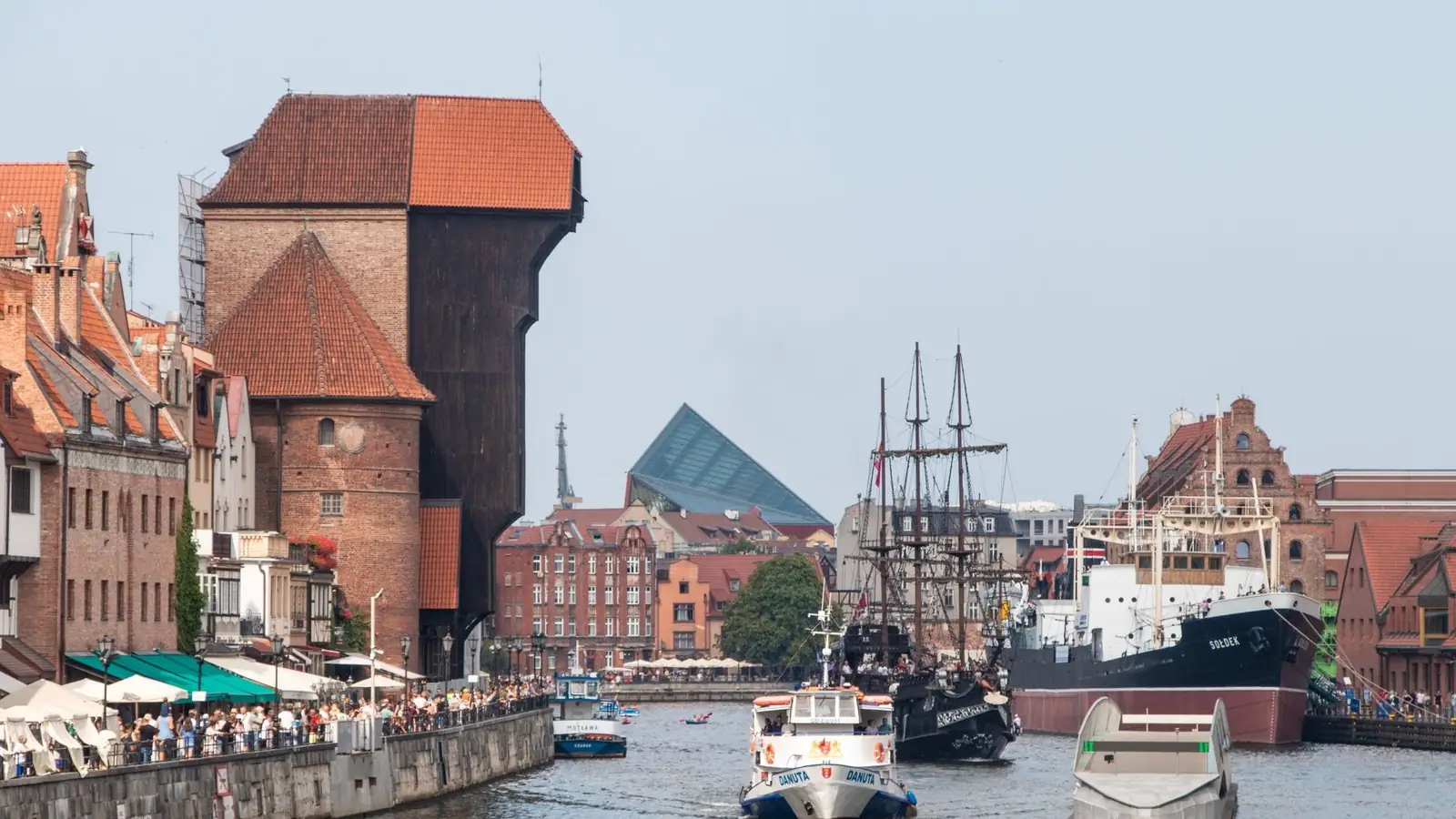

The Rebuilt Port
Gdańsk was largely destroyed in 1945, in the final months of the Second World War. The “medieval” core you walk through today is the result of a painstaking, decades-long post-war reconstruction. Crucially, the architects chose to rebuild the city to an idealised, historical “Polish” image rather than an exact facsimile of the German Danzig that had stood before the bombing. It is a brilliant, defiant piece of restoration — but knowing it is a reconstruction entirely changes how you read the city.

The wealth that funded the original city came from its status as a major Hanseatic port. That deep history is anchored by the colossal brick-Gothic bulk of St Mary’s Church and the heavy timber port Crane — the Żuraw — that once loaded cargo on the river. The city’s historic currency was amber, “Baltic gold,” still worked and sold along the raised terraces of Mariacka Street today.

A Ruptured Identity
Gdańsk carries a heavily contested identity. For long stretches of its history this was the German city of Danzig. Between the two world wars it existed as the semi-independent Free City of Danzig. After the border changes of 1945, its German population was expelled and the ruined city was resettled by Poles, many of them themselves displaced from territories lost to the Soviet Union. That rupture is central to what the city is: the continuity of the architecture masks a complete break in the population.
The Bookends of a Century
Gdańsk carries an immense historical weight, serving as the bookends for Europe’s twentieth century. It was here, on 1 September 1939, that the first shots of the Second World War were fired. You can visit the Westerplatte peninsula, where a tiny Polish garrison held out against a massive naval bombardment, and the Polish Post Office, where postal workers defended their building against SS units.
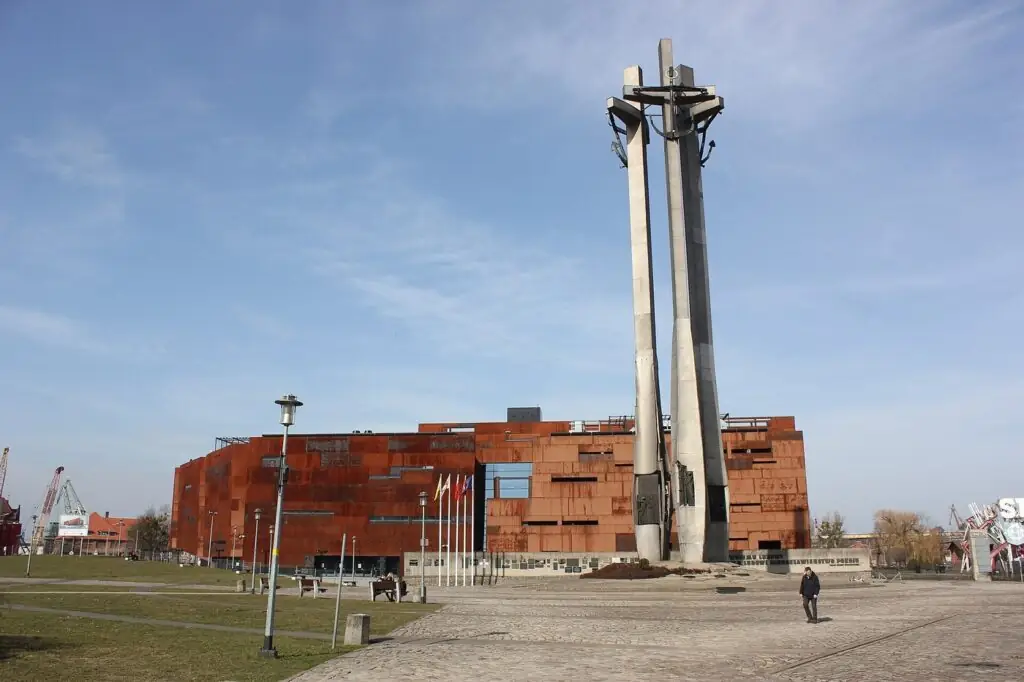
Four decades later, this was where communism began to crack. The working-class Gdańsk Shipyard (formerly the Lenin Shipyard) became the birthplace of the Solidarity movement in 1980. Led by Lech Wałęsa, the shipyard workers staged strikes that eventually helped bring down the Eastern Bloc. The towering cranes still stand, and the exceptional European Solidarity Centre sits right beside the historic shipyard gates to tell the story.
US, UK, and EU visitors currently get visa-free short stays in the Schengen area, though the EU’s ETIAS pre-authorisation system is being phased in. Entry rules change, so you must check current requirements before you book.
The best way to see the city is to look slightly past the polished centre. Walk to the end of the tourist quay along the Motława and keep looking downriver; past the restored galleons and the pleasure boats, the rusting cranes and heavy machinery of the still-working port keep swinging against the sky, as they have for centuries.
FAQ
How do I get from Gdańsk airport into the city?
Lech Wałęsa Airport (GDN) is roughly twelve kilometres from the centre. The most reliable route is the PKM/SKM commuter train, which connects the airport to the main railway station in about thirty minutes. Dedicated buses also run.
Is Gdańsk’s Old Town original or rebuilt?
It is almost entirely rebuilt. The historic centre was devastated in 1945 and systematically reconstructed over the post-war decades, often referencing older styles to create an idealised version of the city’s past.
What should I see in Gdańsk?
The immediate draws are the Długi Targ (Long Market), St Mary’s Church, and the waterfront Crane. But make time for Westerplatte, where the Second World War began, and the European Solidarity Centre at the historic shipyard.
When is the best time to visit?
Late spring (May to June) and early autumn (September) offer the best balance of clear weather and manageable crowds. The Baltic winter is bitterly cold and sharply windy, though the city looks striking under snow.

