

The Castle Town Logic
Kanazawa was the seat of the powerful Maeda clan, which ruled the Kaga Domain. It was the richest domain in Japan outside of the Tokugawa shogunate itself, famously known as the “million-koku” domain—a reference to the immense annual rice yield that funded it. That staggering wealth built the distinct cultural and architectural districts that survived into the modern era.

Samurai and Geisha Districts
The samurai lived in Nagamachi, a district defined by its earthen walls and narrow water canals. The meticulously preserved Nomura Clan Samurai House remains open to visitors. The area straddles a delicate line: the spectacular inner garden of the Nomura house functions as a museum, while the quiet, walled alleys immediately outside remain a lived-in residential neighbourhood.
Across town lies Higashi Chaya, the largest of Kanazawa’s three historic geisha teahouse districts. Working teahouses still operate here alongside those converted into sophisticated cafés and craft shops. You can step directly into the era by visiting the Shima teahouse, which is fully open to the public as a museum.
The Garden and the Gold
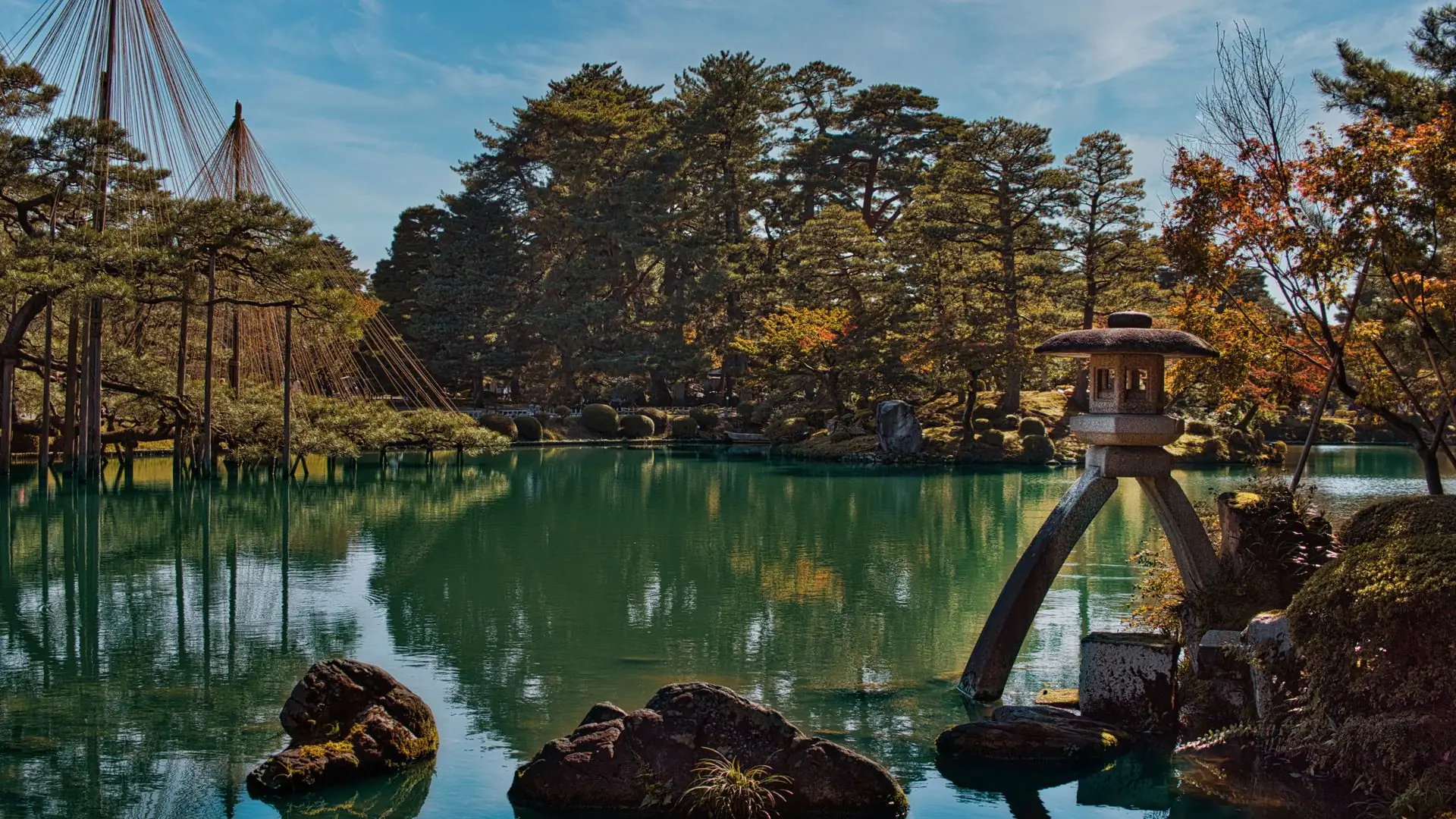
Kenroku-en is universally celebrated as one of Japan’s three great landscape gardens. It is famous for its two-legged Kotoji lantern and, in winter, the conical yukitsuri ropes designed to protect the pine branches from heavy snow. It is spectacularly beautiful, but the reality of its fame means you must arrive exactly at opening time if you want to experience the garden without the heavy daytime tour groups.
The city’s wealth is also literal: Kanazawa produces roughly 99 percent of Japan’s domestic gold leaf. You will see it applied to everything from serious temple restorations to tourist-bait gold-leaf soft cream. The craft itself is deeply authentic, the ice cream is sheer theatre, and both registers are perfectly fine to enjoy.
The Modern Counterweight
The city balances its history with spectacular modern architecture, anchored by the 21st Century Museum of Contemporary Art and the minimalist D.T. Suzuki Museum. Crucially, both are currently open and fully operating, though the contemporary art museum has announced a long renovation closure planned from spring 2027 into early 2028—check its calendar when you plan. While the tragic January 2024 Noto earthquake struck the peninsula to the north, Kanazawa itself came through with limited damage and remains a safe, functioning destination.
The Honest Calendar
Kanazawa is one of Japan’s rainiest major cities. The local proverb warns that even if you forget your lunch box, you should never forget your umbrella. Winter brings heavy, wet snow—the yukitsuri ropes exist for a highly practical reason—and summers are intensely humid. But the rain is not a flaw; it is exactly why the city’s famous moss gardens look as intensely green as they do.
The Practical Frame
There are two primary ways in. The Hokuriku Shinkansen connects Tokyo directly to Kanazawa; the fastest Kagayaki service completes the journey in roughly two and a half hours. Alternatively, if you fly into Komatsu Airport (KMQ), the direct airport limousine bus transfers you to the city centre in about 40 minutes. If you are flying in, refer to our Tokyo flights guide.
Regarding entry, US and UK passport holders currently receive 90-day visa-free entry to Japan. You can use the official Visit Japan Web service to digitally register your immigration details before flying to expedite arrival, but always check current requirements before you book.
To grasp the city’s rarity, stand in Higashi Chaya in the early morning before the shutters open. Look at the wet stone, the wooden lattices built two centuries ago, and the one thing you cannot capture in a photograph: the absolute knowledge that none of it is a replica.
FAQ
Is Kanazawa worth visiting?
Yes. It offers the historical depth and traditional architecture of Kyoto, but with the profound authenticity of a city that survived the war intact, making its Edo-period districts genuinely original.
Why was Kanazawa not bombed in World War II?
Kanazawa lacked the heavy military and industrial infrastructure that made cities like Tokyo or Nagoya strategic targets. Consequently, it was spared from the large-scale air raids that destroyed most other major Japanese cities.
How do I get to Kanazawa from Tokyo?
The most efficient route is the Hokuriku Shinkansen. The direct Kagayaki bullet train covers the distance from Tokyo Station to Kanazawa in approximately two hours and thirty minutes.
When is the best time to visit Kanazawa?
Autumn and spring are the most comfortable seasons. However, be prepared for rain year-round. Winter is cold and snowy—which is beautiful if you want to see the gardens protected by traditional ropes—while summer is notably hot and humid.


