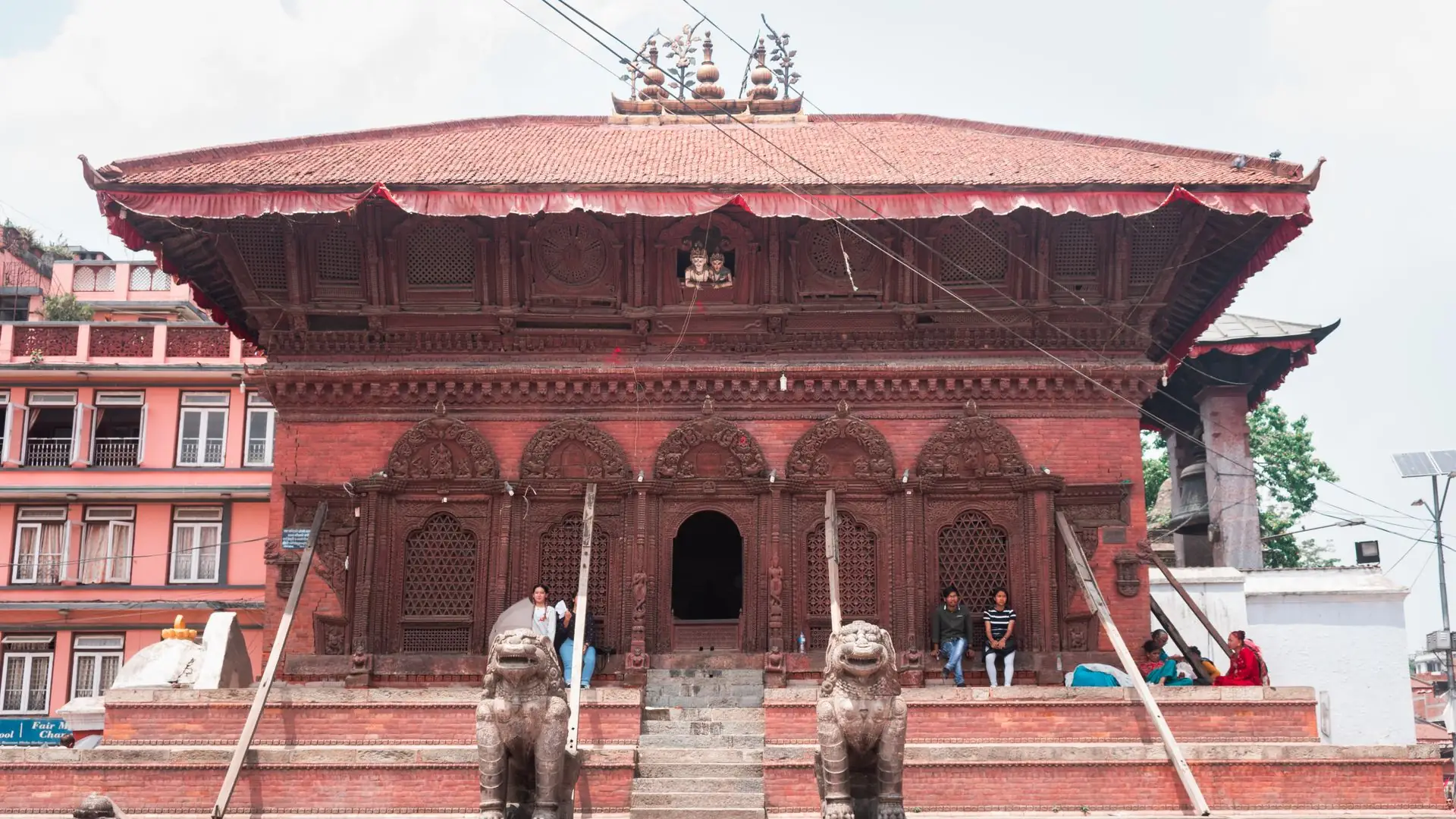

That is the fact that reorganises Kathmandu in your head — not that it is the way to Everest, which is the only thing most people know about it. The valley is small enough to cross in a morning, and it holds three complete royal cities, because for centuries it held three rival kingdoms competing in the one currency that has outlived them all: architecture.
Three kings, one valley
Under the Malla kings, the valley was divided between the courts of Kathmandu, Patan — properly Lalitpur — and Bhaktapur: rival capitals close enough to see each other’s smoke, each with its own palace, its own Durbar square, and its own guilds of carvers, casters and stonemasons whose job was to make sure the neighbours were not out-building them.
The result is an arrangement UNESCO had to invent a shape for. The Kathmandu Valley is a single World Heritage property inscribed, in the organisation’s own words, “as seven Monument Zones” — the three Durbar squares, the Buddhist stupas of Swayambhu and Bauddhanath, and the Hindu sites of Pashupati and Changu Narayan, scattered across a valley floor rather than gathered in a city.
So the first correction is this: Kathmandu is not a city with a heritage quarter. It is a valley with three of them, and the difference between them is the point of the trip.
The carvers’ decade
In 2015 an earthquake gave the valley a reason to find out whether its craft guilds still existed. They did.
What has happened since is, to my mind, the best craft story in Asia, and it is barely told outside Nepal. The families who cut these buildings never stopped — the Newar woodcarvers, the Shilpakar or Sikamī, still work out of the same Bhaktapur neighbourhoods, close to the palaces whose windows and door frames were their standing commission. One family workshop, an open room down an alley where men carve barefoot and hold the piece steady with a foot, is run by a household that has been at it for fourteen generations. When the rebuilding began, master carvers were called back to the temples within days.
You can see the results by looking at what is standing. In Patan, the Kathmandu Valley Preservation Trust ran the restoration of more than thirty monuments and the square is now around ninety-five per cent rebuilt; the master stone carver there devised a numbering system so every original block could be lifted, catalogued and put back where it came from, with new stone cut only where new stone was needed and set in traditional lime-and-brick-dust mortar. Bhaktapur, which has funded its own conservation from a visitor ticket since 1993, had rebuilt ninety-one of its hundred and thirty-four affected monuments while its neighbours were still deciding, and finished its last major temple in 2021 — which is why the square you walk into is free of scaffolding.
And in Kathmandu’s own square stands Kasthamandap, the wooden pavilion that may have given the city its name — a public rest-house rather than a temple, at the crossroads of the old trade route north. Officials wanted it back up quickly in concrete. Local people and conservationists objected, and won: it was rebuilt by hand, by traditional methods, reusing as much original timber as could be saved, and reopened by the president in 2022. Access to the inside has been on and off since, for reasons that are local and ongoing, so treat the interior as a bonus rather than a plan. The building is the story, and it is right there in the open.
The goddess who comes to the window
On Kathmandu’s Durbar Square there is a three-storey brick house with wooden lattice windows so finely cut that people photograph the building and miss the point of it. This is the Kumari Ghar, and a girl lives here who is worshipped as the living embodiment of the goddess Taleju.
The Royal Kumari is chosen as a small child from the Shakya clan of the valley’s Newar Buddhist community — a Hindu goddess, by tradition, embodied in a girl from Buddhist families, which tells you something true about how religion works here. The tradition explains itself with a story about the last Malla king of Kathmandu, visited by the goddess in human form until he forgot himself, at which point she stopped coming and promised to return in the body of a young girl instead. That is tradition rather than record, and worth enjoying as such. What is documented: the selection is conducted by senior Bajracharya priests, the current Kumari, Aryatara Shakya, was installed in 2025 at the age of two, her tenure ends at puberty, and government-appointed tutors come to the house so her schooling continues throughout.
The etiquette is simple and worth getting right. The public may stand in the inner courtyard; the house itself is not open. There is no timetable — she appears at a window when she appears, often for less than a minute, and people wait. You may photograph the courtyard and its carving freely. You may not photograph her: when she comes to the window, cameras and phones go down, and the courtyard goes quiet by itself. If you would rather not gamble on a window, she rides in procession at the autumn festival of Indra Jatra, when the chariots go out and the whole square turns up.
Patan and Bhaktapur: the other two courts
Patan is the one people come away talking about. Its square is denser than Kathmandu’s and better composed, and its set piece is the Krishna Mandir — built entirely of stone, in the northern Indian shikhara style rather than the valley’s usual tiered timber, with twenty-one shrines stacked up its tower and friezes carved with scenes from the Mahabharata. It went up in the seventeenth century under Siddhi Narsingh Malla, and standing in front of a stone building in a city of brick and wood you get the whole rivalry in one object: a king building something his neighbours could not.
Behind it, the Patan Museum occupies Keshav Narayan Chowk, an old residential courtyard of the palace. The collection is sacred bronze and stone — around three hundred pieces from a national holding several times that size — but the building is the exhibit. It was restored across fifteen years as a joint Nepali-Austrian project, largely under the architect Götz Hagmüller, and opened in 1997: the galleries are the palace rooms, the light comes through the original windows, and it is the only museum I have been to where I spent as long looking at the ceilings.
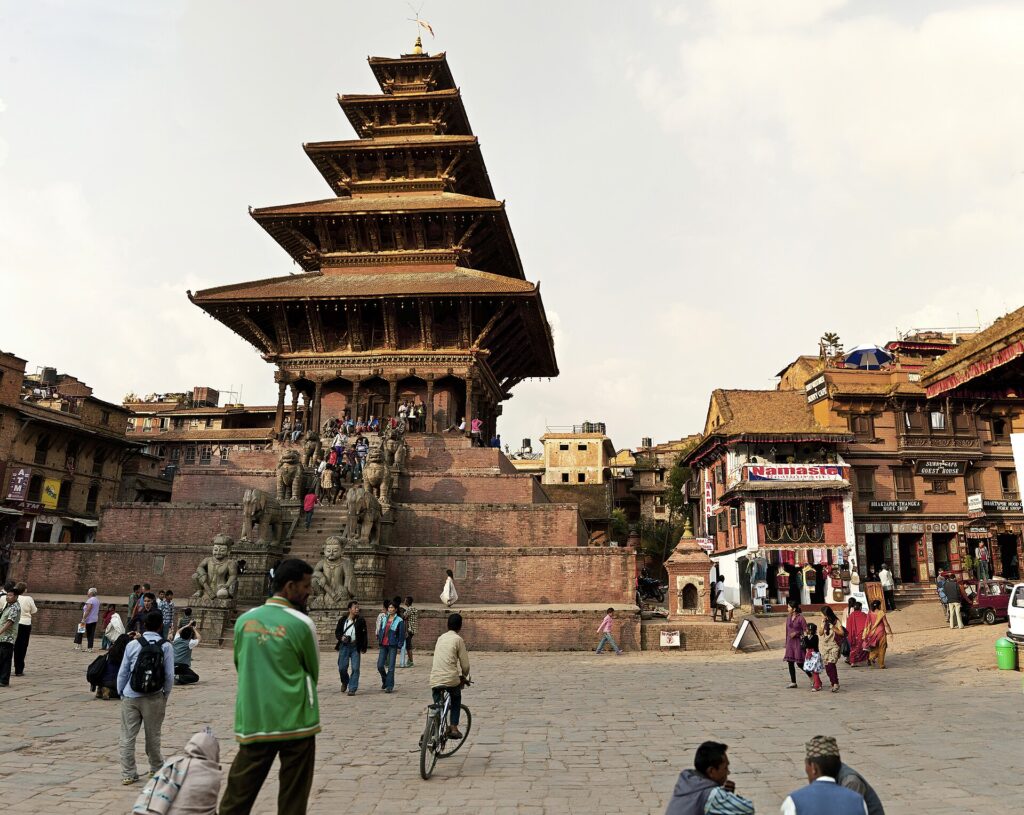
Bhaktapur is the third court, and the one that feels least like a monument and most like a town. Its palace is known for a single carved window bay — fifty-five of them along one facade — and its skyline belongs to Nyatapola, a five-tiered temple that is the tallest in Nepal. It was raised in 1702 for Bhupatindra Malla, reportedly in a little over two hundred days, with a hundred and eight carved struts holding out the roofs and a stairway flanked by pairs of stone guardians — wrestlers at the bottom, then elephants, lions, griffins and deities, each pair said by tradition to be ten times stronger than the pair below. It has stood through three centuries of the valley’s tremors with little more than cosmetic damage, which is why the carvers talk about it the way engineers talk about a bridge.
A few streets away is the pottery square, which is exactly what it sounds like: rows of black clay pots out in the sun to dry, wheels turning under awnings, a smell of wet earth. Buy nothing and stand for ten minutes — it is the least performed thing in the valley. Then find juju dhau, the “king yoghurt”: buffalo milk boiled down with sugar and set in an unglazed clay pot whose porous walls draw out the water, served so thick it will not fall out if you turn the pot over. Around sixty Bhaktapur families still make it. It is the best yoghurt on earth and I am not going to hedge that one.
All three squares charge visitors to enter, and in Bhaktapur’s case that ticket has been the conservation budget since the early nineties — the fee is why the temples are back up. Stay overnight in town and it can be extended to a week at no extra charge at the ticket office, which is the single most useful thing in this article.
The two hills
Swayambhunath sits on a wooded hill west of the city, up three hundred and sixty-five stone steps — one, in the telling, for each day of the year. At the top: a whitewashed dome, a gilded spire, and on each of its four sides a pair of painted eyes with a curl between them that is the Nepali numeral one, read as unity. Monkeys hold the tenancy of the hill and will take sunglasses, food and anything in a plastic bag. The valley view from the terrace is the best free thing in Kathmandu.
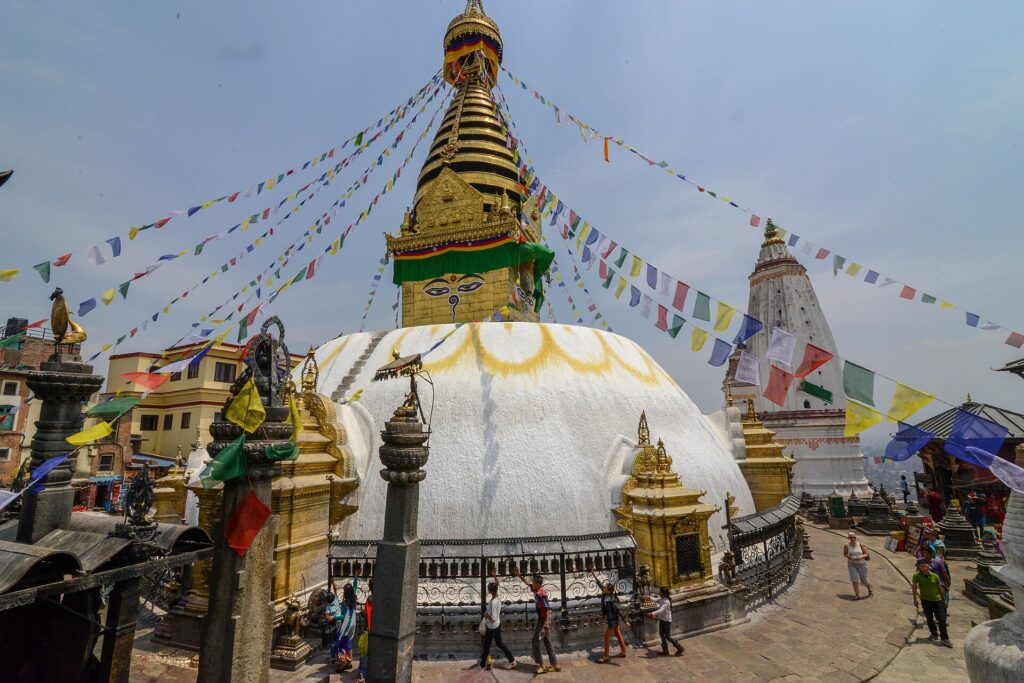
The legend attached to the place is the founding story of the whole valley, and it is a legend — the Swayambhu Purana tells it. The valley was a lake; the bodhisattva Manjushri cut through the hills at Chobhar with his sword to drain it; a lotus floating on the water came to rest where the stupa now stands. The reason to tell it is that geologists then went and found the lake. The basin holds hundreds of metres of lake-bed sediment, the drainage did happen southward through the Chobhar gorge, and the water left over tens of thousands of years rather than in one stroke. The story and the rock disagree entirely about the method and agree exactly about the place.
Boudhanath, northeast of the centre, is the other pole. UNESCO’s listing calls it the largest stupa in Nepal: a vast white dome on a stepped mandala base, the golden tower above, the painted eyes again, and around it a ring of monasteries, shops and kitchens that form the heart of the valley’s Tibetan community. The thing to do here is nothing in particular, at dusk. The crowd moves clockwise around the base — the kora — pilgrims, monks, families, people on their way home from work, prayer wheels ticking under their hands, butter lamps going up one by one. A circuit takes a few minutes and most people do several, and after two or three you stop looking at it and start being in it.
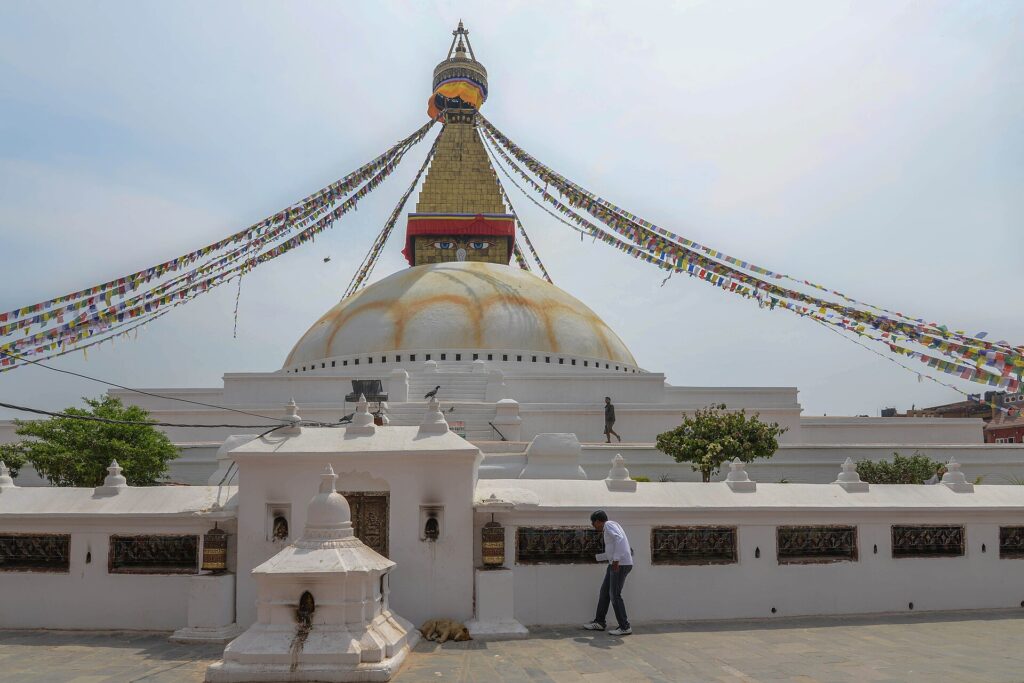
Its own repair was paid for by that community rather than by the state: donations from Buddhist groups worldwide, local volunteers, traditional methods, and more than thirty kilograms of donated gold on the pinnacle. It reopened in November 2016 with a three-day ceremony and flowers dropped from a helicopter, and the prime minister of the day called it “proof that we can rebuild our heritage”.
The table
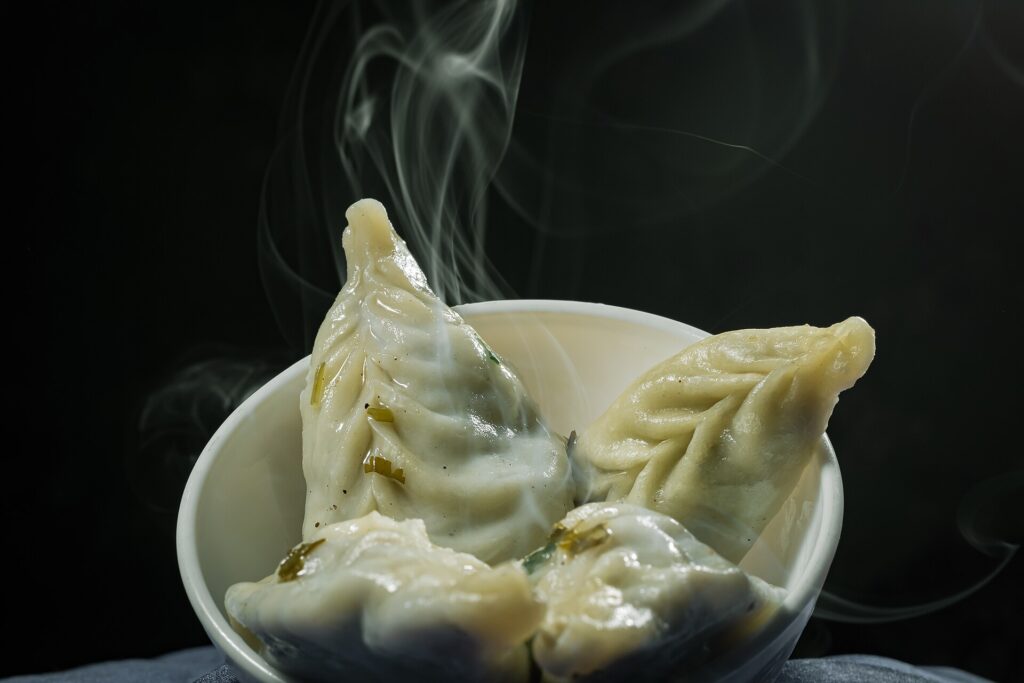
Momos are the common language: dumplings, steamed or fried, in bamboo baskets, filled with buffalo, chicken or vegetables and dipped in a tomato-and-chilli achar that varies by kitchen and is the actual subject of local argument. Dal bhat is the working meal — lentils, rice, a vegetable curry, pickle, and more of everything brought round without being asked. Trekkers chant a slogan about it on the way uphill, “dal bhat power, twenty-four hour”, which is affectionate rather than ironic: the thing genuinely works.
The meal worth planning for, though, is Newari. Samay baji is not a dish but a composed platter, laid out in a circle around a bed of beaten rice: marinated grilled buffalo, black soybeans, a fried egg, ginger cut in fine sticks, sometimes lentil patties, fish, greens, a little of the local spirit. It is festival food that became restaurant food, every element is a different texture, and it is the best argument for staying in the valley longer than the tour schedules allow. Drink chiya with it — milk tea with cardamom and ginger, sold everywhere, and the reason nothing here starts before it has been served.
When the day gets long, the Garden of Dreams behind Thamel is the answer: a walled neoclassical garden built in the 1920s with a pavilion for each of Nepal’s six seasons, left to fall apart, restored with Austrian help, and now a café, a lawn and a very effective wall between you and the traffic.
Thamel, fairly
Thamel is the tourist bazaar and it knows it: gear shops selling jackets whose brand names are, let us say, aspirational — a running joke everyone including the shopkeepers is in on — plus singing bowls, pashmina, secondhand bookshops that are genuinely good, live music every night, rooftop restaurants strung with lights. It is loud, and it is honestly fun for an evening. The useful thing to know is how thin it is: walk one lane out in any direction and you are in ordinary Kathmandu, past a corner shrine with fresh marigolds on it, a tailor, a bicycle repair, a courtyard with washing hung out and a temple in the middle that nobody has put on a list. Thamel is a room in the city, not the city.
The rim
The valley has a rim, and the rim is where you go for the mountains. Nagarkot, on a ridge east of Bhaktapur at a little over two thousand metres, is the classic sunrise stop: on a clear autumn morning the horizon carries a long line of Himalaya, Annapurna in the west round to the Everest group in the east, with Manaslu, Ganesh Himal and Langtang Lirung standing out in between. Two honest caveats. Get above the hotels to the view tower for the whole sweep; and Everest from here is a distant grey tooth, not the star of the photograph — the wall as a whole is the show, and anyone telling you otherwise is selling something. Go up the night before, be outside before the sun, and accept that the mountain does not owe you a clear morning.
Dhulikhel, on the other side of the same ridge, does the same job with a working Newar town attached, and there is a walking route between the two through pine forest and villages. For quiet, Panauti and Kirtipur are the valley’s small Newar towns — brick, carving, temples, no ticket booths, almost no one.
When to come
Autumn, and it is not close. October and November are what the whole year is arranged around: the monsoon clears, the air is washed, and the cloud cover drops away through October until the peaks are simply there on the northern horizon from the edge of town. Days run warm rather than hot, nights turn properly cool by mid-November, and rain is close to a rumour.
It is also festival season, which is the real reason to aim at these weeks. Dashain, the country’s longest festival, runs through the middle of October in 2026 with the main tika day on the twenty-first: kites over the rooftops, swings built in the villages, and the city half-empty because everyone has gone home to family. Then Tihar in early November — the festival of lights, marigold garlands on doorways, oil lamps on every sill, crows, dogs and cows honoured on their own days in turn, and an evening when children go singing house to house. Indra Jatra, with the Kumari’s chariot, falls in late September. These dates move with the lunar calendar every year, so pin them before booking rather than assuming.
Spring — March into April — is the other good window: warm, rhododendrons out in the hills, the mountains still there but through more haze. Monsoon, June to September, is green, dramatic, cheap and quiet, with the valley washed clean between downpours and the peaks mostly hidden. Winter is cold at night and often brilliant by day: clear light, quiet squares, the best temple photography of the year.
On entry: Nepal issues a tourist visa on arrival to most nationalities, with a short list of exceptions who must arrange one in advance — our guide to the airport in the bowl of mountains carries the detail. Check current requirements before you book.
Evening circles
Finish at Boudhanath, late in the afternoon, and let the crowd carry you round. The dome goes from white to gold to grey; the lamps come up in ones and twos; the wheels turn under a hundred hands, and the painted eyes look out over the whole valley in four directions at once.
Somewhere behind you in the dark, in a workshop with the door open, someone is still cutting a strut for a roof that will outlast them, with the same tools and the same drawings their family used five hundred years ago. That is the thing about this valley. It did not preserve its wonders. It kept the people who make them.
FAQ
Is Kathmandu worth visiting?
Yes — and for more than the two nights most trekking itineraries allow it. In a small valley you get three separate royal squares built by three rival courts, a living goddess who appears at a window, two of the great stupas of the Buddhist world, and the best food in the Himalaya. Three full days covers the three Durbar squares plus Swayambhunath and Boudhanath without rushing; four lets you add the valley rim for a mountain sunrise.
Who is the Kumari of Kathmandu?
The Kumari is a young girl venerated as the living embodiment of the goddess Taleju. The Royal Kumari is chosen in early childhood from the Shakya clan of the valley’s Newar Buddhist community, lives in the Kumari Ghar on Kathmandu’s Durbar Square, and holds the role until puberty; tutors appointed by the government continue her education throughout. Visitors may wait in the inner courtyard, where she sometimes appears briefly at an upper window. Photographing the courtyard is fine; photographing her is not, and everyone puts their phone away when she comes.
What are the Durbar squares in Kathmandu?
“Durbar” means palace, and there are three of them — one each in Kathmandu, Patan and Bhaktapur — because the valley was once divided between three rival kingdoms that competed by building. Each square holds a royal palace and a cluster of temples, and all three are part of a single UNESCO World Heritage property that is inscribed as seven monument zones spread across the valley. Patan’s is the most tightly composed, Bhaktapur’s the most town-like, Kathmandu’s the busiest and the one with the Kumari’s house.
When is the best time to visit Kathmandu?
October and November, comfortably. The monsoon has cleared, the skies open up, days are warm and nights cool, and the mountains come back onto the horizon. It is also the great festival stretch — Dashain in October, Tihar in early November — which is the most enjoyable time of year to be in the valley. Spring, in March and April, is the second window. Monsoon is green and quiet and much cheaper if you don’t mind losing the mountain views.
Photos: Mithunkunwar9 (CC BY-SA 4.0), Jorge Láscar (CC BY 2.0), Göran Höglund (CC BY 2.0), Tapas Kumar Halder (CC BY-SA 4.0), via Wikimedia Commons.


