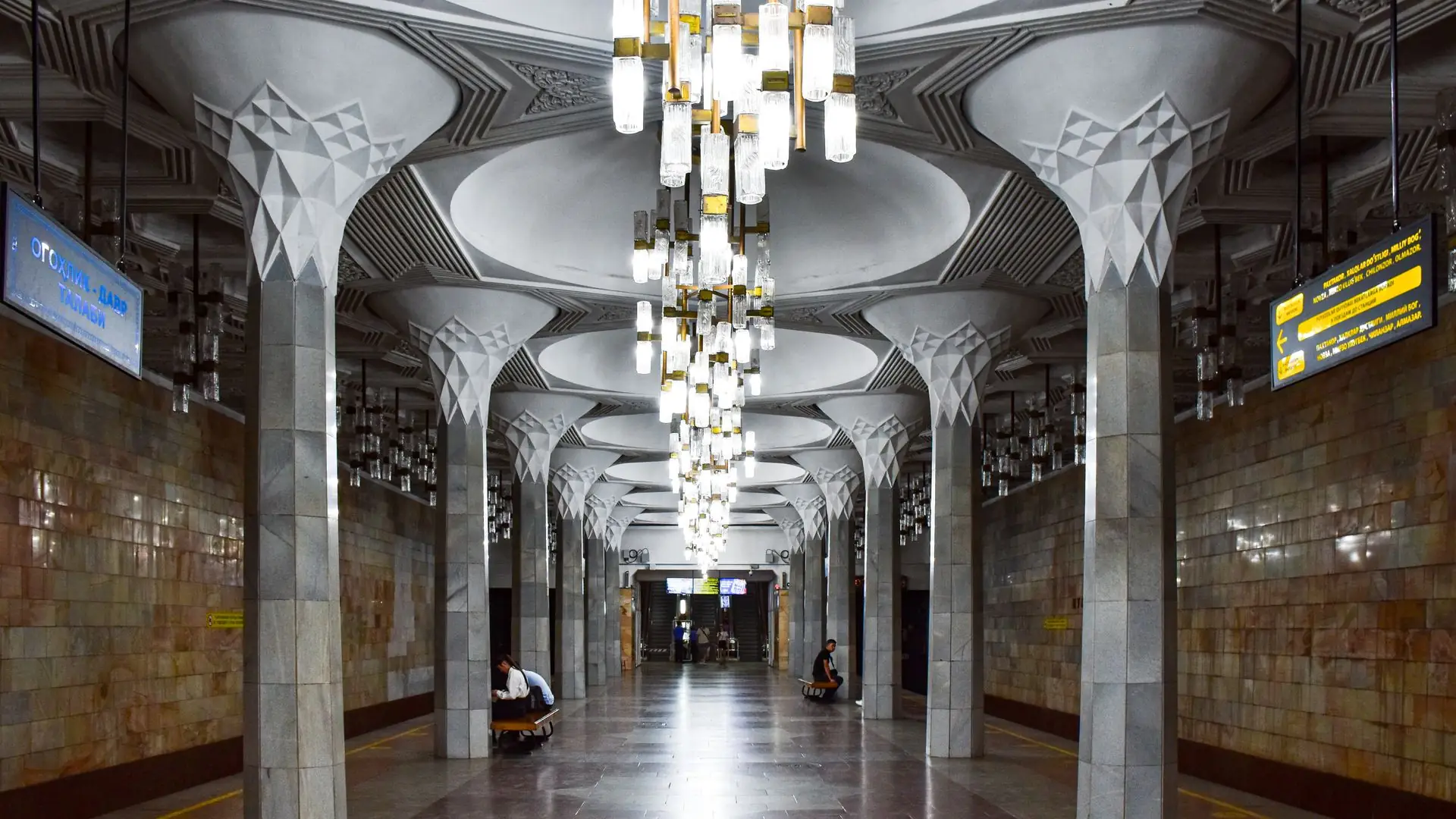

This is Kosmonavtlar station, and it is the best argument I know for stopping in a city most people treat as an airport with a hotel attached. Tashkent is the capital nearly everyone changes planes in on the way to Samarkand. It also happens to be a city that was redrawn in one enormous gesture, and that decided its finest rooms should be the ones everybody passes through on the way to work.
Redrawn in one gesture
The shape of the modern city dates from 1966, when an earthquake gave Tashkent a reason to rebuild itself from the plan up. What followed was one of the great state building projects of the century: design institutes and building teams from across the union sent here at once, a new layout organised on two great axes, prefabricated apartment districts engineered to move rather than crack, and boulevards laid out wide enough to be startling even now.
What that gives you as a visitor is a capital of very generous proportions: avenues under double rows of plane trees, fountains running in every public square, parks that are actually used, and a stock of confident 1970s architecture that the city has recently started to treat as heritage rather than as something to knock down. Tashkent’s modernist ensemble now sits on UNESCO’s tentative list, described there as an urban centre combining twentieth-century architecture with local architectural features — and the same buildings were the subject of Uzbekistan’s pavilion at the Venice architecture biennale.
Riga spent its boom on facades. Tashkent spent its rebuild on public space — and then put the ornament underground.
The palaces underground
The metro opened in 1977, the first in Central Asia and the seventh in the Soviet Union, starting with a single line of nine stations out to the Chilonzor district. There are four lines and around fifty stations now, and the older ones are not stations in any sense you are used to. They are themed halls.
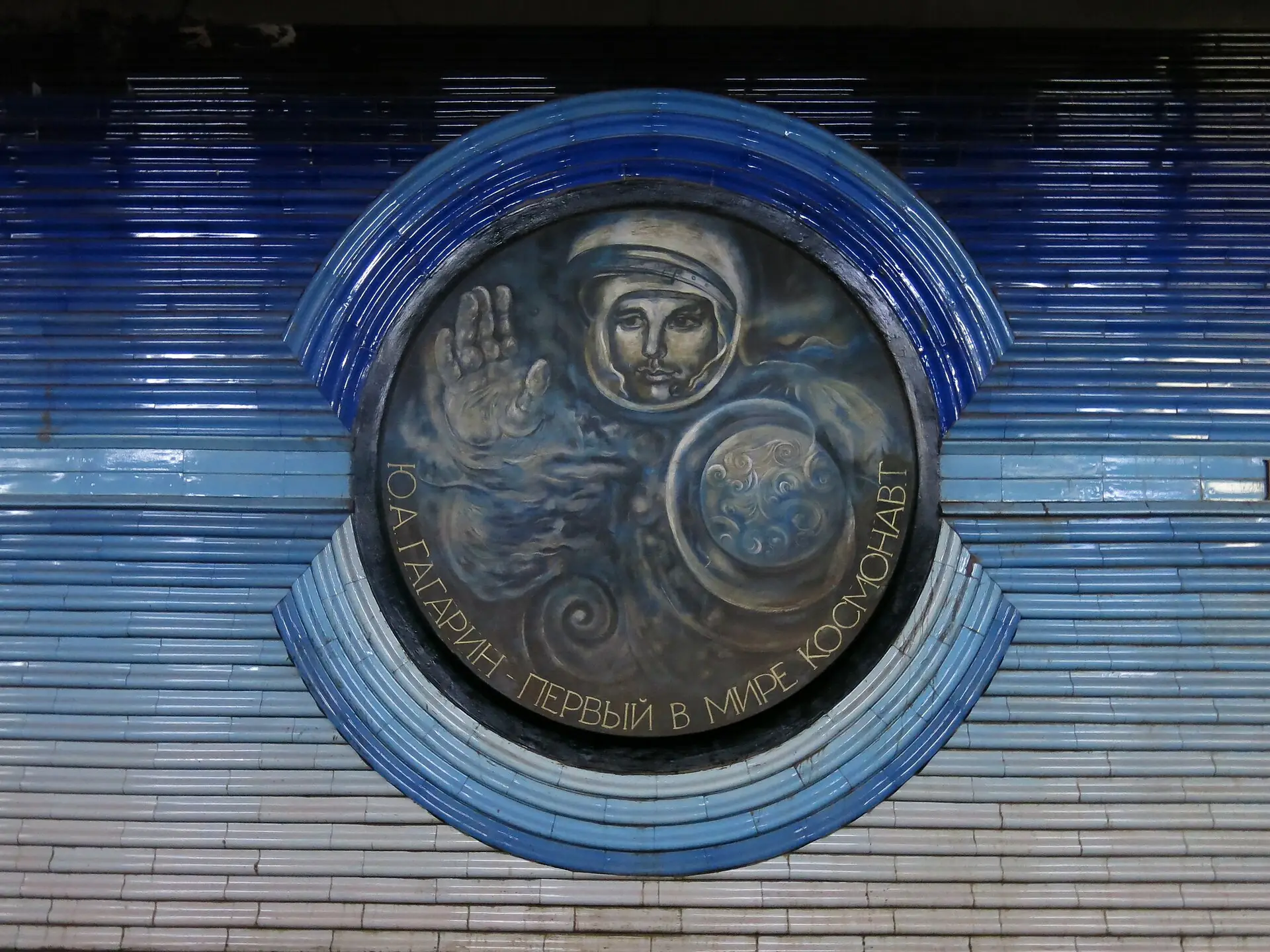
Kosmonavtlar, opened in 1984, is the space one: deep blue ceramics, a colonnade flecked with glass to suggest the Milky Way, and portrait medallions of astronomers and cosmonauts running the length of the platform. Alisher Navoi is the opposite in temperament — pale ribbed domes and geometric brickwork borrowed from the region’s Islamic architecture, named for the fifteenth-century poet and sitting opposite the opera house named for him too. Paxtakor, from the opening year, means “cotton picker”, and its walls carry green and blue mosaics of flowering cotton.
Here is the part that makes the whole thing worth a paragraph of its own. Until 2018 you were not allowed to photograph any of it. The metro doubled as a civil-defence shelter and was treated as a strategic object, so cameras were forbidden — for forty-one years, in a system whose entire purpose above the tracks was to be looked at. The ban was lifted on 1 June 2018. Within months the stations had been photographed by half the travel press on earth, and they are now the country’s most-shared image.
So: ride it. Not to get anywhere — go down mid-morning when the platforms are near-empty, get off at every station with a name that sounds interesting, cross the platform, come back. An hour of that is one of the best hours in the city, and the only sightseeing I can think of that is also air-conditioned.
The old city, and where the Quran went
Northwest of the centre, the Hazrati Imam complex — Khast Imam — is the thread the redraw left alone: madrasas and a mosque in warm brick and turquoise tile, wooden pillars, pigeons, a courtyard with the temperature dropped several degrees by shade and water.
It is also where the guidebooks will send you to see the Uthman Quran, and this is where you need current information rather than a guidebook. The manuscript — enormous, on parchment, written in Kufic script, and inscribed on UNESCO’s Memory of the World register — spent decades in the small Muyi Muborak library on this square. At the end of 2025 it was moved. It is now the centrepiece of the Center of Islamic Civilization, a vast new institution which opened on 17 March 2026 a short walk away in the same district, where it sits in a hall beneath a dome sixty-five metres high, alongside more than a hundred other rare Qurans. You cannot get close to it and you cannot photograph it; there are facsimiles and screens for that.
On the manuscript itself, the honest version is more interesting than the marketing one. Tradition attributes it to the caliph Uthman in the seventh century, and that is the story you will be told on the spot. Modern scholarship dates the parchment later — commonly to the eighth or ninth century — and treats the attribution as tradition rather than fact. Either way you are looking at one of the oldest Qurans in existence, at the scale of a small door, and the room has been built to make you feel that.
Chorsu, under the turquoise dome
The city’s great bazaar sits under a shallow turquoise dome about eighty metres across, designed by Vladimir Azimov and Sabir Adylov and finished in 1980 — heavy concrete engineering wearing a skin of ceramic tile, which is the whole aesthetic of rebuilt Tashkent in one building. UNESCO’s tentative listing calls the dome an icon of the city, which for once is not overselling it.
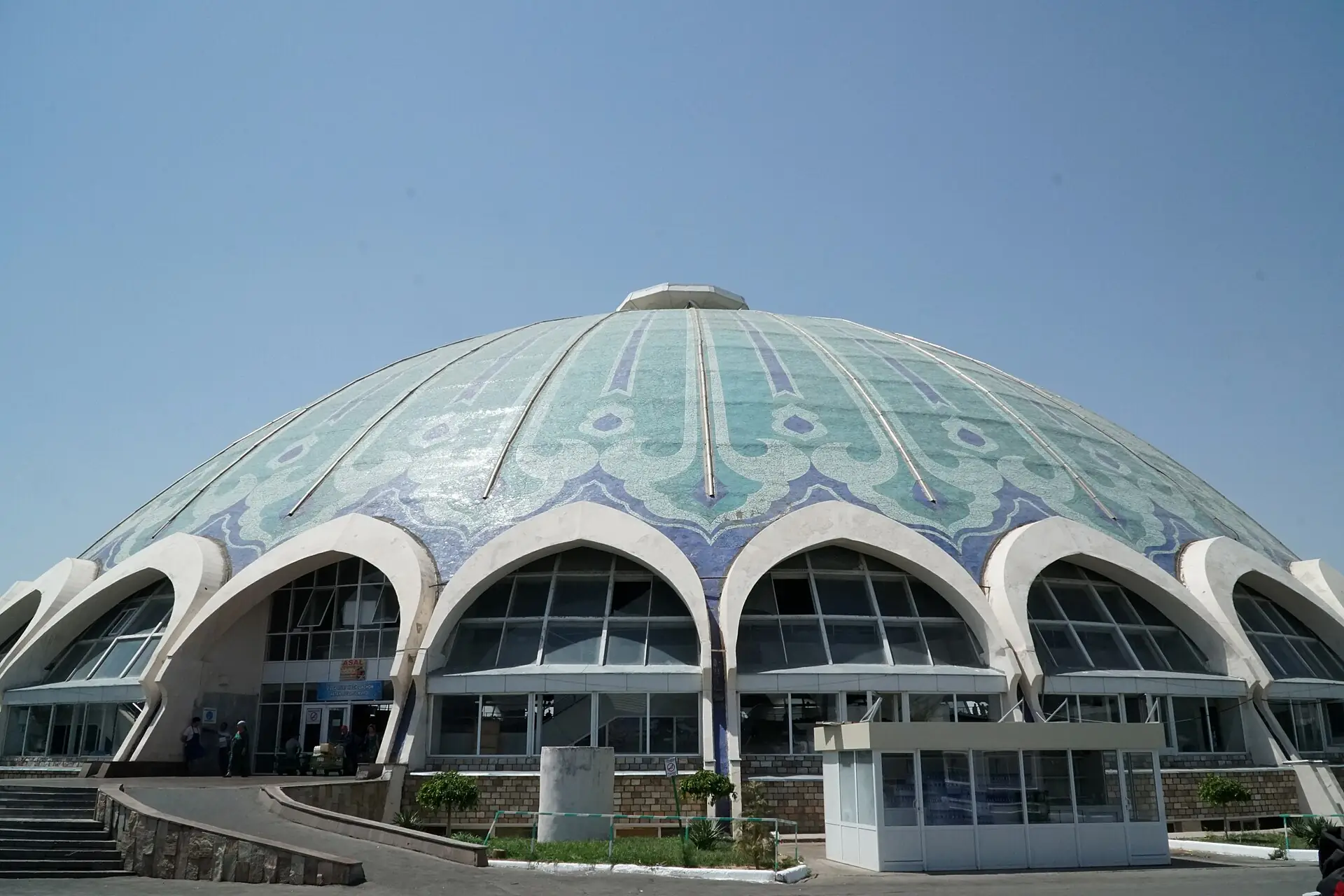
Inside, the produce is stacked in mounds on tiered counters and the sellers stand behind them like people defending a position. Go for three things in particular. The bread: round non, baked against the wall of a clay tandir, with the middle pressed flat by a chekich — a handled stamp studded with pins — in a pattern that tells you which region the baker learned in. The melons, if you are here in late summer: Uzbekistan grows well over a hundred varieties, and the long yellow Mirzachul, sold abroad as the torpedo, comes in around August and September. And the dried fruit and nut stalls, where you will be handed samples faster than you can eat them.
Bread is never cut here, incidentally. It is torn, and it is not put face-down on a table.
Plov, and the city’s clock
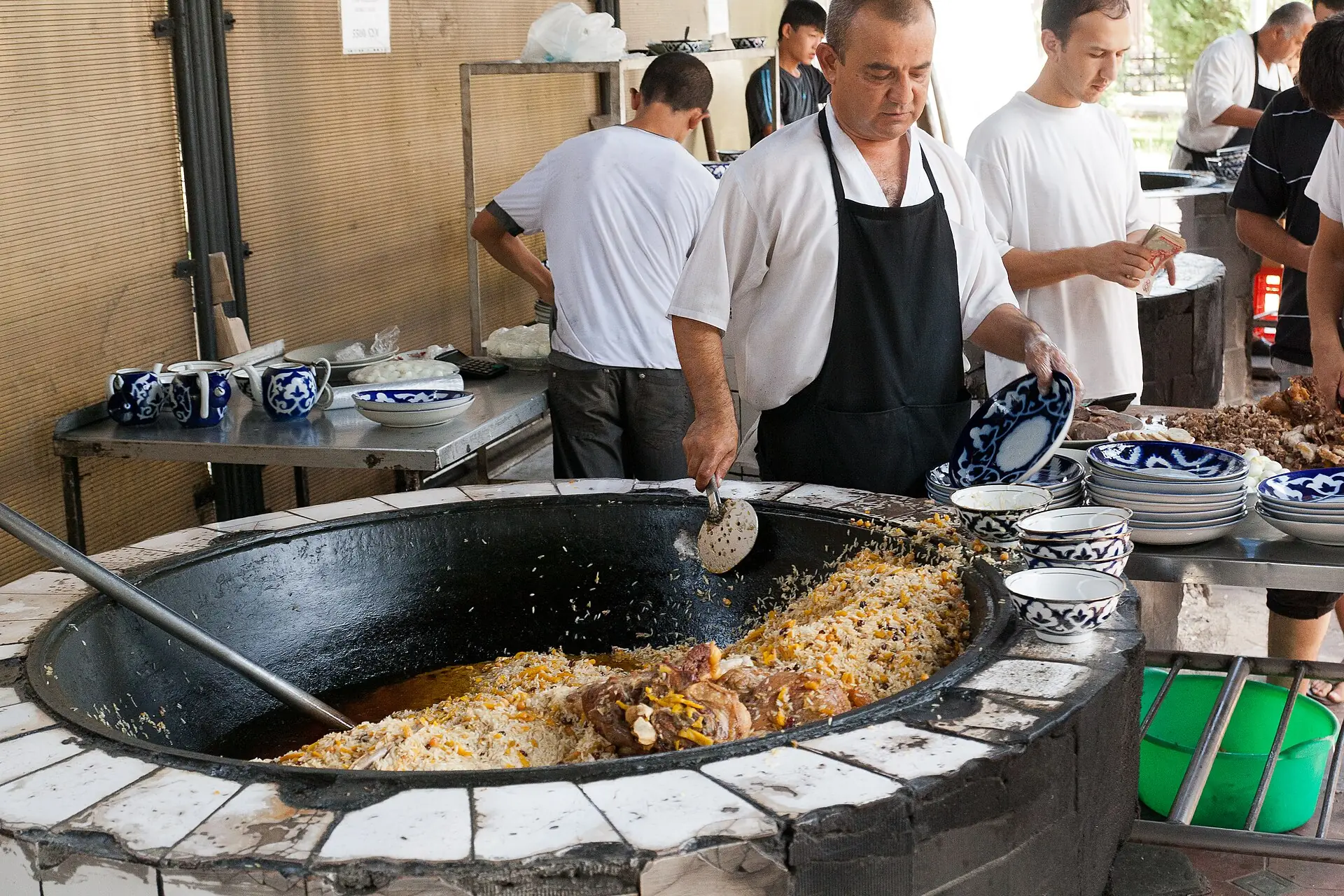
Uzbek plov — rice cooked down with lamb, carrot, onion, cumin and whole heads of garlic in a wide cast-iron kazan — is on UNESCO’s intangible heritage list, inscribed in 2016 as “Palov culture and tradition”. The listing is not really about the recipe. It is about the transmission: master to apprentice, family to family, and the role the dish plays at weddings, funerals, and any occasion where a neighbourhood needs feeding at once.
At the Central Asian Plov Centre — Besh Qozon, “five cauldrons” — you can watch it made at industrial scale, several regional versions going at once in cauldrons the size of paddling pools, each stirred with a skimmer on a broom handle. It is not a dinner dish. This is lunchtime food in a lunchtime city: the cooking is the show through the late morning, the crush comes at about one, and the best versions run down as the afternoon goes on. Get there before noon, watch the cauldrons, eat early, and accept that you have now had your main meal of the day at 12.15 like everybody else.
The supporting cast is straightforward and very good: skewers of lamb over charcoal, samsa baked against the tandir wall, tomato-and-onion salad with everything, and green tea in a pot on the table from the moment you sit down. The chaikhana — teahouse — is a functioning institution rather than a heritage attraction, and an hour in one is not a waste of an afternoon.
The buildings the city is learning to love
Above ground, the set piece is Hotel Uzbekistan on Amir Temur Square: seventeen storeys, built by 1974 to a design by a team under Ilya Merport, and wrapped in a full-height perforated screen that shades the rooms behind it. Locals nicknamed the screen after a traditional garment, which tells you how the building was read from the start — as modernism speaking with a local accent.
Once you have noticed that trick you will see it everywhere: sun-screens as ornament, mosaic panels on the ends of apartment blocks, ceramic and glass work on public buildings by artists who were commissioned as part of the architecture rather than added afterwards. Much of it went unloved for years. It is now being catalogued, exhibited and argued about, which is usually the last thing that happens before a city decides to keep something.
Out of the valley
When the heat gets silly, the answer is altitude. Roughly ninety minutes northeast, the Tien Shan foothills rise behind the Charvak reservoir — a genuinely turquoise body of water with mountains standing in it, beaches on the shore in summer, and snow up top from winter into spring. There are chairlifts up at Chimgan and a modern gondola at the Amirsoy resort, which runs to a viewing point well above the treeline; the older Chimgan lift is seasonal and its running depends on the time of year, so ask locally the day before rather than driving out on faith.
And yes, Samarkand is close enough to do from here, and the Registan is everything you have been told it is. That is a rail question rather than a Tashkent question, and our guide to the new gateway to Central Asia handles the getting-there end of it.
When to come
Two windows, and they are both excellent. April and May: the city green, blossom over the older streets, fountains switched on, the first produce arriving at Chorsu. Then September and October, which is the one I would book — the heat breaks, and the bazaar is at its absolute peak with melons, grapes, pomegranates and the year’s dried fruit all on the counters at once.
Summer is hot in a dry, uncompromising way. It is manageable if you plan around it — mountains and reservoir at the weekend, metro halls and shaded chaikhanas in the middle of the day, everything else early or late. Winter is grey and mild by continental standards, and the teahouse season is the point.
If your dates are movable, aim at Navruz on 21 March — the spring new year, celebrated across this whole region and on UNESCO’s heritage list since 2009. The detail that will stay with you is sumalak: sprouted wheat cooked down in an enormous cauldron over roughly twenty-four hours, stirred in shifts by the women of a neighbourhood through the whole night, with songs and wishes going into the pot, and everyone fed from it at dawn. If you are offered a turn at the paddle, take it.
On entry: Uzbekistan overhauled its visa rules in recent years and the list of countries that can arrive without one is now long — our guide to the new gateway to Central Asia carries the current detail. Check current requirements before you book.
Down out of the heat
Finish on a hot afternoon, which in Tashkent is most of them between June and September. Come off a bright street into the dim of a station entrance, ride down, and stand for a moment on an empty platform in that particular underground cool.
Above you: a vaulted ceiling in space-blue ceramic. Along the wall: Gagarin, smiling out of a medallion in a hall that for forty-one years nobody was permitted to photograph, in a city that rebuilt itself from scratch and decided, while it was at it, that the tunnels ought to be beautiful. Now everyone photographs it, all day, and the city seems pleased about that. It should be.
FAQ
Is Tashkent worth visiting?
Yes — and specifically, it is worth more than the twenty-four hours most itineraries give it on the way to Samarkand. Two full days gets you the metro halls, Chorsu bazaar under its turquoise dome, the Khast Imam complex and the new Islamic civilisation centre beside it, plov at a cauldron the size of a paddling pool, and an evening walking wide green boulevards with fountains running. Three days lets you add the mountains and the reservoir.
Why is the Tashkent metro famous?
Because the stations were built as decorated halls — space-themed ceramics at Kosmonavtlar, ribbed domes at Alisher Navoi, cotton mosaics at Paxtakor — and because for forty-one years nobody was allowed to photograph them. The system, which opened in 1977 as the first metro in Central Asia, doubled as a civil-defence shelter and was treated as a strategic object; the photography ban was only lifted on 1 June 2018. The stations went from officially unseeable to internationally famous in about six months.
What food is Tashkent known for?
Plov above all — rice with lamb, carrot, onion and garlic cooked in a wide kazan, inscribed on UNESCO’s intangible heritage list in 2016 as “Palov culture and tradition”. It is a lunch dish here, not a dinner one: at the Central Asian Plov Centre the cauldrons are the morning’s entertainment, the rush lands around one, and the best versions thin out through the afternoon. Beyond that: tandir-baked non with its stamped centre, lamb skewers, samsa, endless green tea, and — in late summer — some of the best melons you will ever eat.
When is the best time to visit Tashkent?
April to May, or September to October. Spring gives you blossom, green streets and the fountains coming on; autumn gives you the melon, grape and pomegranate harvest, which turns Chorsu into something worth crossing a continent for. Summer is very hot and dry — workable if you use the mountains and the metro. Winter is mild-grey and quiet, and the teahouses come into their own.
Photos: LBM1948 (CC BY-SA 4.0), Enric (CC BY 4.0), Adam Harangozó (CC BY-SA 4.0), Ekrem Canli (CC BY-SA 3.0), via Wikimedia Commons.


