
Most old cities offer you a legend when you ask how they began — a wolf, a prophecy, a hero who came ashore. Yerevan hands you a receipt. The city celebrated its 2,800th birthday in 2018 and treats the number as a plain fact of civic life rather than a boast, which is somehow more impressive. For the record, 782 BC puts it twenty-nine years ahead of the traditional founding date of Rome.
The pink city, drawn in one go
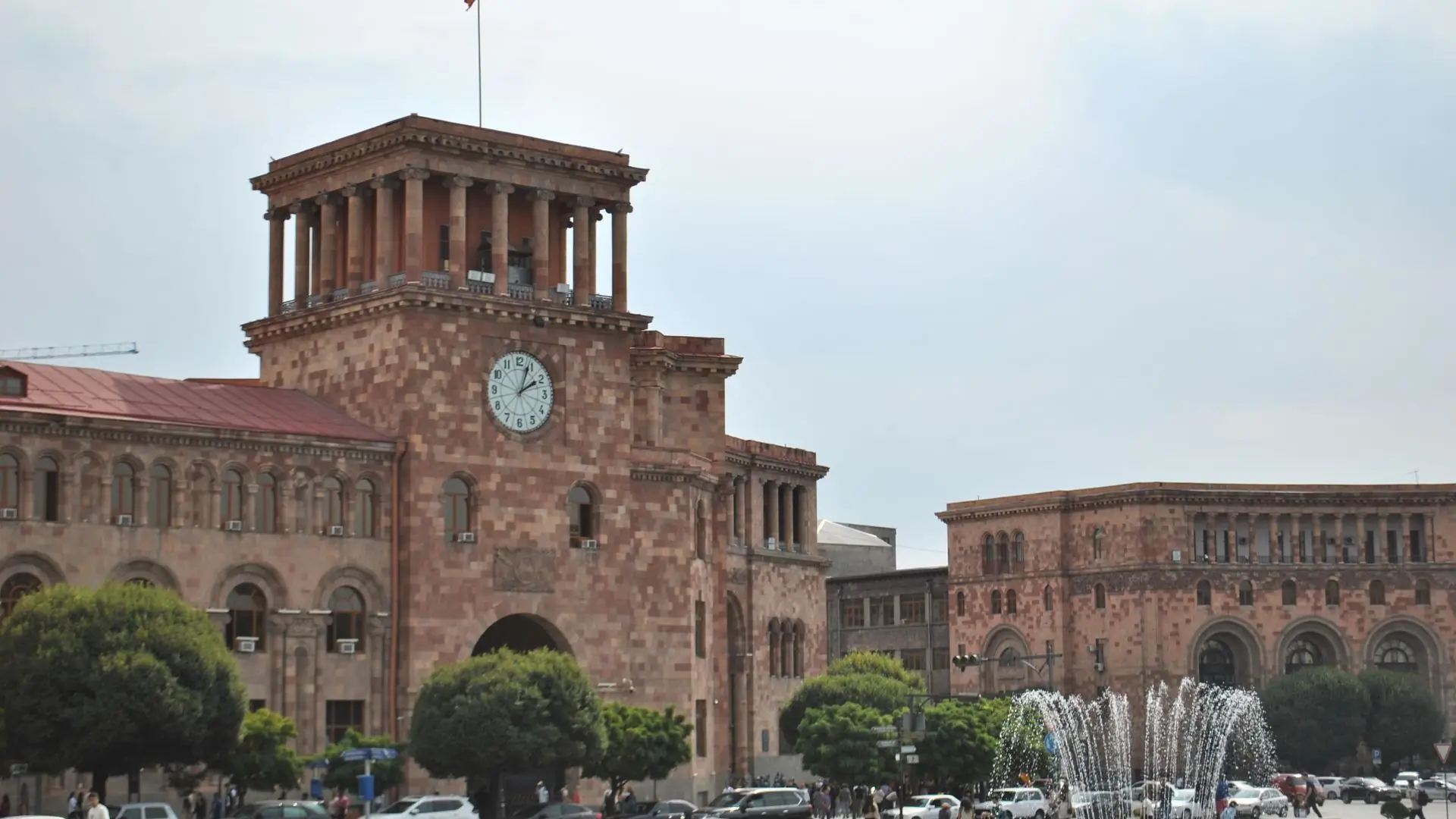
What you actually walk around in, though, is barely a century old, and it is one of the most coherent city centres in this part of the world. In 1924 Yerevan approved a master plan by the architect Alexander Tamanyan — a radial design with a ring boulevard, wide avenues meeting at squares meant for government, culture and sitting about. He had spent years studying local building traditions, and he made one decision that defines the place: he built it out of tuff.
Tuff is the local volcanic stone, and it comes in pinks, roses and warm apricot tones. Whole streets of it, and an entire ceremonial square, all cut from the same quarries — which is why Yerevan is called the pink city, and why the light at the end of the day does something to it that you will want to photograph badly and unsuccessfully.
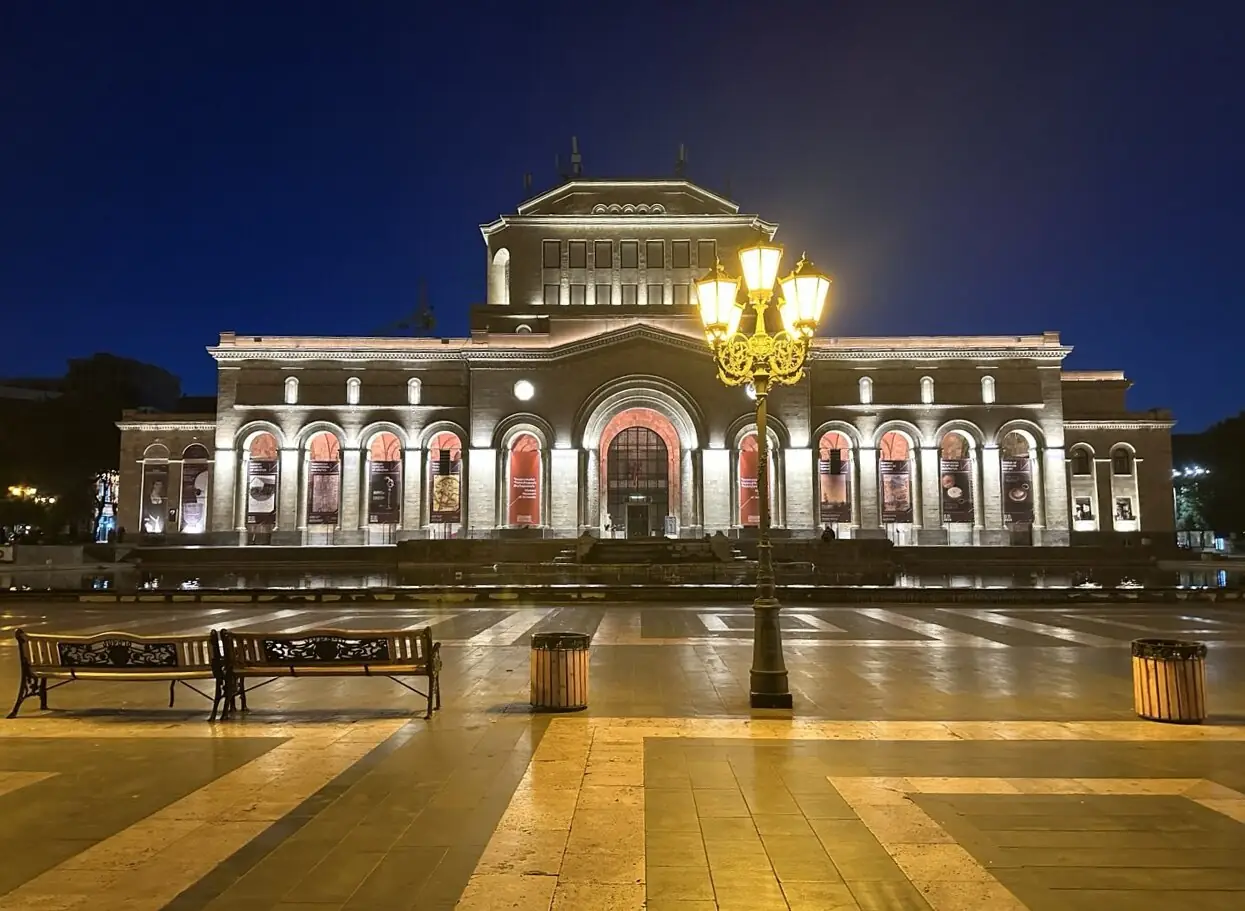
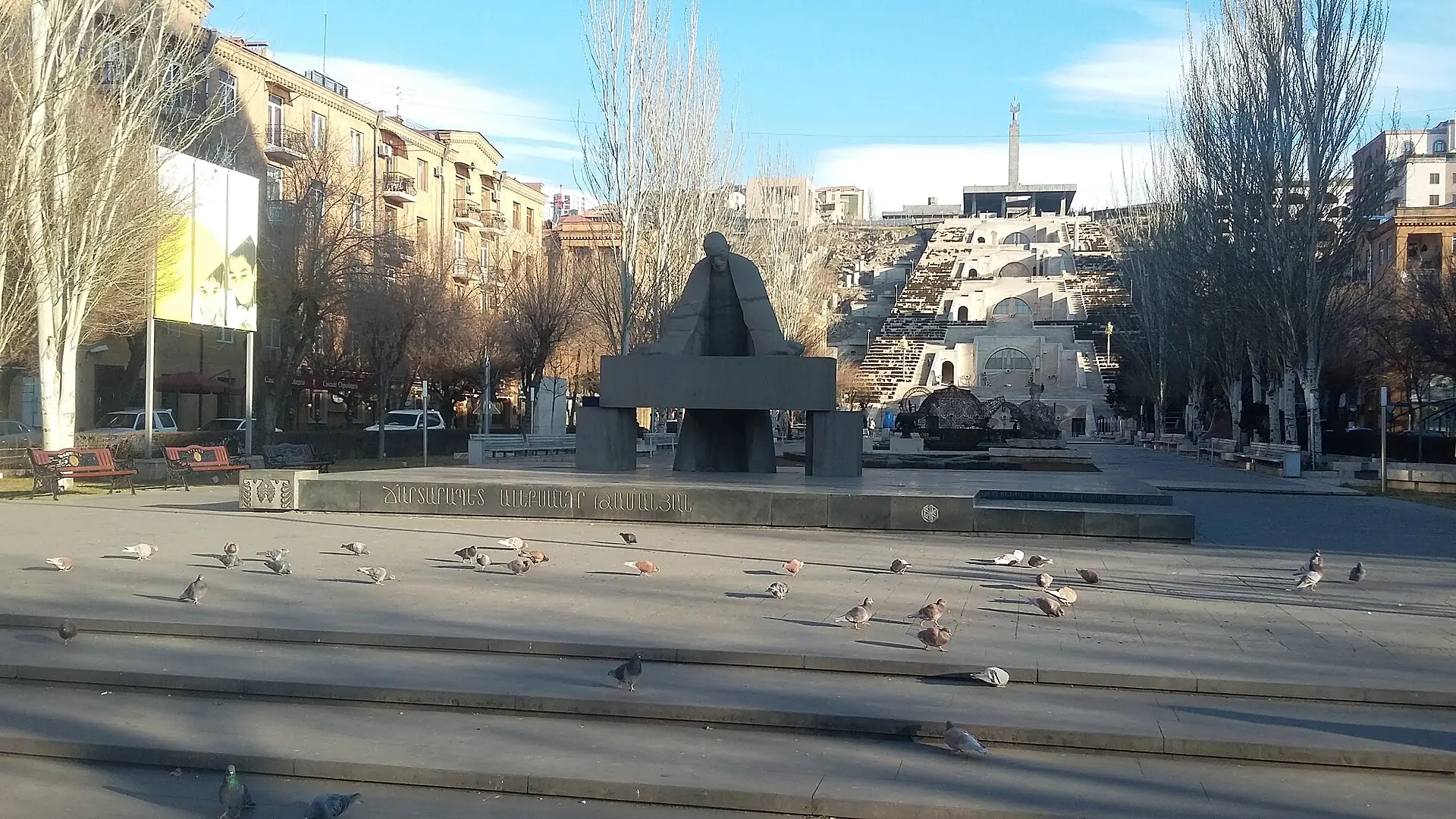
Republic Square is the set piece: a ring of monumental buildings in pink and rose tuff, faced with Armenian ornament, begun in 1926 and finished off with the National Gallery on the north side in 1977. Tamanyan himself is at the foot of the Cascade, cast in bronze, bent over a drawing board with his sleeves rolled up. He also had a hand in designing the national coat of arms, which tells you how much of this country’s self-image came off one man’s drafting table.
The Cascade, and what you see from the top
From the middle of the city, a giant stairway climbs the hillside in terraces: 572 steps, fountains, planting, and a sculpture garden at the bottom holding work by Fernando Botero, Lynn Chadwick and others — Botero’s enormous, entirely unbothered cat is the one everybody photographs. Inside the structure is the Cafesjian Center for the Arts, opened in 2009 around the collection of the Armenian-American philanthropist Gerard Cafesjian, and here is the detail nobody tells you: there are escalators running up through the middle of it, with galleries at every landing. You can ride up through a museum and walk down through a garden.
Climb or ride to the top platform in the early morning and you get the whole argument of the city in one view. Below you, the pink centre laid out on Tamanyan’s radial plan. Above and beyond it, floating over the haze on the Ararat plain, the mountain: Ararat, twin-peaked, snow on it most of the year, the national symbol and the thing at the centre of Armenia’s coat of arms. It rises across the border, in Turkey. It is also, unarguably, the view from every good window in Yerevan.
Two honest notes. Go early: by midday in summer the haze usually eats it. And in winter, when the air is cold and dry, it is at its sharpest — people who live here will tell you the mountain belongs to January.
The oldest numbers in the region
Armenia deals in dates that make other countries’ history look brisk, and three of them are worth your time.
An hour and a half south of the city, in a cave near the village of Areni, archaeologists working from 2007 found a shallow clay basin for treading grapes, a vat beneath it to catch the juice, storage jars, cups, and the withered remains of vines, skins and seeds. Radiocarbon dating put it at roughly 4100–4000 BC. The excavators, publishing in the Journal of Archaeological Science, described it as the earliest reliable evidence of wine production — a complete winemaking operation about 6,100 years old, which makes Areni-1 the oldest known winery in the world. The Armenian wine industry that has grown up around Areni since is, you will not be surprised to hear, quite pleased about this.
Then the church. By tradition, Armenia adopted Christianity as its state religion in 301, which is the basis of its claim to have been the first country in the world to do so — a date the Armenian church itself uses, though you should know that some historians argue for a decade or so later. The mother cathedral at Etchmiadzin, half an hour west of Yerevan, is described as one of the oldest cathedrals in the world; it was inscribed by UNESCO in 2000 along with the nearby churches and the ruins of Zvartnots, and it reopened in September 2024 after a six-year restoration. Much of what stands is seventeenth-century work on much older foundations, which the guides will tell you without being asked.
And on a hill above the centre sits the Matenadaran, the manuscript institute — part library, part museum, a great stone bunker of a building with Mesrop Mashtots, inventor of the Armenian alphabet, seated outside it. How many manuscripts it holds depends on who is counting and whether fragments count: UNESCO’s Memory of the World register says about 17,000, the institute’s own listing says around 23,000 plus several hundred thousand archival documents. Go and look at the things themselves — illuminated gospels the size of a paving slab, and others small enough to hide in a coat.
The ring of day trips
Yerevan sits in the middle of a set of very good half-days, all of them under two hours out.
Garni is a colonnaded temple in the Greek and Roman manner standing on a cliff edge east of the city — the only pre-Christian temple of its kind still standing in the country, and about as far east as this style of building got. Be clear about what you are looking at: it came down in an earthquake in 1679 and was re-erected between 1969 and 1975 using anastylosis, the method that puts the original stones back where they were and fills the gaps with new ones. Roughly a third of the material is original, and the conservators deliberately made the new stone distinguishable, so you can read the repair with your own eyes. Below the temple, the gorge is lined with hexagonal basalt columns hanging down the cliff like organ pipes — locally the Symphony of Stones, and worth the walk down.
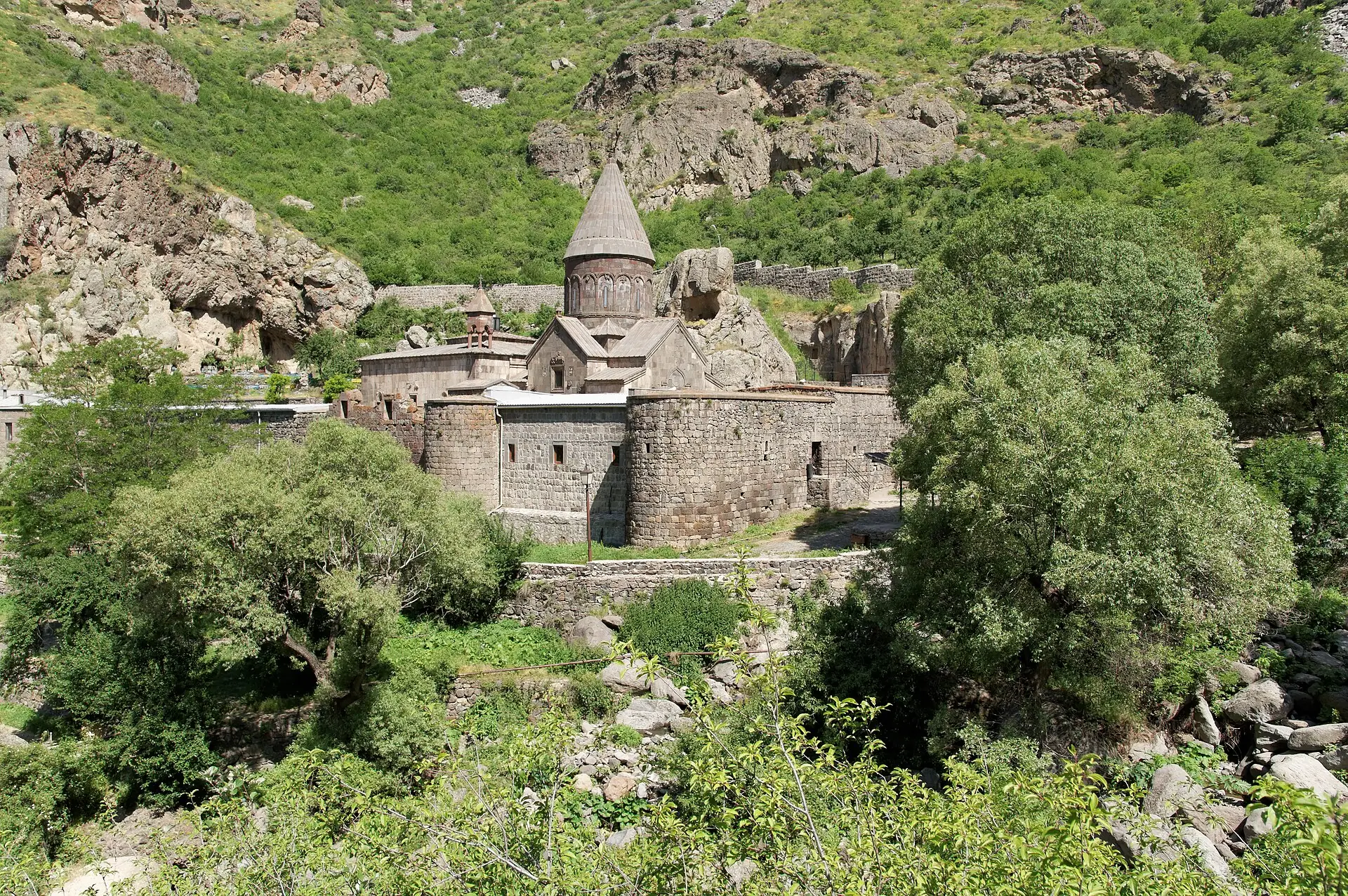
Geghard, a few minutes further up the same valley, is the one that will stay with you. Part of the monastery is built; part of it is carved directly into the cliff, chambers hollowed out of solid rock with pillars and domes cut in place, from the top down, by people who could not afford a mistake. The main church dates from 1215 and the rock-cut chapels from the decades after. UNESCO listed it in 2000 as the Monastery of Geghard and the Upper Azat Valley. If somebody starts singing in the carved chamber, stop walking — that acoustic is the reason people sing in there.
Lake Sevan is the summer answer to the heat: a huge freshwater lake at about 1,900 metres, the largest in the Caucasus and one of the largest high-altitude lakes anywhere, an easy run north-east of the city. Climb the steps at Sevanavank, the ninth-century monastery on the headland — it stood on an island once and the water has since dropped enough to join it to the shore — and take in a lot of very blue water with mountains behind it. Then eat the local trout, the ishkhan, by the water with lavash and herbs.
Bread, apricots, brandy
Lavash — the paper-thin flatbread that comes with everything — is on UNESCO’s intangible heritage list, inscribed in 2014 under the splendid title “Lavash, the preparation, meaning and appearance of traditional bread as an expression of culture in Armenia”. Watch it made and you will understand why it earned its own listing: the dough is rolled out, stretched over a padded cushion and slapped onto the inside wall of a tonir, a clay oven sunk into the ground, then peeled off half a minute later. It is baked in company, by women working in a practised rhythm, and at weddings it is laid over the shoulders of the couple.
Apricots you already half know, because the tree is called Prunus armeniaca — “the Armenian one”. That is a preserved geographical mistake rather than a fact: the name comes down through the botanist Gaspard Bauhin and was fixed by Linnaeus in 1753, and modern genetics puts the fruit’s origins in China and Central Asia. Armenia simply grew them for so long, and sat so squarely on the road west, that Europe assumed. Nobody here is in a hurry to correct it, and after a June apricot bought from a crate on the pavement, neither will you be.
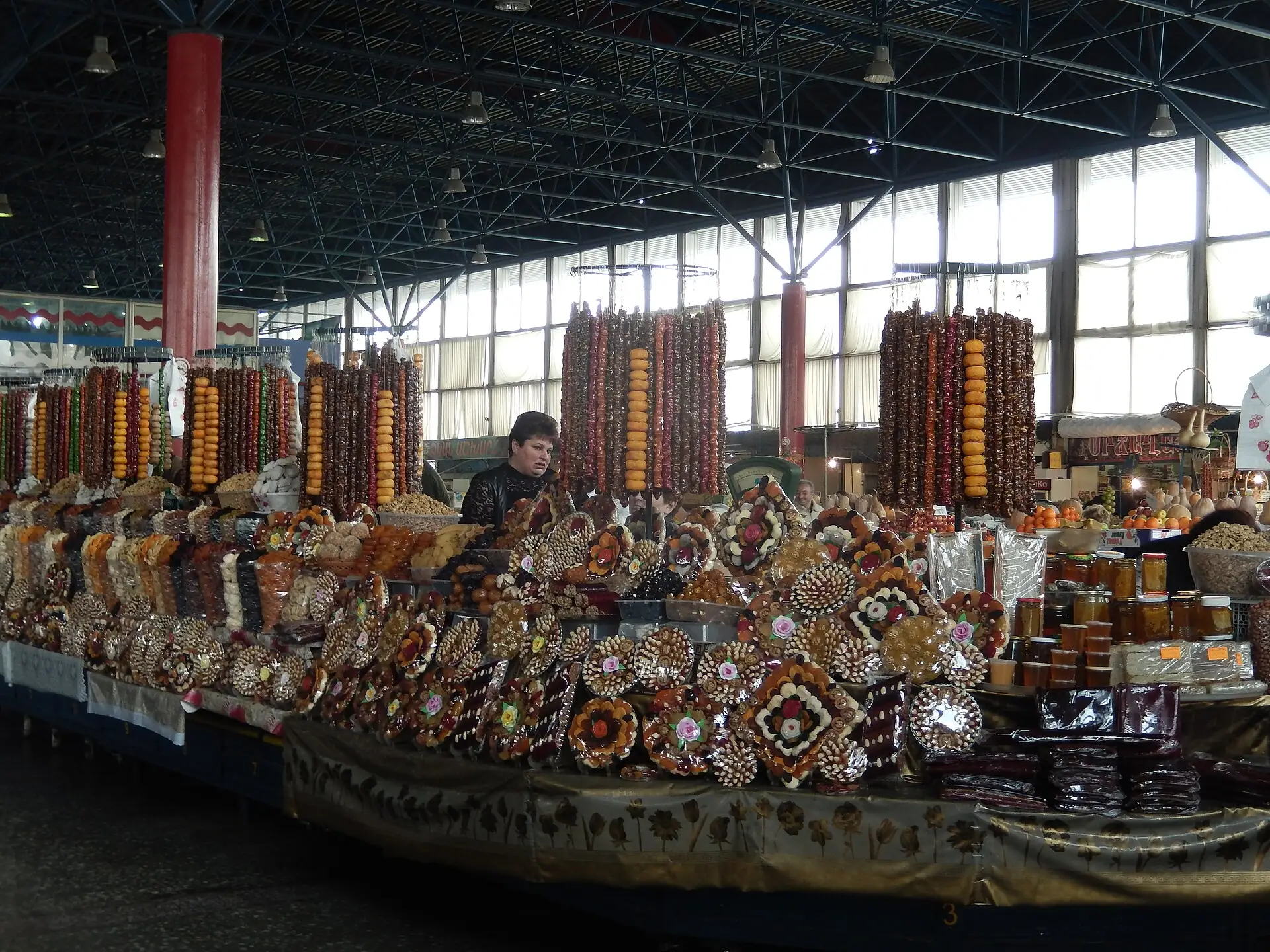
For the full spread, go to the GUM market, where the front half of the hall is a wall of dried fruit and nuts — apricots, figs, sheets of pressed fruit lavash, sujukh strung up like candles — and the vendors will feed you samples faster than you can swallow them. Buy the dried apricots. They are not the orange rubber ones.
And the brandy. The Yerevan Brandy Company traces its production to 1887, runs tours through the still halls and barrel cellars, and finishes them with a tasting; the house markets its brandy as Winston Churchill’s favourite drink, and every guide in the city has a version of the story attached. Treat it as the house’s own telling rather than documented history — the anecdotes have been polished by a century of repetition — and enjoy the brandy, which does not need the anecdote.
Coffee, terraces, and the case for sitting still
The thing Yerevan actually does best is not on any list. It is the evening: café tables spilling across pavements the length of the centre, families out walking, fountains running, the tuff going from rose to gold to grey while everyone works through another coffee. The local version, soorj, comes in a small cup with grounds in the bottom, and you order it and then stay for an hour.
The weather makes it possible. This is a dry city — around 430 millimetres of rain a year — and in July it averages close to twelve hours of sunshine a day. The place is built for being outdoors after work, and that habit, more than any monument, is what people miss when they leave.
When to come
Summer in the valley is genuinely hot: July and August routinely reach the mid-thirties and can go past forty, though the humidity is low and the evenings are the reward. The answer is altitude — Sevan, or the hills — and a habit of doing your walking early.
The comfortable windows are May and June, and mid-September into mid-October. Autumn is the one I would pick: the apricots are finished but the grapes and pomegranates are in, the markets are at their fullest, and the wine harvest is on. Winter is cold and clear, the terraces move indoors, and the mountain comes out sharp.
If your dates are flexible, aim at Vardavar. It moves — the fourteenth Sunday after Easter, so it lands in high summer — and it is a national water fight. Everyone throws water at everyone: buckets from balconies, hoses, water pistols, the fire brigade joining in, strangers included, cameras at your own risk. It began as a festival of an old goddess of water and was folded into the church calendar, and it is the single most joyful thing in the Armenian year. It is not a public holiday, so the city works through it, wet.
On entry: Armenia is not in the Schengen area and runs its own rules — US and UK passport holders can currently visit visa-free, and our guide to reaching Yerevan without a nonstop covers the practical side. Check current requirements before you book.
Last light on the steps
Finish on the Cascade about an hour before sunset, halfway up, where the steps are wide enough to sit on. The tuff below you turns from pink to rose-gold. The fountains go on. Somewhere down to the left a wedding party is being photographed for the fourth time that afternoon, and the traffic noise arrives soft and late.
Then the haze thins, the way it sometimes does at the end of a hot day, and the mountain comes back — enormous, snow-lit, apparently much closer than it is. A city that has been keeping its own records for two thousand eight hundred years, still ending the day the way it presumably always has: sitting outside, facing the same horizon, with something cold to hand.
FAQ
Is Yerevan worth visiting?
Yes, and it is one of the better-value city breaks left in this part of the world. You get a coherent pink-stone capital built to a single 1920s plan, a museum you ride up through on escalators, the world’s oldest known winery and a Hellenistic temple within a couple of hours’ drive, food worth crossing a continent for, and a café culture that runs from mid-morning until very late. Three or four days is the right length: two in the city, two out of it.
Is Yerevan really older than Rome?
By its own founding date, yes. The fortress of Erebuni was built here in 782 BC by the Urartian king Argishti I, and we know because he left a cuneiform inscription saying so — a basalt slab now in the Erebuni museum, with two further copies found on the same citadel. Rome’s traditional founding date is 753 BC, which makes Yerevan twenty-nine years older on paper. The city celebrated its 2,800th birthday in 2018.
What is Yerevan famous for?
Four things, mostly. The stone: the centre is built of pink volcanic tuff, which is why it is called the pink city. The Cascade: a monumental stairway with a sculpture garden at its foot and an art museum inside it. Brandy: the Yerevan Brandy Company has been at it since 1887 and runs tours. And the mountain: Ararat dominates the skyline and sits at the centre of the national coat of arms, though it rises across the border in Turkey. Add lavash, apricots and one of the world’s great dried-fruit markets.
When is the best time to visit Yerevan?
May and June, or mid-September to mid-October. Summer in the valley is hot — the mid-thirties and sometimes beyond — which is manageable if you keep to early mornings and head for Lake Sevan or the hills in the afternoons. Autumn is the connoisseur’s choice for the harvest and the markets. Winter is cold, clear and quiet, and it gives you the sharpest views of Ararat you will get all year.
Photos: Serouj Ourishian (CC BY 4.0), 23artashes (CC BY-SA 4.0), 22Photopat (CC0), Vyacheslav Argenberg (CC BY 4.0), Armineaghayan (CC BY-SA 4.0), via Wikimedia Commons.


