
The Moor’s Last Sigh
The surrender is famously captured in a legend too good to skip, even if it is too heavily embroidered to state as historical record. Tradition says that as the defeated Emir Boabdil rode away into exile, he turned back at a mountain pass to take one last look at his city and wept—prompting his mother to rebuke him with the line, “Do not weep like a woman for what you could not defend as a man.” The pass is still known today as the Puerto del Suspiro del Moro, or the Pass of the Moor’s Sigh.

The Alhambra
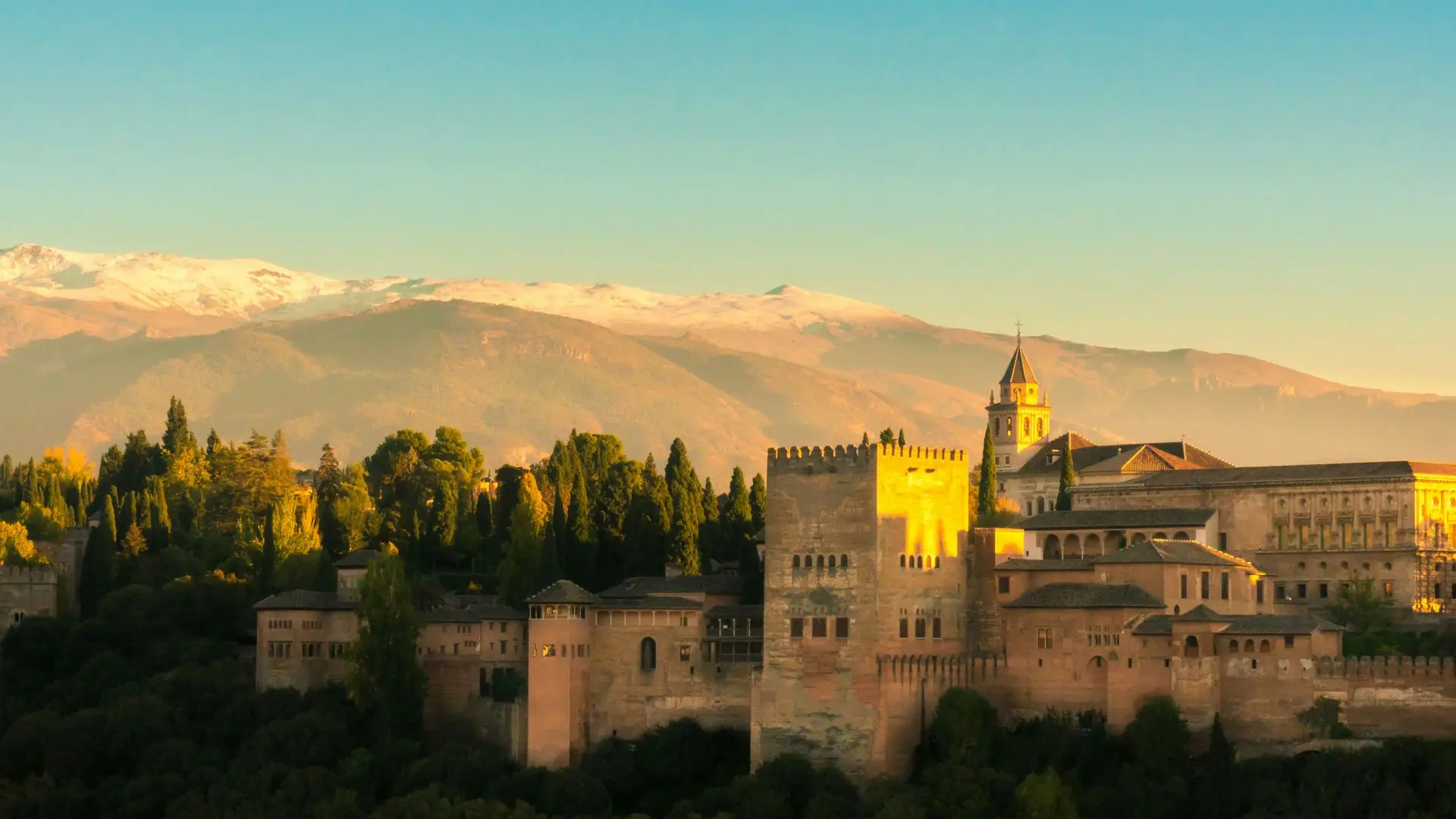
The Alhambra was not built as a monument; it was the active, fortified palace-city of the Nasrid court. The profound melancholy of the architecture comes from knowing that its finest rooms were built by a kingdom that was already living on borrowed time. The complex, along with the adjacent Generalife gardens, was inscribed as a UNESCO World Heritage site in 1984 (the Albaicín neighbourhood was added later, in 1994).
Practically speaking, visiting the Alhambra requires serious planning. Tickets routinely sell out up to three months in advance. You must book early through the official Patronato de la Alhambra channel, as your entry to the spectacular Nasrid Palaces is tied to a strict, non-negotiable time slot.

The Albaicín and Sacromonte
Across the valley sits the Albaicín, the old Muslim quarter. It is a steep maze of whitewashed lanes and cármenes (the traditional, high-walled houses concealing private orchards and gardens). The neighbourhood climbs to the Mirador de San Nicolás, which offers the defining postcard view of the Alhambra against the backdrop of the Sierra Nevada. The mirador is always crowded at sunset, but it is crowded because the view absolutely earns it.
Further along the hillside lies Sacromonte, the traditional cave-house district. This is the historic home of the city’s Roma community and the birthplace of zambra, a distinct, passionate style of flamenco performed in the caves themselves, carrying a very different rhythm to the tablaos of Seville.
The Christian Overwrite
Following the 1492 conquest, the new rulers stamped their authority directly into the urban fabric. Isabella and Ferdinand chose to be buried in the city they had just taken; their grand tombs sit in the Royal Chapel. Right next door, the massive Granada Cathedral was built directly onto the footprint of the city’s former Main Mosque. Centuries later, Granada produced one of Spain’s greatest modern ghosts: the poet Federico García Lorca, who was born just outside the city and murdered nearby in the early days of the Civil War.

The Free Tapas Tradition
Granada remains one of the last major Spanish cities where a drink still reliably brings an unasked-for, complimentary plate of food. This is a real, living custom. In most traditional bars, ordering a beer or wine means you will be served a tapa. Order a second round, and a different, often more substantial tapa arrives. It dictates the entire evening rhythm of the city.
The Practical Frame
The city sits at an elevation of roughly 700 metres. This means the summers are brutally hot, but the winters are genuinely cold. In the spring, the geography allows for a famous local boast: you can ski in the morning on the slopes of the Sierra Nevada, drive down the mountain, and reach the beaches of the Costa Tropical in the same afternoon.
For most visitors, standard Schengen area rules apply, but always check current entry requirements and the rollout of the ETIAS system before you book. While Granada does have a small airport (GRX), many travellers fly into Málaga and make the easy journey up by road.
To understand the city’s enduring gravity, walk down a narrow Albaicín lane in the early evening. As the floodlights come on across the valley, the last emirate is still the very first thing the city shows you.
FAQ
Do I need to book Alhambra tickets in advance?
Yes. Alhambra tickets regularly sell out weeks or even months in advance. You should book through the official website as soon as your travel dates are confirmed. Your entry to the Nasrid Palaces will be tied to a strict, specific time slot.
How many days do I need in Granada?
Two to three days is ideal. The Alhambra requires an entire half-day on its own, leaving the rest of your time to explore the steep streets of the Albaicín, the cathedral district, and the evening tapas culture.
Is the free tapas tradition in Granada real?
Absolutely. In the vast majority of local bars, every round of drinks you order will be accompanied by a complimentary plate of food. It is a deeply ingrained local custom rather than a tourist gimmick.
Can you visit Granada as a day trip from Seville or Málaga?
You can, and many tour buses do exactly that. However, much like Seville, doing so means you miss the city at its best. By leaving before dusk, you miss the sunset from the miradors and the entire evening tapas culture, reducing a layered city to a rushed palace tour.


