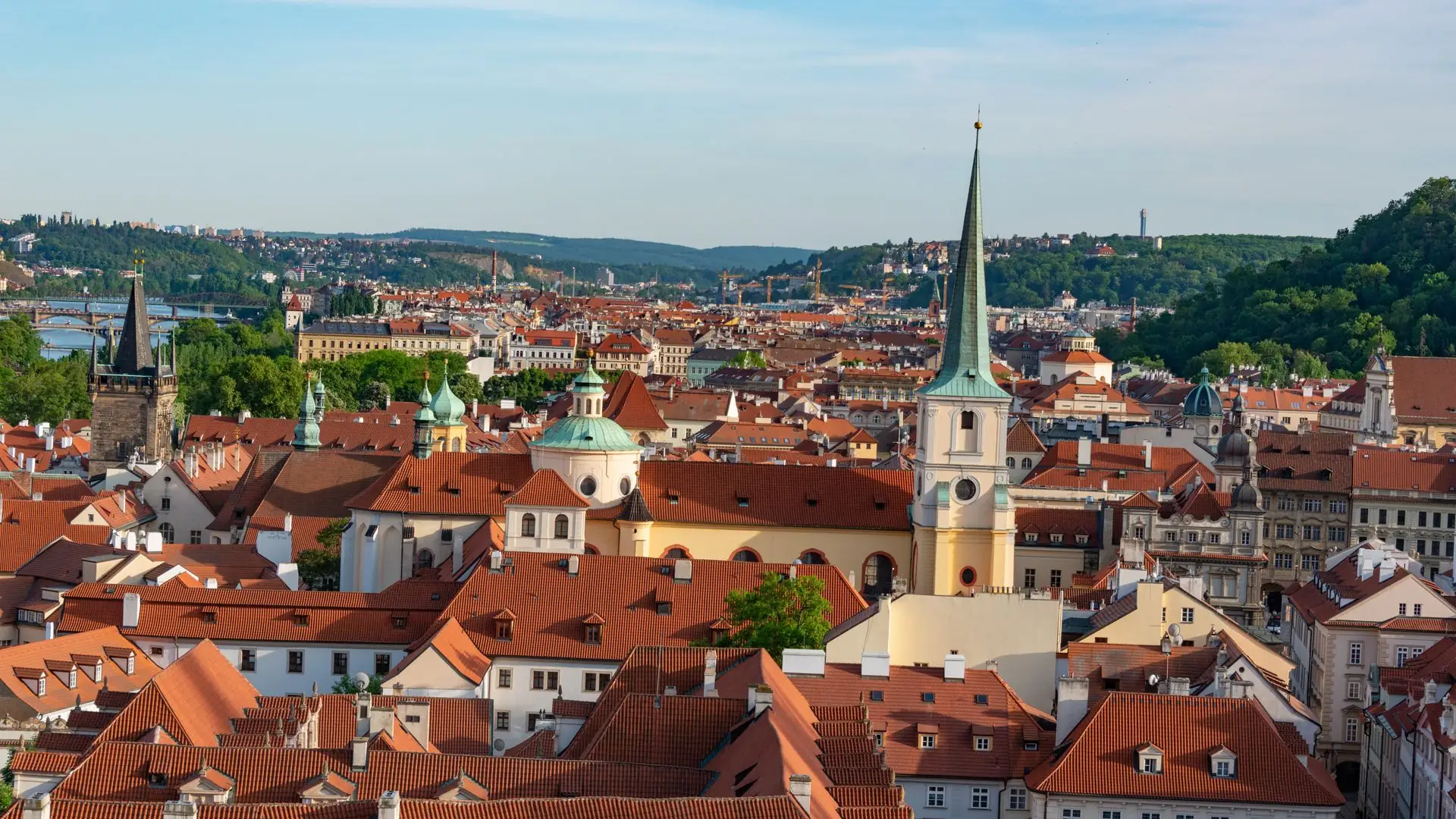

That gap is the honest way into this city, because it is the exception. Almost everything around it is the real thing — not a reconstruction, not a facsimile, not a careful post-war copy of something that burned. Prague’s centre is original stone. And that fact, more than any beauty in it, is why you will be sharing it with everyone else.
Preserved by bad weather, then by bad economics
Warsaw was rebuilt from photographs and rubble. Dresden burned in February 1945 and spent the rest of the century putting itself back together. Prague came through the war substantially intact, which is the reason its Gothic and Baroque streetscape reads the way it does: because it is that streetscape, not a memory of one.
So: luck, mostly. Then came the second half of the mechanism, and it was not reverence either. Four decades of communist rule left the historic centre alone — not out of care, but because there was no money, no property market and no motive to knock anything down and build higher. No towers went up on the river. The facades crumbled quietly instead. When the country opened in 1989, tourism inherited a complete historic city that nobody had ever designed as a stage, and it went to work on it immediately. UNESCO listed the historic centre in 1992.
The castle and the bridge, on the crowd clock
Guinness World Records lists Prague Castle under the title “largest ancient castle”, describing it as “the largest ancient castle in the world”. The castle’s own administration prefers a slightly different formula — the largest coherent castle complex — and the two versions have been circling each other for years. Either way, the important thing about it is less the acreage than the address: it is still the official seat of the Czech president. You are walking through a working head-of-state’s offices with a cathedral in the middle.
Charles Bridge was commissioned by Charles IV in 1357, after a flood took its predecessor, the Judith Bridge, in 1342; Peter Parler, who also built St Vitus, took over its construction. There is a well-loved local story that the first stone was laid at 5.31am on 9 July 1357 because the sequence of numbers made a palindrome and Charles believed it would hold the bridge up. Treat that as tradition rather than record — a clock giving the minute would have been a tall order in 1357.
My only practical advice about the bridge is about the hour, not the stone. At dawn it belongs to the city: joggers, a delivery van at the far end, the statues black against a grey river. By ten it belongs to everybody. Same bridge, entirely different experience, and the difference costs you nothing but an alarm.
Forty-five seconds
The astronomical clock on the Old Town Hall — the Orloj — had its mechanism and astronomical dial installed in 1410, built by Mikuláš of Kadaň to a design by the mathematician Jan Šindel; the first written record dates to October of that year. The recognised formula for it is careful, and worth repeating exactly: it is the oldest astronomical clock still in operation. There is an older one at Wells in England, from 1386, but it no longer runs on its original mechanism. Prague’s does, in large part.
It has not had an easy life. The mechanism was wrecked when the Old Town Hall burned in May 1945 and did not run again until 1948. Its most thorough restoration since then ran through 2018, and one of its better decisions was to take out the electric movement fitted in 1948 and put an 1860s mechanism back in its place.
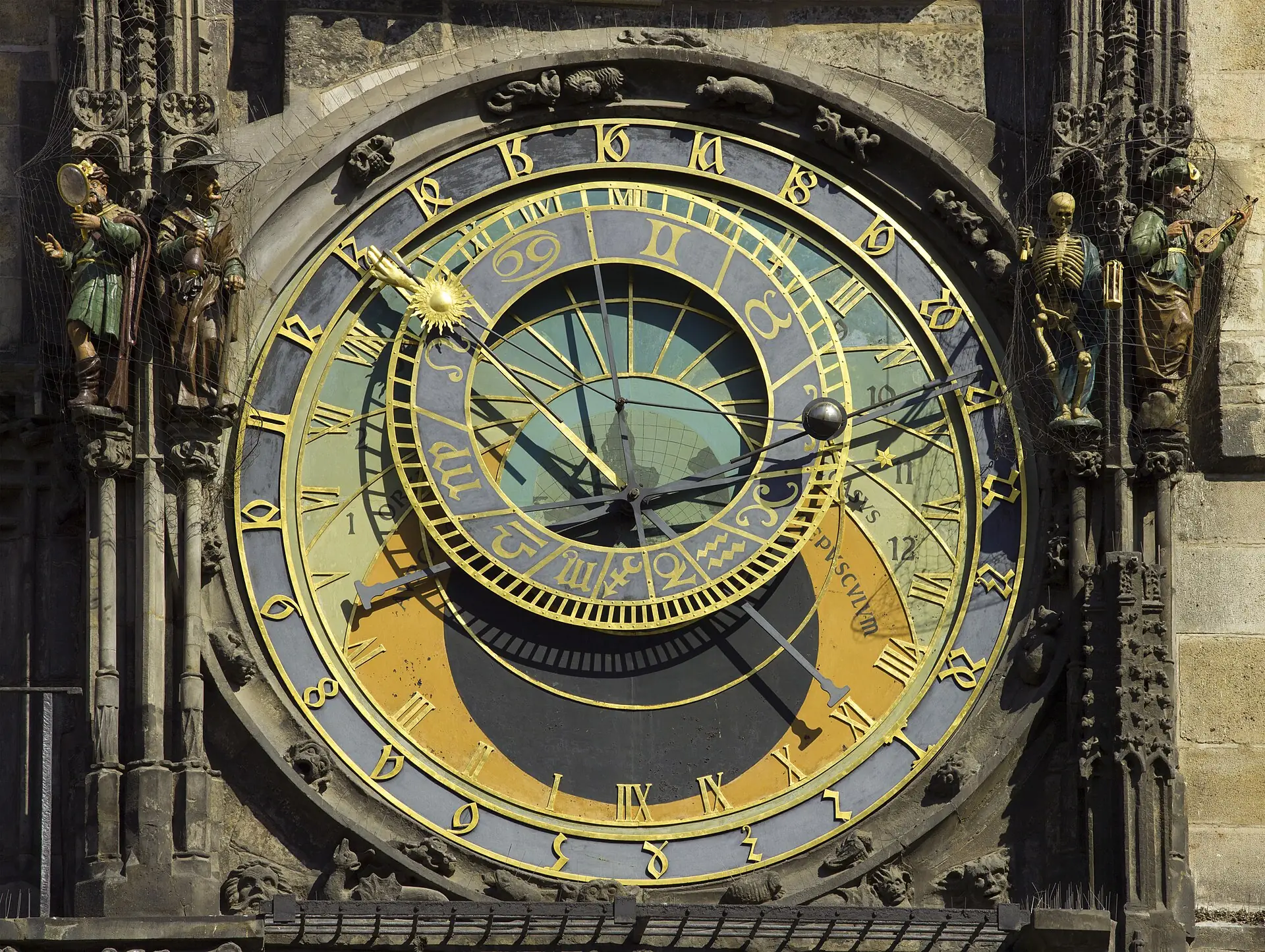
The show on the hour lasts about forty-five seconds. Death pulls his rope, two little doors open, the apostles file past, a gilded cockerel crows, and it is over. I have watched people wait forty-five minutes for it. My honest position: the clock is remarkable and the show is not, and you can look at the dial properly at eight in the morning when there is nobody in front of it.
Josefov, the old quarter that isn’t old
This is the part of Prague that most rewards knowing what you are looking at. Walk up Pařížská, the wide boulevard running north from Old Town Square, and you are on a street that was cut on the Paris model at the turn of the twentieth century. The elegant apartment blocks either side of you are Art Nouveau. The “old Jewish quarter”, as a piece of townscape, is younger than the Eiffel Tower.
The clearance law was approved by Franz Josef in February 1893 and demolition began in 1895. The quarter it removed was genuinely desperate — appallingly overcrowded, with shared wells and shared toilets, and repeated outbreaks of disease — and support for clearing it came from inside the community as well as outside. Over the following two decades several hundred houses went. What stopped the bulldozers at the monuments was that they had been listed, plus a good deal of public protest: six synagogues, the Jewish Town Hall and the cemetery survived, and almost nothing else did.
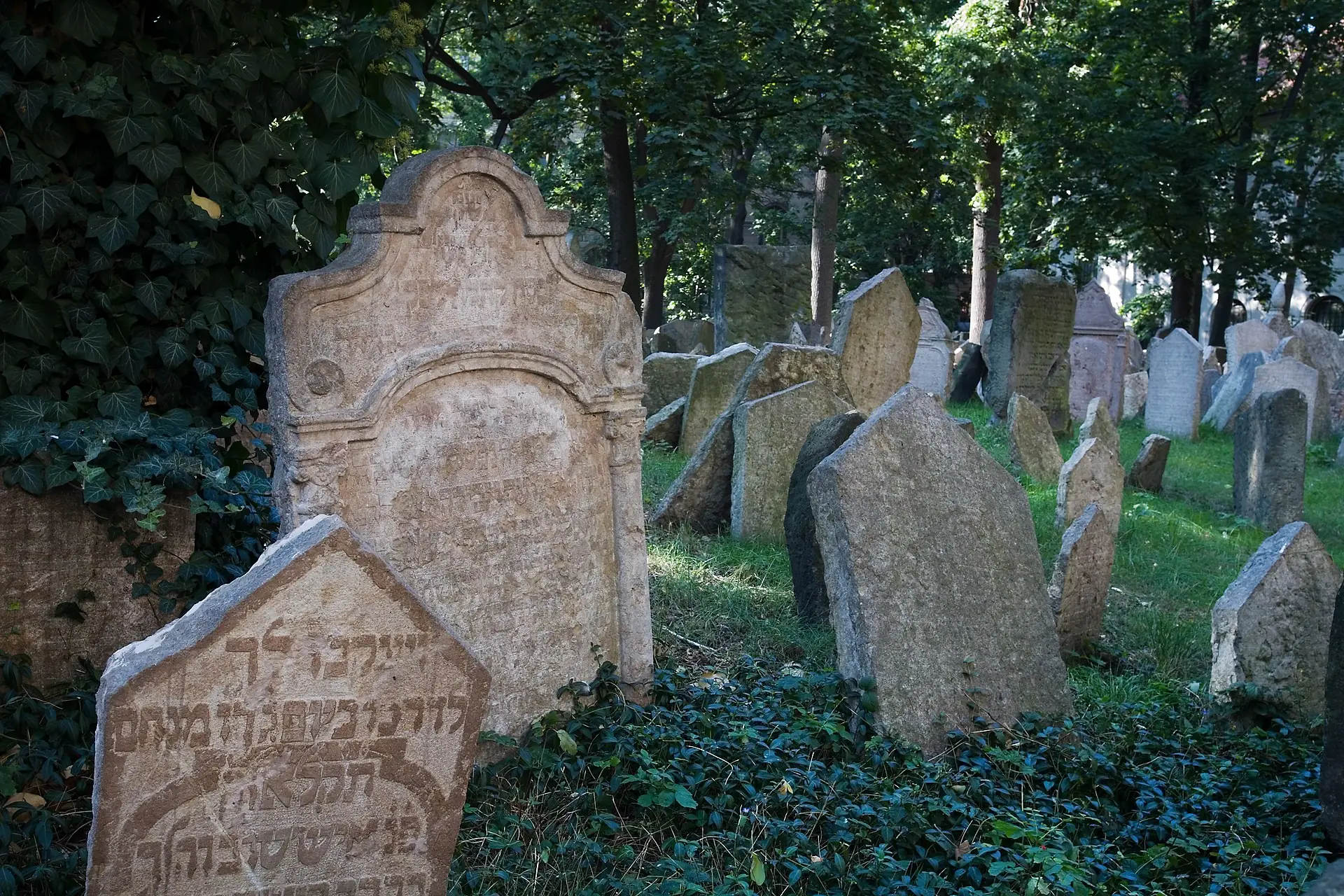
The Old-New Synagogue is the anchor. Completed around 1270, it is by the standard formula the oldest active synagogue in Europe, and it has served the Prague community for more than seven and a half centuries. Next door, the Old Jewish Cemetery holds more than twelve thousand headstones on a plot far too small for them: Jewish law forbids disturbing a grave, so earth was brought in and the stones were lifted to the new level, again and again, up to a dozen layers deep. The oldest surviving stone is from 1439. Burials stopped in 1787, when Joseph II banned graveyards inside the inhabited city.
The century nobody puts on a postcard
Ride the metro’s line A, opened in August 1978, and look at the walls: curved sheets of anodised aluminium pressed into rows of domes and dimples, gold at Hradčanská, green at Malostranská, red at Staroměstská. It looks like a design statement and it half is — but the pressed panels were also cheap, and there was no stone to spare for cladding. Necessity, decorated.
Out at Žižkov, the television tower from the 1980s has ten faceless bronze babies crawling up its legs — David Černý’s work, added in the 1990s. The ones up there now are replicas: the originals came down in 2017 and copies went up in 2019 under an agreement that should keep them in place for two decades.
Then there is Wenceslas Square, which is not a square but a boulevard, and which has been the country’s stage more than once. Independence was proclaimed at the foot of the Wenceslas statue in October 1918. And in November 1989, Václav Havel spoke to the crowd from the balcony of the Melantrich building at number 36, standing there days later with Alexander Dubček. Look up. The balcony is above a branch of a British high-street chain, and almost nobody looking at the shop window knows it is there.
The beer question, honestly
The Czech Republic has come top of the world’s per-capita beer table every year since 1993 in the annual Kirin survey, though the figure has been falling for the last couple of years. That statistic, plus cheap flights, built the other Prague: the stag-weekend economy that made a certain kind of Briton internationally recognisable in Staré Město.
The city has pushed back. In October 2024 the council amended the market order to prohibit commercially organised pub crawls in the centre between 10pm and 6am, and that ban is what is in force now. It bites on the agencies, not on you: guided tours run in daylight hours, bars keep their own closing times, and four friends walking between pubs at midnight are doing nothing wrong. Whether it has changed the noise on Dlouhá is a question locals will answer differently depending on which floor they live on.
The useful thing to know about beer here has nothing to do with any of that. Walk two streets off the Royal Route — the processional line from the Powder Tower through Old Town Square, across the bridge and up to the castle — and the same lager is served to a completely different room: no English menu on a stand outside, a tap list of one, and a waiter who marks your tab on a slip of paper and expects you to sit down and stay a while.
Where the city actually lives
Vinohrady, up the hill east of the centre, was vineyards before it was a district, and it is where Czech Prague drinks its coffee: broad nineteenth-century streets, a farmers’ market on Jiřího z Poděbrad square, and a church on it that looks like nothing else here: Jože Plečnik’s Sacred Heart, finished in 1932, its flat tower carrying a glass clock face nearly eight metres across. If you have read our piece on the capital Plečnik designed almost single-handed, that name will be familiar — this is the same man, working abroad. Riegrovy sady is the slope above it where the whole neighbourhood goes to watch the sun set behind the castle, beer garden included.
Across the river, Letná gives you the better view and knows it. The beer garden on the edge of the park is trestle tables under trees, and from the fence you can count bridges across the Vltava — a proper row of them, with the Old Town roofs behind. No ticket, no queue, no turnstile. Below it, Holešovice sits in a bend of the river doing what former industrial districts do: contemporary art in a converted building, an arthouse cinema, a lot of coffee.
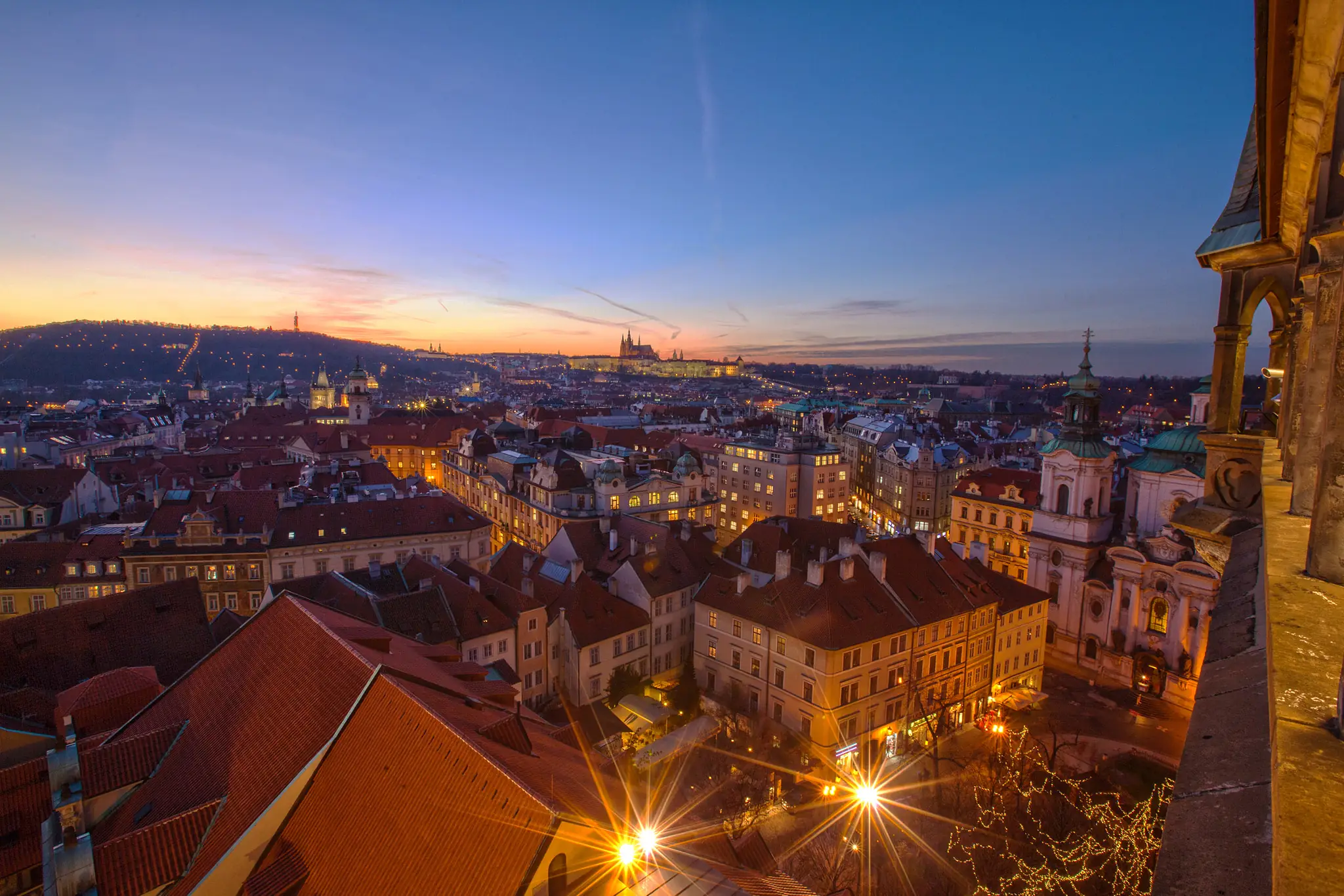
None of these places will change your understanding of European history. They will change your understanding of Prague, which spends its days being looked at and its evenings being lived in.
When to come
Summer is the crush, and the centre in July is not a place I would send anyone who dislikes queueing. December has its own arithmetic: the markets on Old Town Square and Wenceslas Square run from the end of November to Epiphany, and they are genuinely good — mulled wine, a tree, roasting smells — but they are also the year’s second peak, and everything from beds to seats gets tighter (our guide to actually getting into the city from the airport goes through the practical side of that in more detail). The sane windows are roughly April to May and September to October: workable weather, daylight worth having, and streets you can move through.
If you can only come in late autumn, take it. Fog on the Vltava in November, the bridge statues going in and out of it, the castle a suggestion above the murk — that is the version of this city nobody puts on a postcard, and it is the best one.
On entry: the Czech Republic is in the Schengen area, and US and UK passport holders visit without a visa for up to 90 days in any 180. Passports are now recorded in the EU’s biometric Entry/Exit System rather than stamped, and the ETIAS travel authorisation is still to come without a confirmed start date — check current requirements before you book.
One last thing, if you come in December
Through Advent, a man in a nineteenth-century gasworks uniform walks onto Charles Bridge in the late afternoon with a bamboo pole about the length of himself, and lights the bridge’s forty-six gas lamps by hand, one at a time, out to the Malá Strana tower and back down the other side. The rest of the gas lamps along the Royal Route come on automatically; the bridge is the only one that gets a lamplighter, and — the gasworks maintain — the only bridge anywhere still lit by gas.
A small crowd follows him for the first dozen lamps. By the halfway point most of them have drifted off to the markets, and what you have is a bridge going slowly warm in the dark, a man working at walking pace, and the river underneath doing nothing at all. Prague spends most of the year performing. That is one of the few minutes when it simply gets on with something.
FAQ
Is Prague’s Old Town original or rebuilt?
Largely original — which makes it unusual in central Europe. The historic core came through the Second World War substantially intact, unlike Warsaw or Dresden. The Jewish quarter is the big asterisk — most of Josefov was demolished and rebuilt around 1900, so its handsome streets are Art Nouveau, not medieval.
Is Prague still cheap?
Cheaper than Vienna, Paris or Copenhagen, but the days when it was a bargain across the board are over. The gap between the centre and everywhere else is now the real story: a table on the Royal Route is priced for people who will be here once, and the same beer two streets away is priced for people who come every Thursday. Eat where the menu is only in Czech and the difference is immediate.
How many days do you need in Prague?
Three, and I would argue hard against two. One day disappears into the castle, the bridge and the Old Town, which is the part everyone else is also doing. The second buys you Josefov properly and the twentieth-century city — Wenceslas Square, Žižkov, the metro stations. The third is the one that changes your opinion of the place, because it is the day you spend in Vinohrady or Letná and stop being processed.
When is the best time to visit Prague?
April to May or September to October. You get usable weather and a centre you can walk through, which is not true in July. December is the trade-off month: the Christmas markets are worth seeing and they arrive with the year’s second crowd. Late autumn is quiet, damp and, if you like fog on a river, the most beautiful.
Images: mendhak / CC BY-SA 2.0; Godot13 / CC BY-SA 4.0; Jorge Royan / CC BY-SA 3.0; Lucy Liu / CC BY-SA 3.0. Source: Wikimedia Commons.


