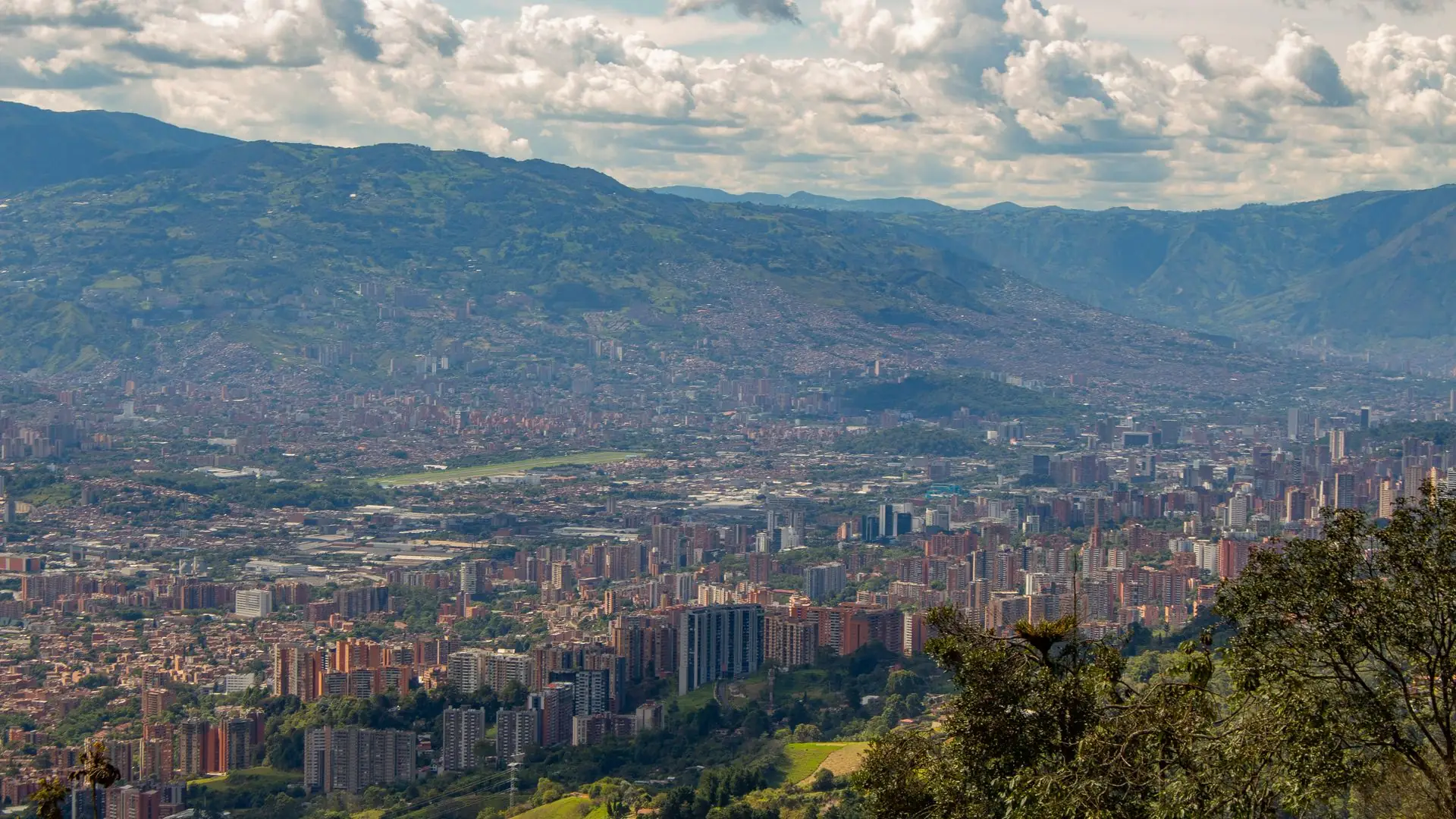

There is also a second airport, which is in the middle of town, and a fare search will cheerfully offer it to you. Sorting out which one you want takes about ninety seconds, and after that this is one of the easier long-haul trips in the Americas — a three-to-four-hour hop from most of the eastern United States, and a country whose weather doesn’t have seasons in the way yours does.
Two airports, and which one you actually want
- José María Córdova (MDE) is the international airport, at Rionegro, about 20 km southeast of the city and sitting at roughly 2,142 meters of elevation. Every flight from outside Colombia lands here. This is the code to search.
- Olaya Herrera (EOH) is inside Medellín — a few kilometers from the centre, close enough to walk out of and be somewhere. It is entirely domestic and regional: no international flights at all, and an aircraft-size limit that keeps it to turboprops and small jets, with one carrier’s 76-seaters as the exception.
So the actionable version: if a fare search offers you EOH, it is offering you a domestic connection. That’s excellent news if you’re coming down from Bogotá and staying in the city — you land twenty minutes from your hotel instead of an hour, and you skip the mountain entirely. It is no use whatsoever as an international arrival. Two carriers do most of the flying there, SATENA and EasyFly, on a busy web of Colombian regional routes; schedule data also shows a third operator, Clic Air, taking a large share, and my sources don’t agree on the current split, so check who’s actually selling your specific route.
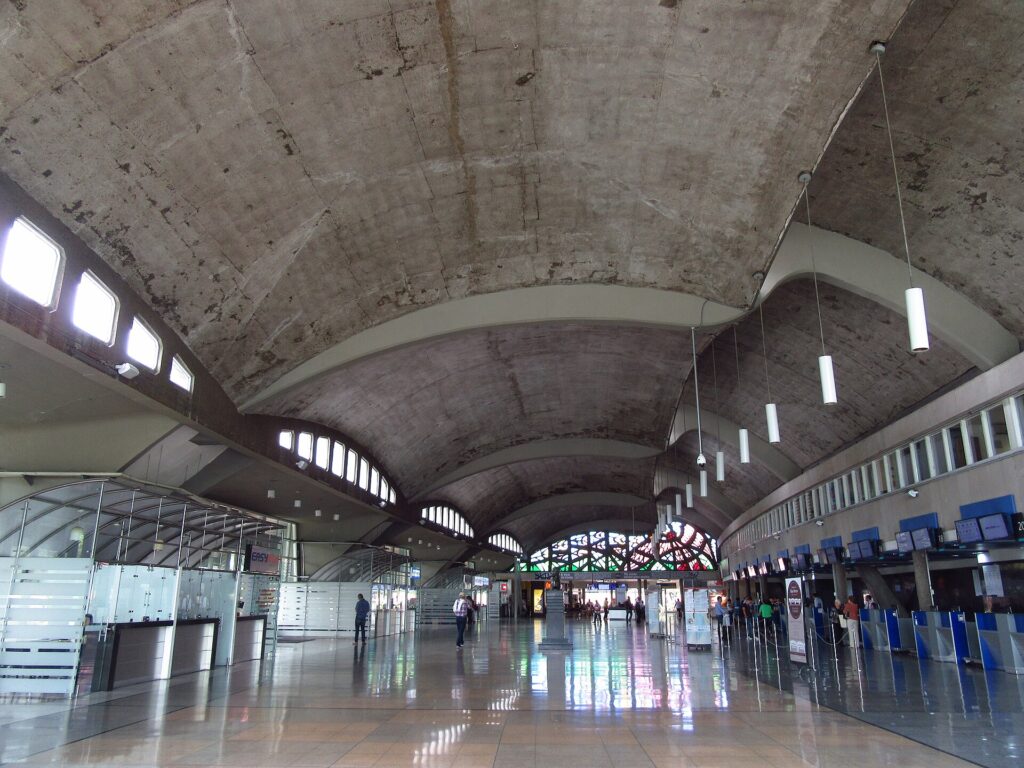
Getting down the mountain, and the tunnel rule almost nobody mentions
Until 2019 the drive from MDE into the city was the price you paid for the airport — an hour or so of switchbacks down off the plateau. Then the Túnel de Oriente opened: a 24-kilometer corridor of tunnels and viaducts that cut the run to somewhere around twenty minutes. If your guidebook still budgets an hour, it predates the road.
Now the part that matters and that I’ve seen almost nowhere in English. The concession’s own operating rules state that on Sundays and holiday Mondays, between 5 p.m. and 9 p.m., the tunnel runs in one direction only — eastbound to westbound, which is Rionegro toward Medellín. It’s done to speed the weekend traffic coming back into the valley. The consequence for you is precise and easy to miss: in that window you cannot use the tunnel to reach the airport. You go up the old way, on the Las Palmas road or the Medellín–Bogotá highway, and you need the hour you thought you’d saved.
Sunday evening is not an unusual time to fly home. If that’s your departure, add the time, and check the concession’s own channel for the day’s status before you set off — they publish real-time operating information, including closures.
The morning fog, which is a scheduling fact rather than a warning
Here’s the other thing the plateau does to you. MDE sits high, in the mountains of eastern Antioquia, and fog banks form over the approach on a good number of mornings. When visibility drops below the minimums, controllers restrict landings — and inbound flights hold, divert, or get cancelled while the airport keeps launching departures.
The reassuring part is the shape of it. This is an early-morning phenomenon: the disruptions cluster roughly between six and nine in the morning and usually clear within a couple of hours, at which point the airport catches up. It’s a delay pattern, not a closure risk. But it does have two practical consequences worth building into a plan:
- Don’t build a tight same-day onward connection on an early-morning arrival at MDE. If you’re continuing to the coast, give the morning some slack — or fly the connection in the afternoon.
- Check your flight status before you leave for the airport, which is the airport’s own standing advice during fog. It posts live updates, and so do the usual tracking services.
Flying in from the United States
This is the strong market, and for a lot of the eastern US it makes Medellín a genuine long-weekend proposition — the flight from Florida is shorter than a transcontinental. The nonstop map:
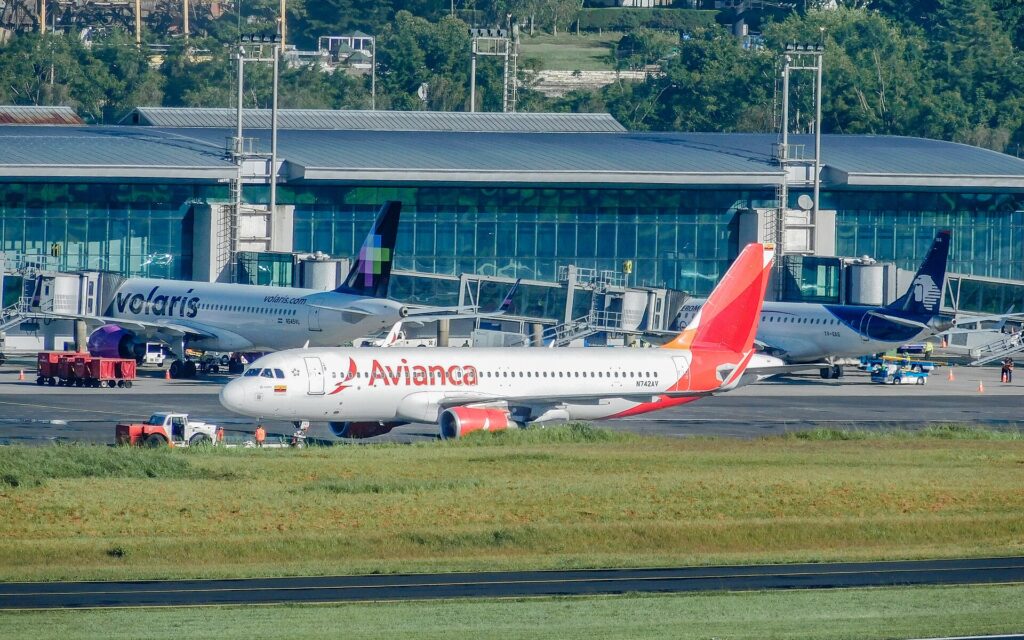
- Avianca carries the most of it — year-round from Miami, Fort Lauderdale and New York JFK, plus seasonal Orlando.
- American Airlines from Miami, JetBlue from Fort Lauderdale, and United from Houston Intercontinental.
- Copa via Panama City is the connection that reaches almost everywhere else in the US, and it’s frequently the cheapest one-stop from cities without a nonstop.
- Around them: Wingo across the Caribbean and Central America, Arajet via Santo Domingo, LATAM, JetSMART, Aeroméxico to Mexico City, Avior to Caracas, Air Europa to Madrid, and Air Transat seasonally from Toronto and Montréal. In total the airport works out at somewhere around fifteen airlines and forty-odd nonstop destinations.
Two honest caveats on that list. Spirit shows on some schedule sources for Houston and is absent from others, so price it but verify it on the airline’s own site before you plan around it. And a bigger one: several aggregators still list a Colombian low-cost carrier at this airport that stopped flying in February 2023 and went into liquidation — one airport database even still describes MDE as its hub. If a search engine shows you a suspiciously cheap operator you’ve never heard of on this route, check that it exists before you get attached.
Flying in from the UK and Europe
There’s no nonstop from the UK, and there isn’t likely to be — the market goes through hubs. The realistic one-stops are Madrid (the natural European gateway to Colombia, with Avianca and Air Europa both flying Madrid–Medellín), Panama City with Copa, Miami, and Bogotá with a short domestic hop on the end.
If the cheap answer your search engine gives you is a long-haul into Bogotá plus a separately booked domestic flight to Medellín, understand what you’re buying: on two tickets, nobody owns your connection. You collect your bags, clear immigration and customs, check in again, and if the first flight is late the second one is your problem. Sometimes the saving is worth it. Build in hours rather than minutes, and know which airport in Bogotá your onward flight leaves from before you’re standing in it.
Bogotá or Medellín as your door?
Bogotá has the wider long-haul choice — more carriers, more European and North American cities, more frequency. Medellín has fewer but enough, and it saves you a connection. The domestic hop between them is short and runs constantly, so neither choice is wrong.
One factor that doesn’t show up in a fare comparison and probably should: altitude. Bogotá sits at about 2,640 meters, high enough that plenty of arrivals notice it in the first day — the shortness of breath on stairs, the poor first night’s sleep. Medellín is at about 1,495 meters, which is around 1,100 meters lower, and comfortably below the altitude where most people feel anything at all. So the connecting itinerary has a small piece of good news built into it: you land high and then you go down. Even MDE, up on its plateau, is well above the city you’re heading for — the drive through the tunnel is a descent of several hundred meters, and the air at the bottom is thicker than the air you landed in.
Entry requirements, as they stand
US and UK citizens don’t need a visa for tourism. The UK government’s wording is that you can visit “for up to 90 days without a visa for business or tourism, at the discretion of the Colombian immigration officer on arrival” — the discretion is the operative part, and it’s why the next item matters. You can extend once you’re in the country, up to a further 120 days, but you cannot be in Colombia more than 180 days in any 12-month period.
- An onward or return ticket is required, valid within that 90-day window, and it does get asked for — at check-in as often as at the border.
- Your passport must be valid on entry; the Colombian authorities recommend it also has at least six months beyond your planned departure, which is the safer standard to travel on.
- Check-Mig, the online migration form, is the part worth reading twice. The UK government currently describes it as optional — something that can speed your entry rather than a condition of it — and gives the window as between 72 hours and one hour before you travel. You will find a great many websites telling you it is compulsory, and a number of those are commercial operations that will charge you for it. The form is free on Colombia’s own government portal. My advice is simple: do it, because it costs nothing and it can shorten the queue, and do it only on the official government domain.
Colombia moves faster than most countries on exactly this kind of rule, so check current requirements before you book, and again before you fly.
The calendar that isn’t a calendar
Medellín’s billing as a city of permanent spring is a straightforward consequence of arithmetic: it sits close to the equator, where the sun doesn’t do seasons, but high enough that the heat never arrives. The result is daytime temperatures generally in the low-to-high twenties Celsius — roughly the low seventies to low eighties Fahrenheit — and evenings in the mid-to-high teens, in January exactly as in July. There’s no summer to wait for and no winter to avoid.
What varies instead is rain, and it runs on a two-and-two pattern that will be backwards to anyone whose instincts were built in the northern hemisphere:
- Drier: roughly mid-December to mid-March, and again from early July to late August.
- Wetter: April–May and September–November, with October typically the wettest month of the year.
- What “wetter” actually means: not washouts, mostly. The characteristic pattern is a bright morning and a heavy afternoon shower that passes. You plan around the afternoon rather than around the month.
The practical upshot for fare-hunting is unusually clean: because the weather barely moves, your choice of month is driven by rain and by school holidays rather than by climate, and the two drier windows conveniently include both the northern winter and the northern summer.
Money and time
The Colombian peso comes with the opposite problem to most currencies a traveler meets: the numbers are very large, ordinary prices run to five and six figures, and locals compress them in speech by talking in thousands — so a number said aloud may be a thousand times smaller than the number you’re bracing for. There’s one more trap layered on top for American readers: the peso uses the dollar sign. A price tag with a $ in front of it is not quoting you dollars. Give yourself the first day to recalibrate and read the digits rather than the symbol.
Cards work fine across the cities for hotels, restaurants and anything mid-range upward; cash still matters for smaller places, markets and transport, and it matters much more once you leave the big centres, where ATMs thin out and occasionally run dry. Two ordinary habits worth carrying: draw larger amounts less often, and if a machine offers to bill you in your home currency, decline it — that conversion is always worse than your bank’s.
Colombia runs on UTC−5 and has had no daylight saving since 1993. That’s simple in itself, and it produces one genuinely useful quirk: because Colombia never moves and your country probably does, the time difference changes twice a year without anything changing in Colombia. New York is an hour ahead of Bogotá for part of the year and level with it for the rest; the gap to the UK swings by an hour the same way. Check the offset for your actual travel dates rather than the one you remember from last time.
Onward by air, briefly
If Medellín is one stop on a longer trip, the two-airport split becomes an advantage rather than a nuisance. MDE handles the bigger domestic runs alongside its international traffic — Cartagena, Santa Marta, San Andrés and the rest of the national network. EOH, in the city, is where the small stuff goes: Bogotá on a very frequent shuttle, the coffee-region airports, and — the ones worth knowing about — Quibdó, Apartadó, Bahía Solano and Nuquí, which is how you reach the Pacific coast without a very long drive. SATENA and EasyFly fly most of it.
Which is the closing argument. You land on a plateau in the mountains, you drive down through a tunnel into a valley, and the temperature rises a few degrees and stays exactly where it is for as long as you’re there. It’s a short flight from a lot of the United States and one connection from most of Europe, the paperwork is a form you don’t strictly have to fill in, and the only thing you genuinely have to get right is which of the two airports your ticket says. What to do once you’re down in the valley is somebody else’s article — ours, the guide to the city that rides cable cars to work. My job was the door.
FAQ
Which airport should I fly into for Medellín?
José María Córdova (MDE), for anything international — it’s the only one with flights from outside Colombia. It’s about 20 km southeast of the city at Rionegro, up on a plateau roughly 2,142 meters above sea level, and the drive down through the Túnel de Oriente takes around twenty minutes. Olaya Herrera (EOH) is the second airport, and it’s inside the city — but it’s domestic and regional only, restricted to smaller aircraft, and served mainly by SATENA and EasyFly. If you’re connecting from Bogotá and staying in Medellín itself, EOH puts you far closer to your hotel. If you’re arriving from abroad, it’s MDE and there’s no choice to make.
Are there direct flights to Medellín from the US?
Yes, several. Avianca flies nonstop from Miami, Fort Lauderdale and New York JFK year-round plus seasonal Orlando; American from Miami; JetBlue from Fort Lauderdale; and United from Houston. From anywhere else in the US, Copa via Panama City is usually the most flexible one-stop. From the UK there is no nonstop — route through Madrid, Panama City, Miami or Bogotá. One caution: some flight-search sites still list a Colombian low-cost airline that ceased operations in 2023, so confirm any unfamiliar carrier exists before building a trip on its fare.
Do US or UK citizens need a visa for Colombia?
No — both can visit for up to 90 days without a visa for tourism or business, granted at the immigration officer’s discretion on arrival, extendable in-country by up to a further 120 days, with a ceiling of 180 days in any 12-month period. You’ll need an onward or return ticket within the 90 days, and a passport valid on entry — six months beyond departure is the safer standard. The Check-Mig online form is currently described by the UK government as optional, completed between 72 hours and one hour before travel; it’s free on Colombia’s official government portal, so fill it in but never pay a third-party site for it. Check current requirements before you book.
When is the best time to fly to Medellín?
Temperature-wise it barely matters — the city sits at about 1,495 meters near the equator, so days run in the twenties Celsius and evenings in the teens all year, in January exactly as in July. Choose by rain instead. The drier windows are mid-December to mid-March and early July to late August; the wetter ones are April–May and September–November, with October usually wettest. Even then, the pattern is typically a clear morning and an afternoon shower rather than all-day rain. One scheduling note: morning fog at MDE can delay or divert early arrivals, generally clearing within a couple of hours, so leave slack in any same-day onward connection.
Photos: Luis90f (CC BY-SA 4.0), Rene Hernandez (CC BY-SA 2.0), Felipe Restrepo Acosta (CC BY-SA 4.0), via Wikimedia Commons.


