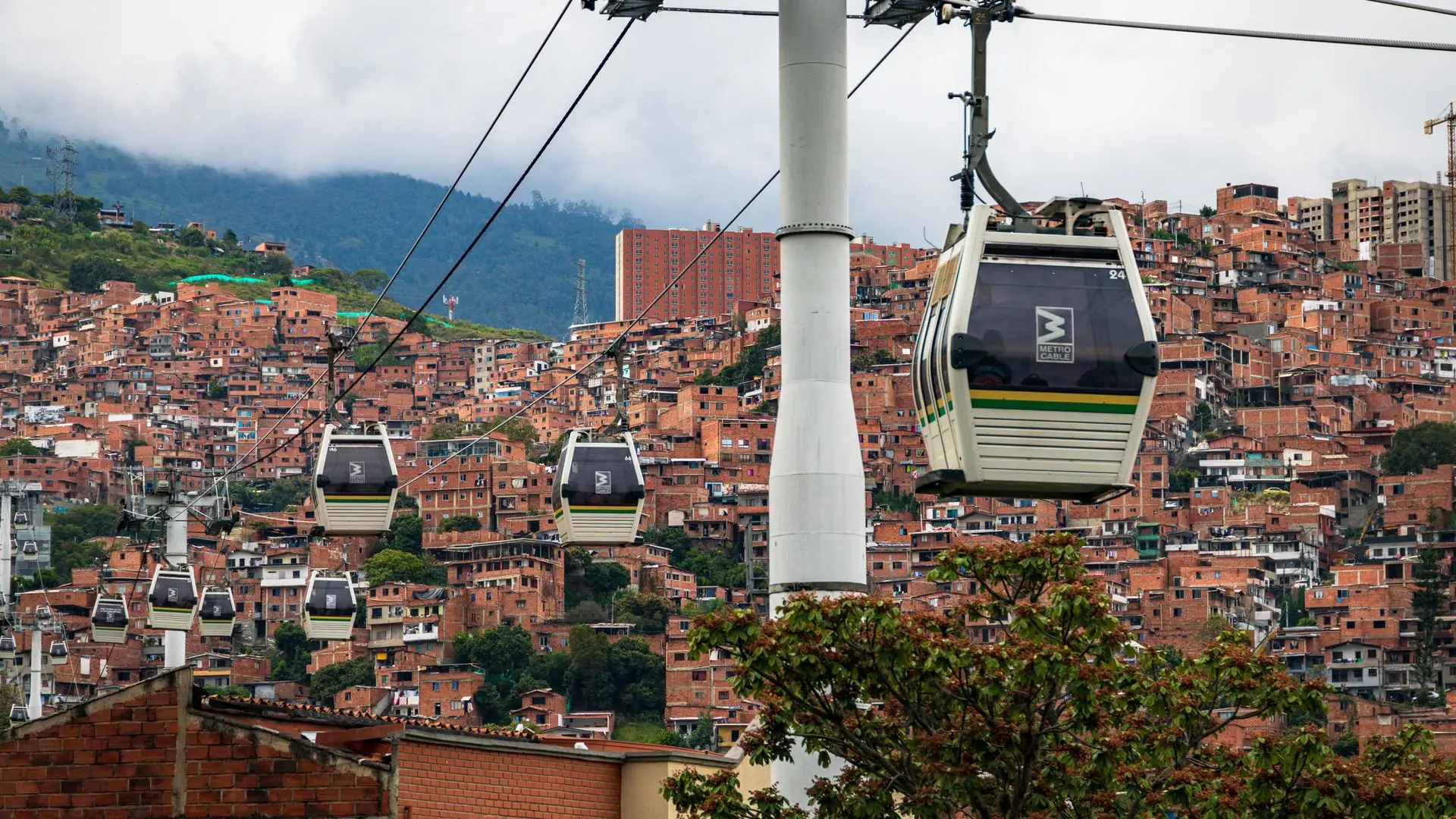

That is Medellín’s whole idea in one sentence, and it is a better idea than most cities have ever had.
A bus that happens to fly
Medellín sits in a narrow valley in the Andes, and the city long ago ran out of flat ground. What happened next is the interesting part: instead of treating the households on the steep slopes as a problem to be managed, the city treated getting them to work as an engineering brief.
The Metrocable opened in 2004, when the first line was hung above the north-eastern hillside and plugged straight into the existing metro network — same system, same journey, no separate excursion ticket, no queue of visitors. The formula you will see attached to it belongs to the World Resources Institute, which calls it the world’s first aerial cable car fully integrated into a public transport system, and the distinction inside that sentence is the one that matters: mountain gondolas are ancient, and cities had built ropeways before. What had not been done was to make one an ordinary leg of an ordinary commute. Others followed quickly — La Paz, Rio de Janeiro, Caracas, Manizales — which is the sincerest verdict on whether the idea worked.
Riding it is the single best thing to do in the city and it costs whatever a train ride costs. The cabin lifts off the station, the roofs drop away beneath you, and for a few minutes you are moving quietly over a whole neighbourhood: washing lines, football on a concrete pitch, a man rendering a wall, three dogs having a disagreement, satellite dishes tilted at the same angle all the way up the hill. Then the ground rises to meet you again and everyone gets off and walks home. Go up, walk about at the top, come back down. Do it in the late afternoon.
The metro underneath it deserves its own paragraph. It opened in 1995 and remains the only metro system in Colombia, and the way people treat it is genuinely unusual: no litter, no feet on seats, no eating, and a collective willingness to point this out to anyone who forgets. That is not an accident of temperament — it is a programme. Under the name Cultura Metro, the operator ran years of public education before a single passenger boarded, including parking unused carriages in a city-centre plaza in 1994 so that people could practise standing behind the yellow line, letting passengers off first and knowing what the doors would do. The system was designed from the start around what its planners called impeccable environments, and the programme never stopped: it now runs libraries, classes and cultural events on metro property. A city that teaches itself how to use its own train, and then keeps the promise for thirty years, is telling you something about itself.
Architecture as a public utility
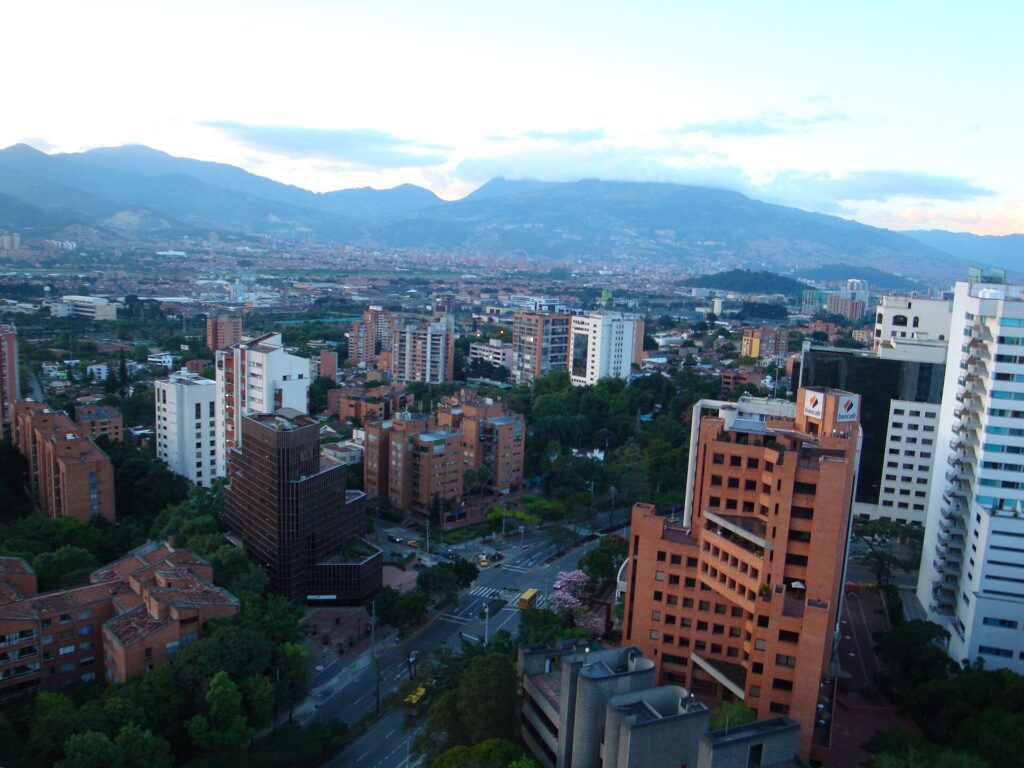
The same instinct produced the thing I find most impressive here, which is a policy decision: that the best buildings in the city should go where the least money is.
The parques biblioteca — library-parks — are landmark public libraries built high on the hillsides, designed by serious architects, with reading rooms, computer rooms, halls and terraces attached to public open space. The most famous of them stands above the Santo Domingo hillside, three black faceted blocks by the Colombian architect Giancarlo Mazzanti, who won an open competition in 2005; it opened in 2007 and entered the permanent collections of MoMA and the Pompidou.
Then it shut. The stone cladding was failing, and the building spent eleven years closed while the city argued about what to do with it. Here is where a guidebook will let you down, because almost all of them still say it is closed: it isn’t. The rebuilt library reopened on 18 June 2026 under a new name, the Parque Biblioteca Santo Domingo Savio. The corroded steel was taken out and the sound concrete kept and reinforced to current seismic codes, and the result reads as the original from a distance and is a different, better-built thing up close. Two of its three blocks opened first, with the auditorium following. Go, and go up by cable car, because the approach is half of it.
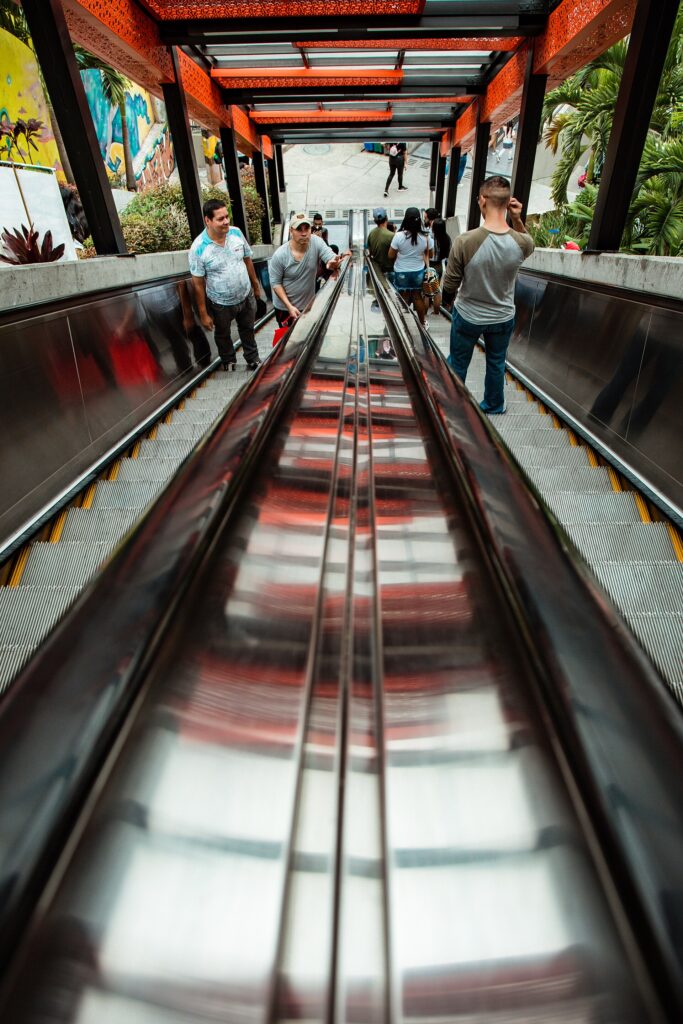
The other piece of infrastructure-as-generosity is a staircase. On a very steep hillside on the western side of the city, in the district called Comuna 13, the city installed six flights of outdoor escalators in 2011 — a covered orange stair-lift running roughly 384 metres up the slope, free to use, built for the several thousand people who otherwise climbed the equivalent of a twenty-eight-storey building to get home with the shopping. It works, it is beautiful in an unglamorous municipal way, and the neighbourhood around it is now the city’s open-air gallery: wall after wall of large-format murals by local painters, hip-hop and breakdancing on the terraces, mango with lime and salt sold from buckets, and a view across the whole valley from halfway up. Wear shoes you can climb in — the escalators cover the worst of it, not all of it — and go with someone from the neighbourhood if you can; the walking tours are run by people who grew up on those stairs and know who painted what.
Botero, in the open air
Down on the flat, in the old quarter, there is a square with twenty-three enormous bronze people in it.
Plaza Botero holds twenty-three sculptures by Fernando Botero, given to his home city by the artist, standing outdoors in a public square that is free and never closes. Photographs do not prepare you for them. In reproduction the style reads as a joke about fat people, which it isn’t; in person, at three metres and two tonnes, the effect is closer to tenderness — a hand, a cat, a horse, a woman reclining, all swollen into these calm, complacent volumes that make everyone in the square smile at strangers. Children climb them. The bronze is polished to gold in the places people touch.
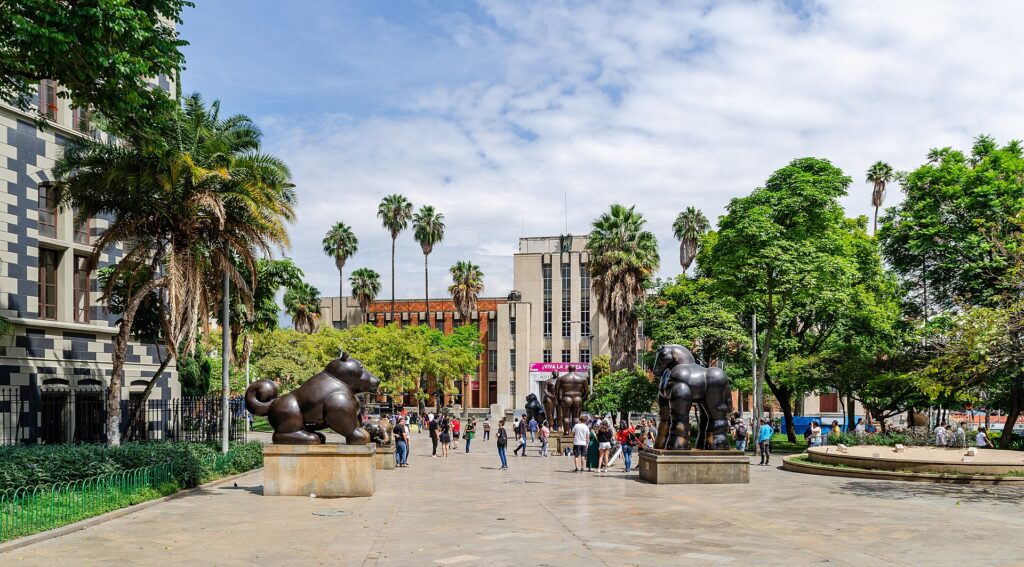
Facing the square is the Museo de Antioquia, founded in 1881 and housed in a handsome 1937 art deco former town hall. Botero gave it a large body of his own work and, better, his personal collection of other people’s — so you get his paintings and then rooms of modern European and American art that a provincial museum would never otherwise own, assembled by a man buying what he liked. It is a strange and generous museum and it deserves two hours.
The green bowl
Things grow here without being asked. Vines come over walls, ferns colonise gutters, and every third balcony in the city is a small jungle. The reason is in the next section, but the showcase is the Jardín Botánico, north of the centre and free to enter: fourteen hectares of palms, a lake, iguanas in the branches and a great deal of shade.
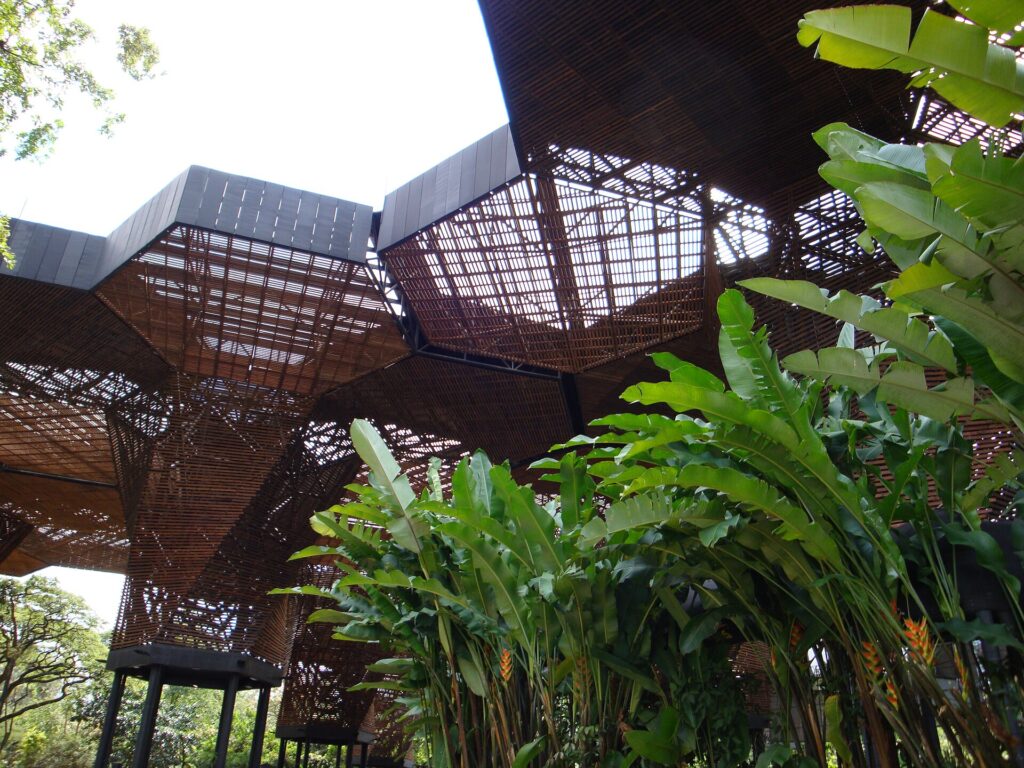
The building in the middle of it is worth the trip on its own. The Orquideorama, designed by Plan:B with JPRCR after a competition in 2005 and completed in 2006, is a canopy rather than a hall — a grid of hexagonal modules the architects called flor-árbol, flower-tree, each a steel trunk opening into a timber-clad crown, repeated until it covers four thousand square metres of orchids and open ground with a roof that behaves like a wood. It is often described as a timber structure and it isn’t quite: the frame is steel, the surfaces are wood, and standing under it in dappled light you would not care either way.
Above the city on the Santa Elena slopes are the flower farms that supply the country and a good deal of the world, worked by families who have grown and carried flowers here for generations. They are the reason for the best day of the Medellín year, which gets its own section below.
Eternal spring, explained
The nickname is real and it has a mechanism. Medellín sits at about 1,500 metres, six degrees north of the equator: near enough to the equator that day length and sun angle barely change, high enough that the heat is taken off the top. The result is that the average temperature of the coldest month and the average of the warmest are about one degree apart, somewhere around twenty-two.
What that means in practice takes a day or two to sink in. Nothing here has heating. Nothing needs air conditioning as a way of life. Restaurants have no indoor rooms because they have never needed them; you eat under a roof with no walls, all year, at any hour. Nobody owns a coat. There is no summer wardrobe or winter wardrobe, no season for going out and season for staying in, and no month in which the city looks worse than it does in any other. It is one of the most comfortable places on earth to be outdoors.
Instead of hot and cold, the year runs wet and dry, and it does it twice: the rainier stretches fall around April to May and again from September into November, with drier weather from December through February and again around July and August. Even in the wet months this rarely means a lost day — the pattern is a bright morning, a serious downpour in the afternoon, and a washed, glittering evening. Carry an umbrella and plan the indoor thing for three o’clock.
The table
The regional dish is bandeja paisa, and it is enormous on purpose: red beans cooked with pork, rice, minced beef, chicharrón, chorizo, a fried egg, sweet fried plantain, avocado, an arepa and hogao, arranged on an oval platter that arrives like a piece of furniture. It was food for people doing agricultural work in the mountains and it has never been downsized. Order one between two if you have sense, then order one each anyway.
The local arepa is plain — a thick white maize cake, grilled, unfilled, served alongside things rather than stuffed with them, which surprises anyone who arrives expecting the Venezuelan sandwich version. Breakfast is often that arepa with cheese and hot chocolate, and the regional habit worth trying at least once is dropping the cheese into the chocolate: it goes soft and stringy and you fish it out with a spoon. It sounds wrong on the page. It is very good.
Then the fruit, which is the real luxury. Juice bars work through a list most northern visitors have never encountered — lulo, tart and green and somewhere near a gooseberry; guanábana, creamy and floral; granadilla, a passionfruit you crack like an egg and eat with a spoon; mangostino, hiding white segments under a hard purple shell. The ritual is fixed: you order, and they ask ¿en agua o en leche? — water or milk. Sharp fruits go in water, creamy ones in milk, and answering confidently is the fastest way to look like you have been here before. This is also Antioquia, which is coffee country, and the cafés in Laureles and Provenza roast and brew to a standard that would hold up anywhere.
The flower parade
If you can time a trip to one thing, time it to the Feria de las Flores, which fills the first days of August — in 2026 it ran from the last day of July to 9 August, and the pattern holds year to year, with the city confirming exact dates a few months ahead.
The event at its heart is the Desfile de Silleteros. The silleta is a wooden frame carried on the back, originally used on these mountains to carry produce and occasionally people, and now used to carry flowers: a panel of blooms, sometimes a couple of metres across, arranged into patterns, portraits, messages and pictures, and walked through the middle of the city by the grower who made it. The first parade in 1957 had thirty of them. The 2025 edition had 540 silleteros covering more than two kilometres, competing in categories from traditional to monumental — the winning monumental panel weighed a hundred kilograms and carried more than seventy varieties of flower. The practice is registered as intangible cultural heritage nationally, the families come down from Santa Elena, and there is a children’s parade up in the village beforehand where the panels are small and the crowd is entirely relatives.
The other civic spectacle is at Christmas, when the utility company strings the river with lights — tens of thousands of hand-woven figures made by a workshop of artisans, millions of bulbs along a couple of kilometres of riverbank and in the main park of every district in the city, switched on in late November and running into January. People come from across the country to walk it, eat buñuelos and complain amiably about the crowds.
Where to base yourself
El Poblado, and inside it the Provenza streets, is where most visitors land: hilly, green, thick with restaurants and rooftop bars, expensive by local standards and full of people working laptops. It is pleasant and it is not the city, and a week spent entirely inside it would waste an air fare.
Laureles is the alternative and the one I would choose — flat, shaded by enormous trees, laid out in circles that will get you lost, with an ordinary Colombian neighbourhood’s butchers and bakeries alongside very good coffee and a nightlife strip on La 70. Time Out put it at the top of its list of the world’s coolest neighbourhoods in 2023, which is the sort of thing that usually ruins a place and so far mostly hasn’t. Further south, Envigado and Sabaneta are small towns that the city grew around and never digested: church squares, old men playing cards, and the best value in the valley.
When to come
Any month. That is not a hedge — it is the single most useful fact about this city. There is no high-season weather and no low-season weather, only slightly wetter stretches and slightly drier ones, and the difference between the best and worst month is a couple of afternoon downpours.
So choose by event rather than by climate. Early August for the flower parade, which is the year’s high point. December for the river lights and the drier, brighter weeks around them. January and February for the same weather without the crowds. April, May, October and November if you don’t mind an umbrella and would like the city greener and cheaper. There is genuinely no wrong answer.
On entry: Colombia admits most nationalities for tourism without a visa, with conditions — our guide to the airport over the mountain carries the detail. Check current requirements before you book.
Going up at six o’clock
Get on a Metrocable at the end of the day. The valley below fills with that particular blue that only happens in mountains, and then the lights come on across the far slope, thousands of them, in a pattern that follows the contours because the houses do.
Inside the cabin somebody is on the phone, somebody is asleep, and there is a bag of shopping on the floor with a pineapple sticking out of it. That is the whole point. This is not a ride. It is a bus that happens to fly, built by a city that decided the people with the longest walk home should get the best view in it.
FAQ
Is Medellín worth visiting?
Yes — for the cable cars and the metro culture around them, for a square full of Botero bronzes that are free to visit at any hour, for library-parks and hillside escalators built as public architecture, for a botanical garden with one of the best contemporary buildings in Latin America inside it, and for weather that does not change all year. Four days covers the city comfortably; a week lets you add the flower farms above it and the towns and lakes within reach of it.
What is the Metrocable in Medellín?
It is a network of gondola lines that form part of the city’s public transport system, running up the steep hillsides where roads are impractical and connecting into the metro on the same journey. The first line opened in 2004 and is described by the World Resources Institute as the world’s first aerial cable car fully integrated into a public transport system; several other Latin American cities have since built their own. For a visitor it is both the cheapest sightseeing in the city and an ordinary commuter service — you will be sharing the cabin with people going home from work.
Why is Medellín called the city of eternal spring?
Because it sits at about 1,500 metres, six degrees north of the equator. The latitude keeps day length and sun angle steady all year and the altitude takes the edge off the heat, so the average temperatures of the warmest month and the coldest month differ by roughly one degree, at around twenty-two. The year divides into wetter and drier spells rather than seasons, and rain usually arrives as an afternoon downpour rather than a lost day.
When is the Feria de las Flores?
The first days of August. The festival runs for about ten days and finishes with the Desfile de Silleteros, in which hundreds of flower growers from the Santa Elena hills carry huge panels of flowers on their backs through the city. In 2026 the fair ran from 31 July to 9 August; the window is consistent year to year, but exact dates are confirmed by the city a few months ahead, so check before booking flights around it.
Photos: Lucelupe (CC BY-SA 4.0), User:CONOCER (public domain), Steffen Schmitz (CC BY-SA 4.0), Juan Gómez (CC BY 2.0), via Wikimedia Commons.


