

The Minaret That Survived
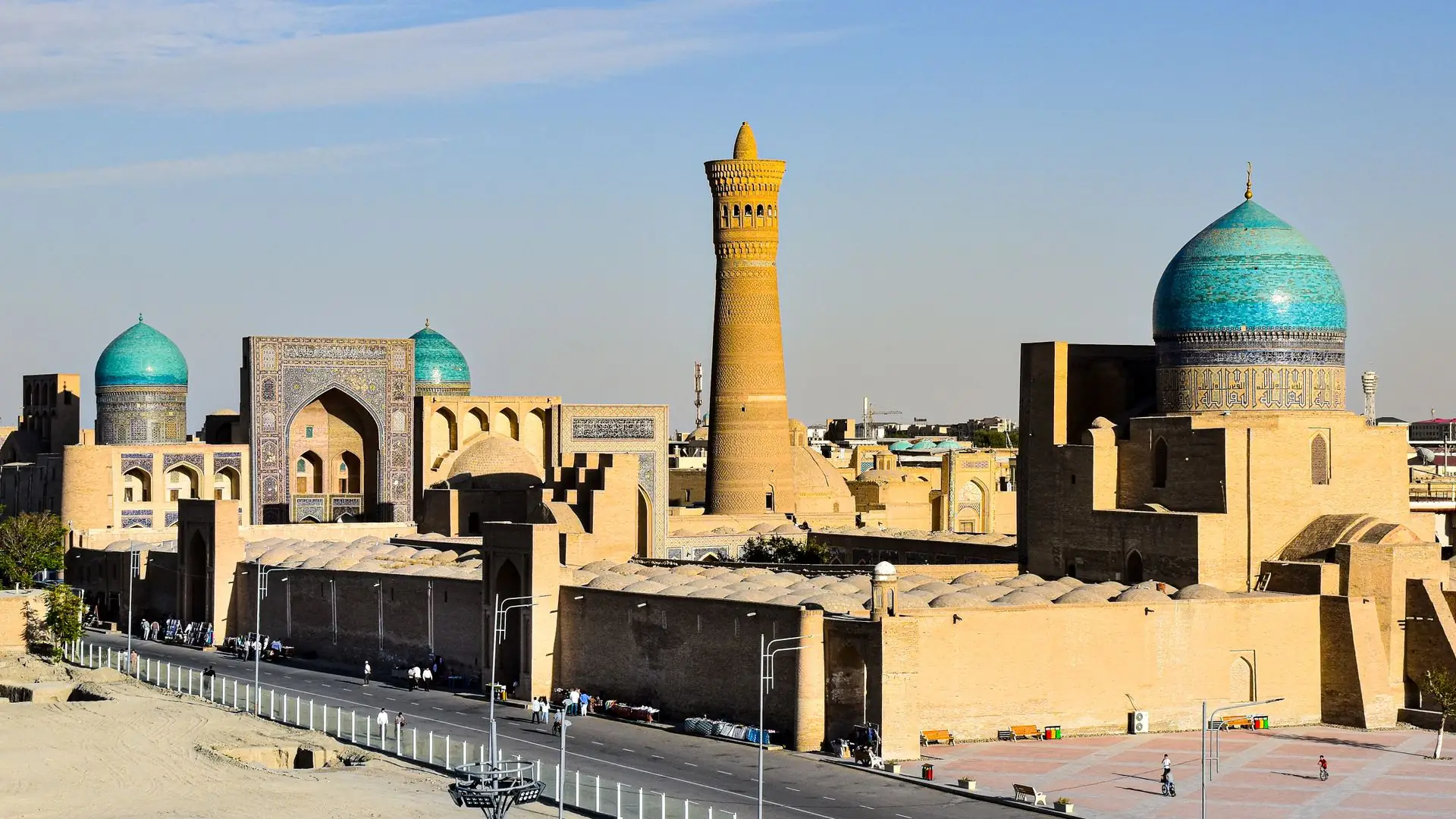
The city’s finest legend belongs to the Kalyan minaret. Built in 1127, the towering brick structure earned the grim nickname “Tower of Death” because it was historically used for public executions. When Genghis Khan sacked and razed Bukhara in 1220, local tradition insists he looked up at the vast minaret and explicitly ordered it to be spared while the rest of the city burned. It is a story too good to skip, even if it is too heavily embroidered to state as historical record.
The minaret forms part of the Po-i-Kalyan ensemble. Directly across the square sits the Mir-i-Arab madrasa, famous for its brilliant blue domes. Crucially, it is not a museum. It remains a working Islamic seminary where students actively study today. Visitors admire the stunning portal from the outside, underscoring the fact that Bukhara remains a living, functioning city.

The Ark and the Domes
A short walk away is the Ark, the massive fortress-citadel that served as the residence of the emirs for centuries. Its immense, sloped walls dominate the square. The fortress’s royal function ended violently in 1920 when it was stormed by the Red Army and the last emir fled the country.

Beyond the fortress lie the toqi, or trading domes. Built over crossroads to allow caravans to trade in the shade, these multi-domed structures still house merchants today selling carpets, suzani embroidery, knives, and karakul hats. It is undeniably a tourist trade now, but the buildings are still doing the exact job they were designed for.
The Layers Beneath
Bukhara is built on deep historical foundations. The Maghoki-Attori mosque is a perfect example: archaeological excavations reveal it was built directly over a much older Zoroastrian-era site, and later Buddhist ruins. The city has long been an intellectual capital, known historically as “Bukhara-i-Sharif” (the Noble). The great polymath Avicenna (Ibn Sina) was born in a village just outside the city in 980 CE, cementing the region’s legacy as a centre of learning long before modern universities existed.
That layered history includes a long-standing Jewish presence. The Bukharan Jews possess centuries of history in the old quarter. While emigration has reduced the community to a very small number today, two synagogues remain open and actively maintain their traditions in the heart of the city.
Lyab-i Hauz
In the evenings, the city gravitates toward Lyab-i Hauz. This 17th-century ensemble is arranged around a tranquil pool shaded by ancient mulberry trees. It serves as Bukhara’s living room, filled with families drinking tea and children playing near the modern, playful statue of the folkloric trickster Nasreddin Hodja.
The Practical Frame
While Bukhara has its own airport (BHK) with domestic links, the classic approach is by rail. The Afrosiyob high-speed train connects Tashkent, Samarkand, and Bukhara reliably, with the Samarkand-Bukhara leg taking roughly two hours.
Timing your visit is critical. The summer months are brutally hot, making the exposed squares punishing by midday. Spring and autumn are the definitive seasons to visit.
In recent years, Uzbekistan has significantly liberalised its entry rules; currently, both US and UK passport holders can enter visa-free for tourist stays of up to 30 days. However, you must check current requirements before you book.
To feel the continuity of the place, stand near the Kalyan minaret at dusk. You will see swifts diving around the tower that outlived the man who spared it, hear the call to prayer from a working madrasa, and listen to the exact same sound the city has produced for two millennia—the steady murmur of someone selling something.
FAQ
Is Bukhara worth visiting after Samarkand?
Yes. While Samarkand offers the grand, isolated monuments of an imperial capital, Bukhara offers a cohesive, walkable old town. It feels like an intact merchant city rather than a collection of separate sights.
How do I get from Samarkand to Bukhara?
The Afrosiyob high-speed train is the best option, covering the distance in approximately two hours. Tickets sell out quickly during the spring and autumn high seasons, so book them well in advance.
How many days do I need in Bukhara?
Two full days is generally sufficient to explore the old city, the Ark, and the trading domes at a comfortable pace, leaving time to relax with tea at Lyab-i Hauz.
Do I need a visa for Uzbekistan?
Currently, citizens of the US, the UK, and the EU can visit Uzbekistan visa-free for up to 30 days. However, entry rules can shift, so verify the requirements with your embassy prior to booking flights.


