
The older city
Samarkand is one of Central Asia’s oldest living cities. The ancient settlement of Marakanda (now the Afrasiab archaeological site) was already great when Alexander the Great took it in 329 BC, prompting the widely attributed tradition that he declared, “Everything I have heard about Samarkand is true, except that it is more beautiful than I imagined.” For centuries, Sogdian merchants made the city a vital hinge of the Silk Road, trading immense wealth across the continent, until Genghis Khan’s Mongol army utterly devastated the city in 1220.
Timur’s capital
The core of what you see today belongs to the fourteenth and fifteenth centuries. From roughly 1370, the conqueror Timur (Tamerlane) made Samarkand the capital of his massive empire. He funded the architecture by force-settling the greatest artisans from every conquered land — Persian tilemakers, Syrian glassmakers, and Indian stonemasons — which explains the city’s astonishing aesthetic coherence.
To read Timur’s ambition, look at the Bibi-Khanym Mosque. It was built too big and far too fast, meaning it began cracking and collapsing almost as soon as it was finished. At the Gur-i Amir, Timur’s own mausoleum sitting beneath a staggering ribbed turquoise dome, you can find the famous legend of the “curse of Timur,” which supposedly triggered the Nazi invasion of the USSR after Soviet archaeologists opened his tomb in June 1941. Above all, you must walk the Shah-i-Zinda necropolis, an avenue of mausoleums that features the most intense, saturated tilework in the Islamic world.

Timur’s grandson, Ulugh Beg, ruled differently. He was an astronomer-king who built a massive observatory; his giant sextant trench still survives, a testament to a ruler who measured the stars and was ultimately deposed and murdered by order of his own son.

The Russian and Soviet layers
In the late nineteenth century, the Russian Empire annexed the city, laying out a neat, European grid-city directly beside the old town. During the Soviet era, the great monuments were turned from mosques into museums, and they were extensively studied and rebuilt. Much of what gleams flawlessly today is actually twentieth-century Soviet reconstruction built over ruins, an honest reality that the city rarely advertises.

The façade and the mahallas
Today, modern city-branding and a massive tourism push (aided by the excellent Afrosiyob high-speed train) are reshaping Samarkand fast. Much of the tourist axis has been heavily polished, and in several places, the living residential neighbourhoods — the mahallas — have been literally walled off behind new, decorative façades to keep them out of sight.
You must push past the curated main route to find the reality of the place. The living city operates in the mahallas a couple of streets away, where families live in low courtyard houses, bread is heavily stamped before baking, and plov (the rich national rice dish) is cooked in massive cauldrons over wood fires.
Uzbekistan now runs a liberal entry regime. Citizens of many countries (including the US, UK, EU, and Canada) can enter visa-free for short stays (typically up to thirty days), and a straightforward e-visa covers most other nationalities. Rules change, however, so always check current requirements before you book.
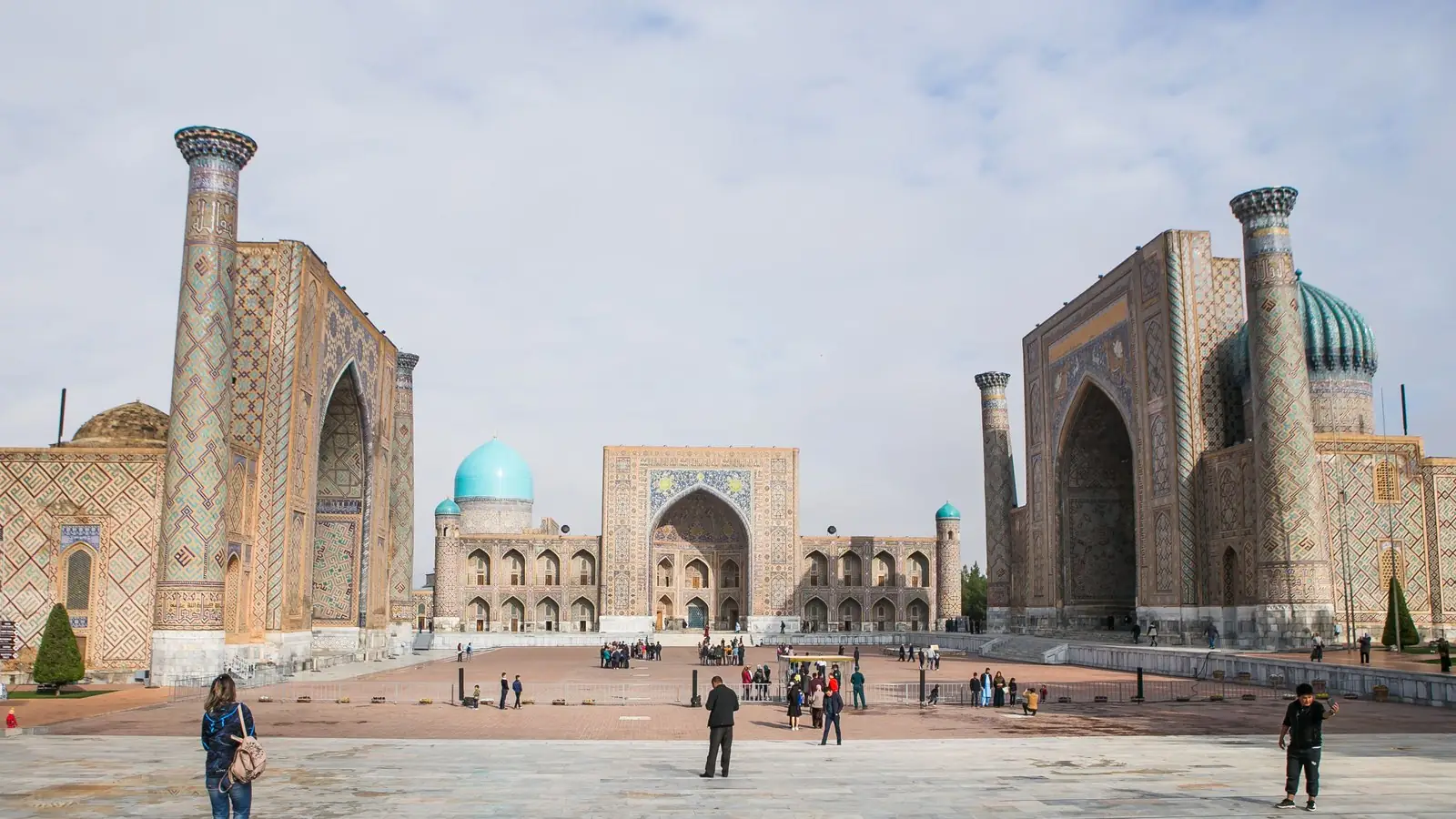
The best way to understand the city is to find a small plov lunch in a dusty mahalla courtyard, and then walk back to the Registan at night, long after the tour buses have gone. That is where the living city and the imperial showcase finally sit in the same frame.
FAQ
How do I get to Samarkand?
You can fly directly into Samarkand International Airport (SKD), which is about six kilometres from the centre. However, many travellers find it easier to fly into the capital, Tashkent (TAS), and take the modern Afrosiyob high-speed train, which covers the distance in roughly two hours. Train tickets sell out quickly, so book them well in advance.
What is the Registan?
The Registan (“Sandy Place”) is a monumental public square framed by three intricately tiled Islamic schools, or madrasahs. It was the commercial and public heart of the ancient city and is widely considered one of the greatest architectural ensembles in the Islamic world.
How many days do I need in Samarkand?
Two full days are sufficient to see the major monuments — the Registan, Gur-i Amir, Shah-i-Zinda, and Bibi-Khanym — without rushing. A third day allows you to explore the Afrasiab museum and the quieter local markets.
When is the best time to visit?
Spring (April to May) and autumn (September to October) offer the most comfortable weather for walking between the wide-spaced monument complexes. High summer is fierce, with punishing daytime heat that makes sightseeing deeply uncomfortable.


