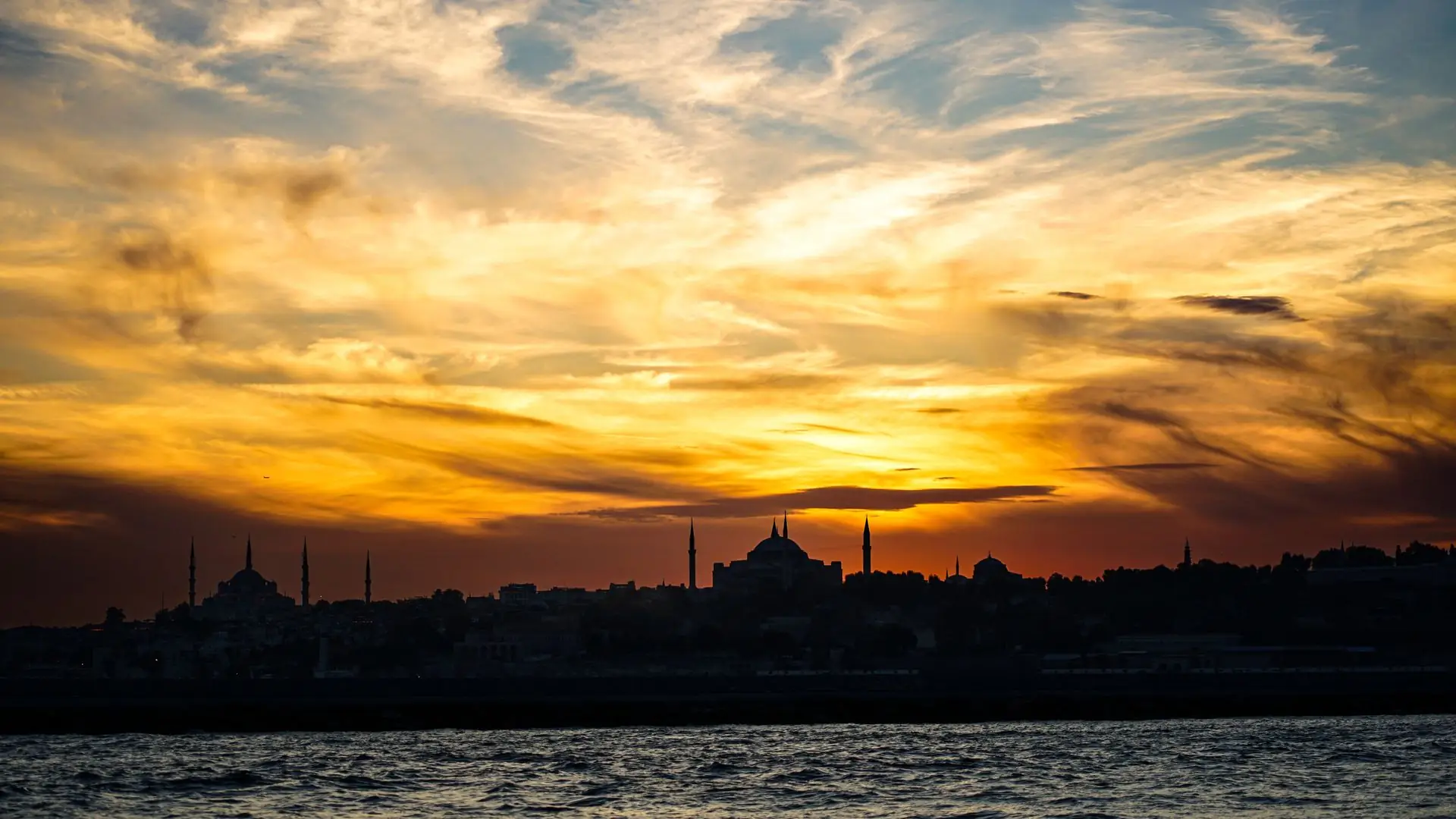

The Building Judged Four Times
There is no better thesis for the city than Hagia Sophia. It was consecrated as a church in 537, converted to a mosque in 1453, secularised as a museum in 1935, and returned to the status of an active mosque in 2020. The current visiting arrangement changed significantly in early 2024: foreign tourists must now purchase a ticket and enter via a separate route to access the upper gallery, while Muslim worship continues on the ground floor below. The building is open daily, and its sheer architectural biography speaks for itself.

The Underground and the Squares
Beneath the streets lies the Basilica Cistern, Justinian’s vast water infrastructure that feels like an accidental cathedral. Fully open following a long restoration, it still holds the famous reused Medusa column bases. Above ground in Sultanahmet Square, the surviving fragments of the Byzantine Hippodrome—specifically the Egyptian Obelisk of Theodosius and the bronze Serpent Column—remain standing exactly where they were placed centuries ago.
Two Palaces, Two Empires
The contrast between the city’s two great palaces reveals the Ottoman Empire’s changing self-image. Topkapı Palace (closed Tuesdays) shows the empire at its confident, inward-looking height, defined by sprawling garden courtyards and tiled pavilions. Further up the Bosphorus, Dolmabahçe Palace (closed Mondays) shows the 19th-century empire desperately dressing itself as European, favouring massive chandeliers and neoclassical facades. Both palaces are currently open to visit.
The Bazaar Economy
The Grand Bazaar is one of the world’s oldest and largest covered markets, an immense labyrinth of thousands of shops. Between here and the Spice Bazaar down by the water, the tourist tout script—”Where are you from, my friend?”—is relentless. But behind the tourist layer, genuine, heavy commercial trade still happens daily, negotiated over small glasses of strong black çay.

The Ordinary Crossing
The greatest experience in Istanbul is its public transport. The Şehir Hatları commuter ferries constantly cross the Bosphorus between the European and Asian shores, trailed by flocks of gulls. It is simply an ordinary ride using your standard Istanbulkart transit card. Crossing to Kadıköy or Üsküdar on the Asian side is where you find the city living at local prices, operating as an ordinary evening rather than a curated attraction.

Galata and Beyond
Across the Golden Horn lies the historic European quarter of Beyoğlu. The Genoese Galata Tower is open and serves as a spectacular 360-degree viewpoint over the peninsula. Further up, the famous red nostalgic tram is currently running the length of İstiklal Avenue, while beneath the Galata Bridge, the dense row of fish restaurants continues to operate exactly as expected.
The Honest Calendar
Summer is hot, heavily crowded, and subject to massive cruise-ship surges. Winter is generally grey and rainy, though occasional snow on the mosque domes provides the city’s best photographic secret. Spring brings April’s city-wide tulip festival plantings. If you visit during Ramadan, remember that the month shifts roughly 11 days earlier each Gregorian year; restaurants in tourist areas remain open, and the sunset iftar picnics around the Blue Mosque are a spectacular communal event.
The Practical Frame
The city is served by two massive airports on two different continents: IST in Europe and SAW in Asia. For the logistics of getting there, see our Istanbul flights guide.
Entry has recently simplified: both US and UK passport holders currently receive visa-free entry to Turkey for tourist stays of up to 90 days. As always, check current requirements immediately before you book.
Take the evening ferry to Kadıköy. Office workers read the news, teenagers share headphones, and vendors sell tea in tulip glasses. Watch the minarets of the old city sink behind one shore while the lights come up on the other. It is the only daily commute on earth that crosses a continent, priced as a standard bus ride, and nobody on board bothers to look up.
FAQ
Is Istanbul worth visiting?
Unquestionably. Its sheer scale and the depth of its layered history—Roman, Byzantine, and Ottoman architecture stacked on the same hills—make it one of the most historically significant and visually staggering cities in the world.
Can tourists visit Hagia Sophia?
Yes. As of early 2024, foreign tourists must buy a ticket and enter through a separate route that leads to the upper gallery, allowing viewing of the mosaics and the nave below without disrupting the active worship on the ground floor.
How do I get between the European and Asian sides?
The best method is the public Şehir Hatları ferry. It is fast, scenic, and operates as standard public transport—you simply tap your Istanbulkart transit card at the terminal turnstile.
When is the best time to visit Istanbul?
Spring (particularly April for the tulips) and autumn offer the best weather. Summer is intensely hot and crowded. Ramadan—which shifts roughly 11 days earlier each year—brings a unique evening atmosphere, though daytime pacing changes.


