

But it demands a clear-eyed approach. Among the food vendors and musicians are the snake charmers and the men with Barbary apes. Best to be honest about this: it’s a pay-to-photograph hustle, operating in a grey area of animal welfare that leaves many visitors uneasy. There’s no romance in it, and if you pause even for a second, a snake may find itself draped over your shoulders, followed by a fierce demand for cash. Keep walking. The real magic of the square is in the people, the food and the sheer scale of the nightly spectacle.
The maze of the medina
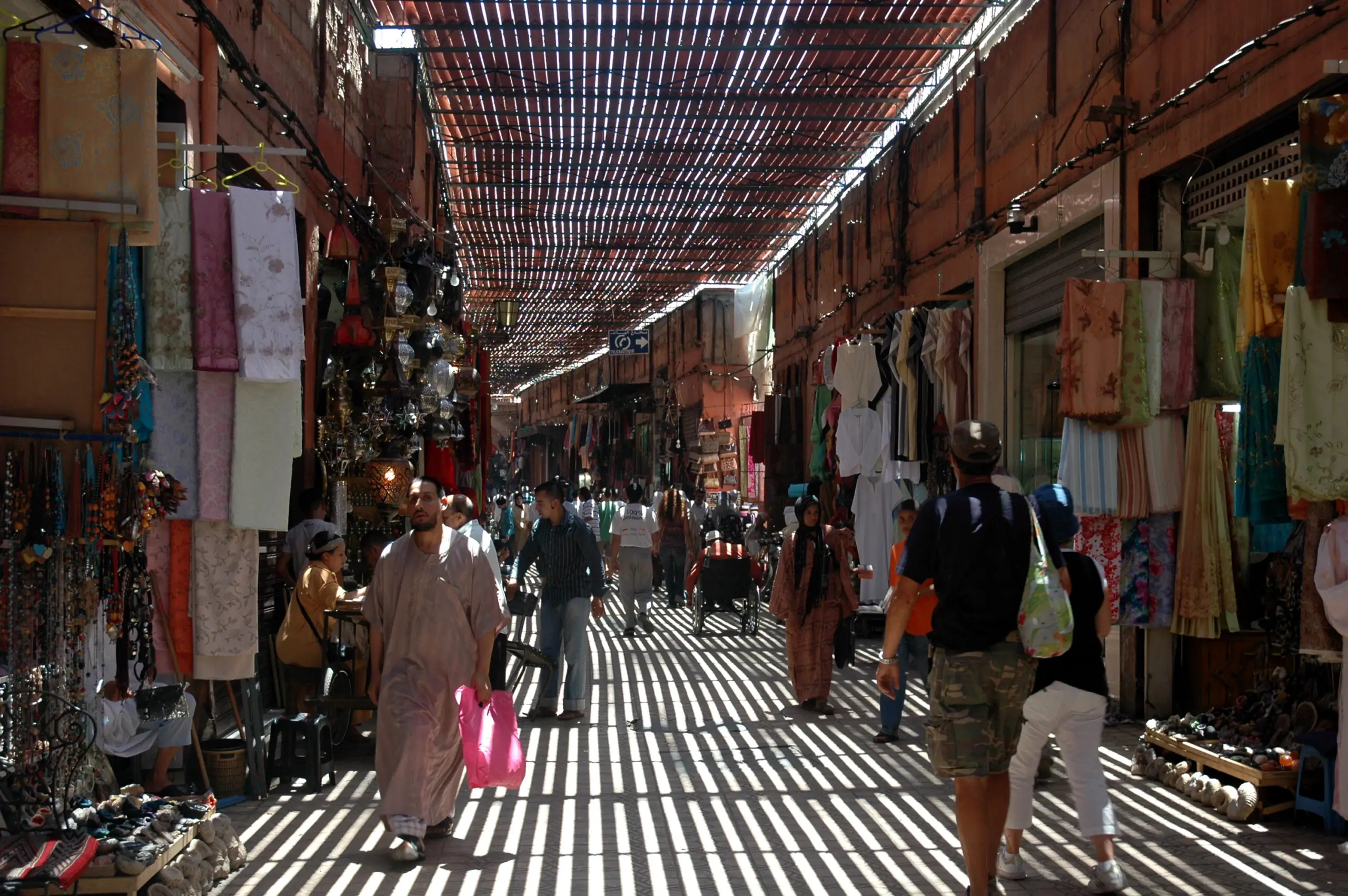
If Jemaa el-Fnaa is the city’s loud, beating heart, the medina is its tangled nervous system. The walled old city is a labyrinth where maps are merely suggestions. The souks are roughly divided by trade — you’ll know you’ve reached the metalworkers by the ringing of hammers on copper, and the leather quarter by the sharp, pungent smell long before you see the vats. The sensory overload is absolute.
Getting lost here isn’t a failure; it’s the entire point. Eventually a “helpful” stranger will appear, insisting the road ahead is closed and offering to guide you — coincidentally, straight to a cousin’s carpet shop. A firm but polite “la, shukran” (no, thank you) and a confident stride are usually enough to shake them.
The stillness of the riad
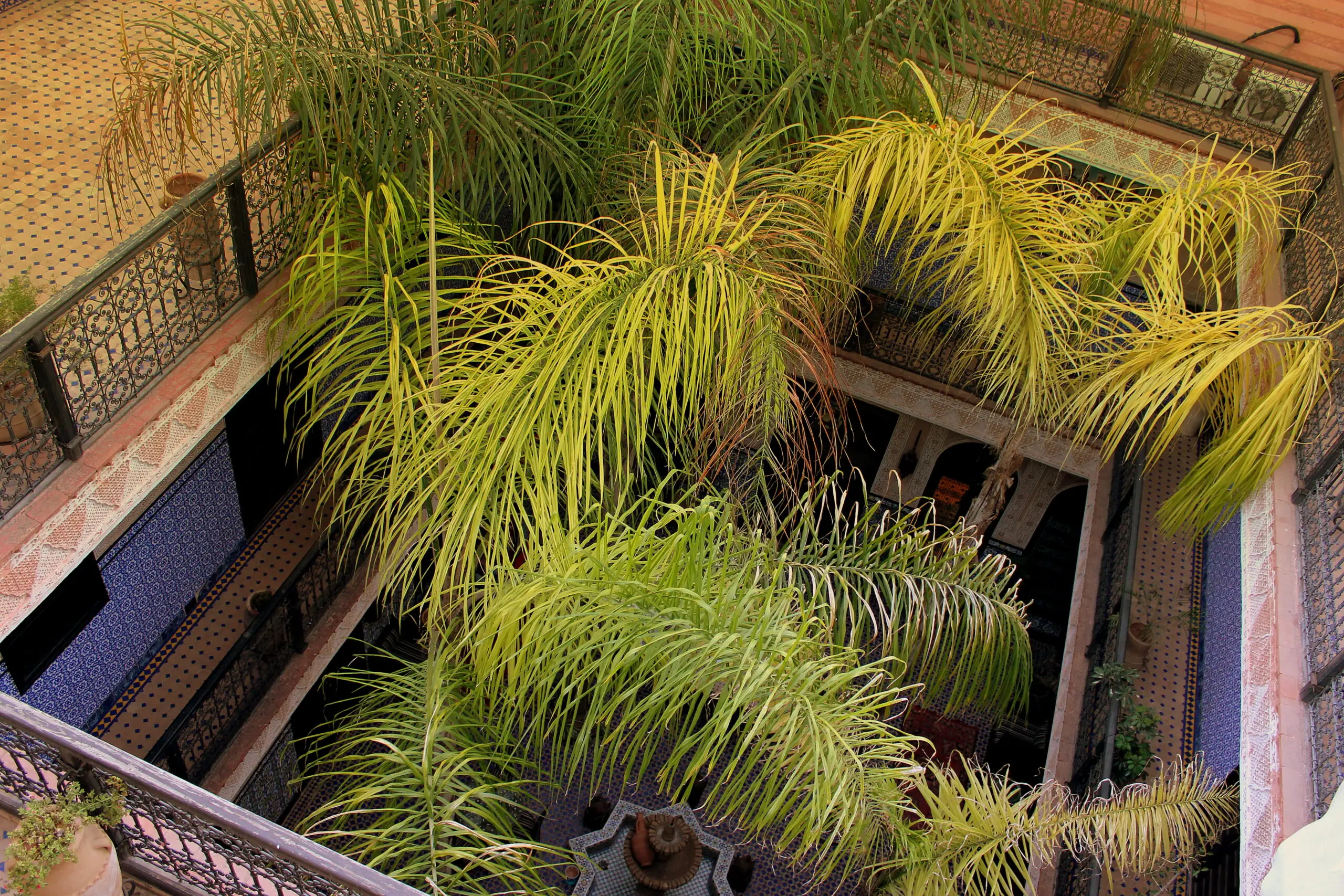
The antidote to the medina’s exhaustion is the riad. The architecture of a traditional riad is entirely inward-facing. From the street it presents nothing but a blank, dusty wall and a heavy wooden door. But step over the threshold and the city’s roar is instantly cut off.
Built around a central courtyard, often with a fountain and citrus trees, riads were designed for family privacy and to pull cool air down through the brutal summer heat. The contrast is jarring in the best way: you go from the frantic, dust-choked alleyways into a quiet, tiled sanctuary smelling of orange blossom and mint. It’s an architecture of retreat, and it makes absolute sense in a city that asks so much of you outside its doors.
Haggling and hospitality
In the souks, buying isn’t a transaction; it’s a ritual. Haggling is the social form here, not a rudeness to be avoided. It often begins with an offer of mint tea — the pour-from-height ceremony that cools the tea and signals hospitality.
Bargaining is a slow dance. You sip tea, exchange pleasantries and eventually circle a price. Doing it well means holding your ground without being a boor, treating it as a game rather than a battle. Once you accept that you’ll probably pay a slight tourist premium regardless, the whole exercise becomes far more enjoyable.
Moments of quiet
When you need a break from the bartering, Marrakech offers a few spectacular set-pieces. The Koutoubia minaret stands as the city’s compass point, its 12th-century Moorish design setting the template for towers across Morocco and Spain. Deeper in the medina, the Ben Youssef Madrasa is a masterclass in Islamic geometry, its intricate tilework and carved cedar making a quiet, reflective space. And outside the old walls, the Jardin Majorelle delivers a shock of cobalt blue and exotic cacti, forever tied to Yves Saint Laurent — though it’s best visited early, before the queues build.
Tagines and the pavement truth
Moroccan food is a slow affair. The classic tagine — named after the conical clay pot it’s cooked in — yields meltingly tender lamb or chicken, sweetened with dates or apricots and spiced with cumin and cinnamon. If you eat in the main square, a cautious approach to street food is wise: stick to stalls where locals are eating, make sure the meat is cooked piping hot in front of you, and perhaps skip the tap-washed salads.
But my most enduring memory of Marrakech didn’t happen in a restaurant or a famous garden. It was a fleeting moment in a narrow alleyway. I watched a man on a heavily loaded moped weave through a crowd that seemed impossibly dense, balancing a tray of flatbreads on his head as he took a corner. He didn’t drop a single loaf, and the crowd parted for him with a practised, fluid grace. A tiny, unscripted ballet in the dust.
One practical note: most Western passports enter Morocco visa-free for up to 90 days — but rules change, so always check the current requirements before you fly.
FAQ
Is Marrakech worth visiting?
Yes, but it asks for energy. The city will test your patience at times, then repay you with extraordinary architecture, a vivid street life and some of the best food in North Africa.
How many days do you need?
Three days is ideal for the medina, the souks and the palaces. Much longer and the hustle starts to wear — which is the perfect cue to head out to the Atlas Mountains.
Is it safe, and how do I handle the hustle?
Violent crime is rare, but petty theft and aggressive touting are common. Walk with purpose, keep your valuables secure, and learn to say a firm “no, thank you” to unsolicited guides.
Should I stay in a riad?
If you can, yes. A traditional riad inside the medina is a peaceful retreat from the noise, and it gives you a far better feel for the city’s architecture and hospitality than a standard hotel.
Images: Petar Milošević / CC BY-SA 4.0; DimiTalen / CC0; calflier001 / CC BY-SA 2.0. Source: Wikimedia Commons.
Read also
- The highest mountain in Africa
- Pros of a holiday in Abu Dhabi: Discovering the Treasury of the Persian Gulf
- Morocco. Agadir is the “city of white”.


