

Hills, Fog, and the Grid
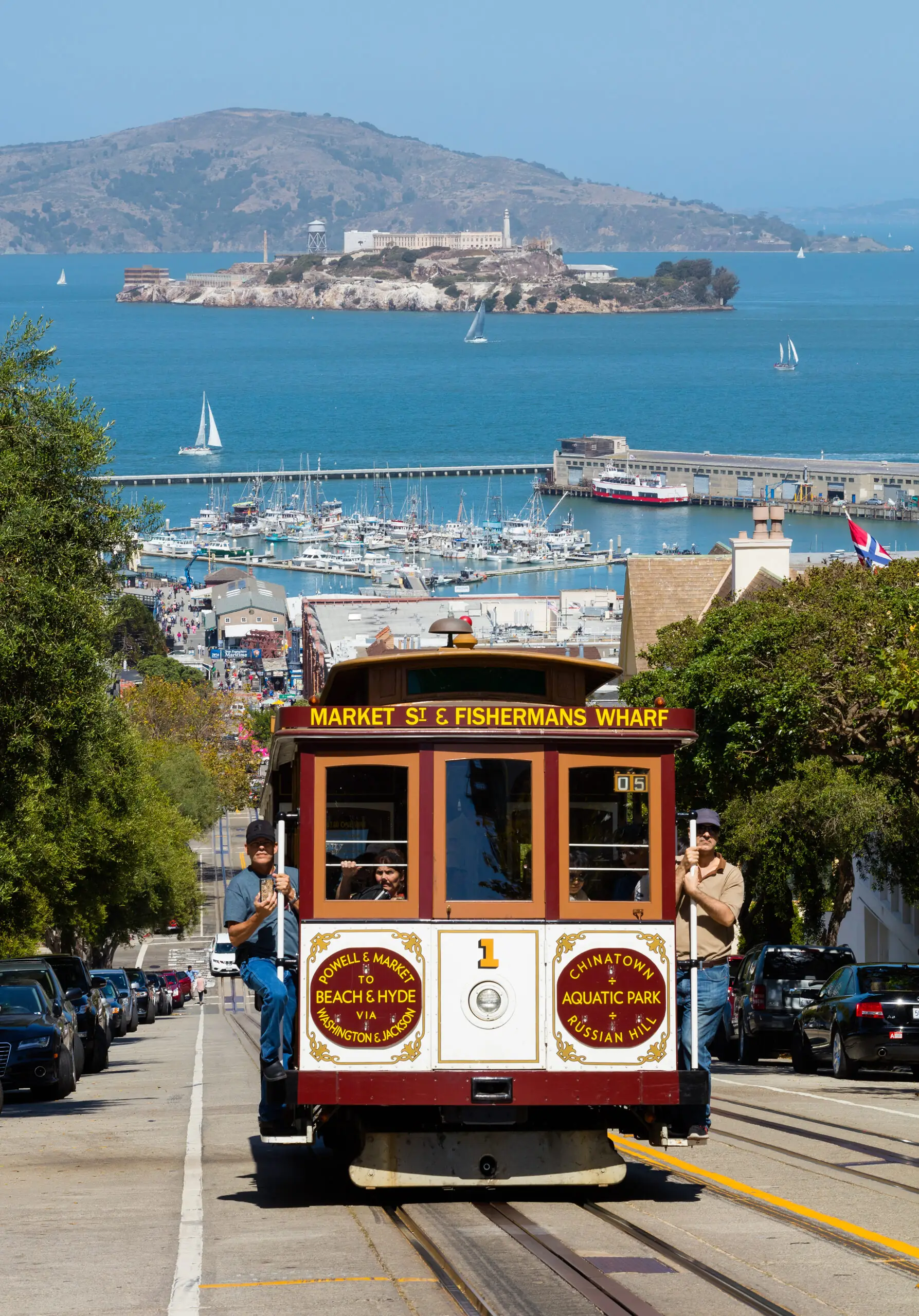
San Francisco’s character is inextricably tied to its landscape. The city’s founders famously laid a strict, uncompromising grid directly over a peninsula of massive hills, resulting in the terrifyingly steep streets that define the modern city. Those hills necessitated the cable cars. It is crucial to understand that these are not merely a tourist attraction, but a genuine, working 19th-century transit relic—the last manually operated cable-car system in the world.
The city’s relationship with the Pacific Ocean also creates its famous microclimates. It is entirely possible to spend a brilliantly sunny, warm afternoon in the Mission District, only to cross town to the Sunset District and find it smothered in freezing, dense fog.
The most famous intersection of the city’s geography and human engineering is the Golden Gate Bridge. Beyond its iconic “International Orange” colour, the bridge is an absolute masterpiece of 1930s Art Deco design and an engineering marvel built across a treacherous, wind-whipped strait. Just inside the bay sits the bleak, rocky outpost of Alcatraz, a stark reminder of the water’s isolating power. The natural setting also brings a profound fragility; the city sits on active fault lines, and the catastrophic earthquakes of 1906 and 1989 have continually forced San Francisco to rebuild and reimagine itself.
The Boom-and-Bust Reality
San Francisco was effectively built overnight during the 1849 Gold Rush (which gave the local American football team its name), and that frantic boom-and-bust cycle has defined it ever since. Today, the boom is driven by the tech industry. That immense, rapid wealth has fundamentally reshaped the city, resulting in a stark, highly visible crisis of inequality and homelessness. Visitors must approach this reality with a clear, compassionate eye: it should neither be exploited for shock value nor ignored, as it is a central part of understanding the modern city.

Countercultures and Communities
The city’s history of radicalism is equally profound, though it requires looking past the heavy nostalgia industry. In North Beach, the legacy of the Beat Generation still breathes in the aisles of City Lights Bookstore. In Haight-Ashbury, the “Summer of Love” is now heavily marketed on t-shirts, but the neighbourhood’s roots in genuine 1960s counterculture remain.
The Castro District stands as one of the most important landmarks in global LGBTQ+ history, shaped by pioneers like Harvey Milk. It is a neighbourhood that demands genuine respect, not just a casual tourist stroll.
Similarly, San Francisco’s Chinatown is the oldest in North America. While the dragon-entwined streetlamps draw the crowds, it is fundamentally a real, living community built upon a hard, deeply unequal history of 19th-century immigration.
My own sharpest memory of San Francisco was standing at the very back of a crowded, wooden cable car as it crested a hill in the financial district. As the gripman yanked the heavy metal lever to catch the cable beneath the street, the towering, sleek glass of a multi-billion-dollar tech headquarters reflected the old, rattling wooden car perfectly. It was the entire boom-and-bust history of the city caught in a single frame.
If you are planning a trip, be aware of US entry rules. Most visitors from Western nations do not need a traditional visa for short tourist stays, but must enter under the Visa Waiver Program by securing an approved ESTA (Electronic System for Travel Authorization) prior to boarding their flight. You must carefully check the current requirements for your passport.
FAQ
When is the best time to visit San Francisco?
Ironically, summer (July and August) is often the foggiest and coldest time of year. September and October are the city’s “Indian Summer,” offering the warmest, clearest, and most reliable weather.
Are the cable cars worth it?
Yes, they are a piece of living, working history. However, to avoid the massive tourist queues at the turnarounds, board a few stops up the line or ride early in the morning.
What’s the weather like in San Francisco?
Highly unpredictable and famously layered. Always carry a jacket or sweater, regardless of the season, as the temperature can drop drastically when the fog rolls in or when you move between different neighbourhoods.
Is San Francisco safe to visit?
Yes, it is generally safe for tourists, though like any major city, you should exercise standard street smarts. The city has a highly visible homelessness crisis, particularly in certain downtown areas, which requires compassion and awareness rather than fear.
Images: Brocken Inaglory / Public domain; Thomas Wolf, www.foto-tw.de / CC BY-SA 3.0; King of Hearts / CC BY-SA 3.0. Source: Wikimedia Commons.
Read also
- Denver: Your Ultimate Travel Guide to the Mile-High City
- Discover San Francisco: The Ultimate Tourist Guide
- What country is the USA


